Astrologie chinoise
Les Quatre Piliers (BaZi) : ce que c’est et comment on les calcule
Le BaZi, en chinois 八字 (« huit caractères »), est une manière traditionnelle de fixer un moment, le plus souvent une naissance, en quatre piliers. Sur cette page, nous expliquons ce que sont ces piliers, comment on les calcule et sur quels points les écoles sont en désaccord. Tout ce que nous établissons est accompagné de sa source ; lorsque les sources divergent ou que quelque chose ne peut pas être confirmé, nous le disons. Vous pouvez calculer vos propres piliers avec le calculateur BaZi.
What is BaZi?
BaZi, also called 四柱八字 (the Four Pillars of Destiny), describes a moment with four pillars: the pillar of the year, of the month, of the day and of the hour. Each pillar is a pair of one heavenly stem and one earthly branch. Four pillars of two characters make eight characters: 八字.
In the tradition described on the Chinese Wikipedia, the stem of the day pillar, the day master, is the center of a chart. The other stems and the branches are read against it, among other things through the ten gods.
We only calculate and explain. BaZi is a traditional system: a chart describes the classical features of a birth moment and predicts nothing.
Heavenly stems, earthly branches and the sixty-cycle
There are ten heavenly stems (天干): 甲 jiǎ, 乙 yǐ, 丙 bǐng, 丁 dīng, 戊 wù, 己 jǐ, 庚 gēng, 辛 xīn, 壬 rén, 癸 guǐ. They come in pairs, each time a yang stem and a yin stem, and belong to the five elements: 甲 and 乙 wood, 丙 and 丁 fire, 戊 and 己 earth, 庚 and 辛 metal, 壬 and 癸 water.
There are twelve earthly branches (地支): 子 zǐ (rat), 丑 chǒu (ox), 寅 yín (tiger), 卯 mǎo (rabbit), 辰 chén (dragon), 巳 sì (snake), 午 wǔ (horse), 未 wèi (goat), 申 shēn (monkey), 酉 yǒu (rooster), 戌 xū (dog), 亥 hài (pig). Their elements: 子 and 亥 water, 寅 and 卯 wood, 巳 and 午 fire, 申 and 酉 metal, 辰, 戌, 丑 and 未 earth.
Let stem and branch run on together and after sixty steps you are back at 甲子: the sixty-cycle (六十甲子; 10 and 12 have 60 as their least common multiple). Only a yang stem with a yang branch and a yin stem with a yin branch occur, so there are sixty of the hundred and twenty combinations.
How each pillar is determined
The year
The year changes at the exact moment of Lìchūn (立春), when the Sun reaches 315° of ecliptic longitude, around February 4: not at Chinese New Year and not on January 1. Within such a year the stem is (year − 4) modulo 10 and the branch is (year − 4) modulo 12.
The month
The month changes at each of the twelve jie (節), the solar terms at every 30° of solar longitude: Lìchūn 315° (month 寅), Jīngzhé 345° (卯), Qīngmíng 15° (辰), Lìxià 45° (巳), Mángzhòng 75° (午), Xiǎoshǔ 105° (未), Lìqiū 135° (申), Báilù 165° (酉), Hánlù 195° (戌), Lìdōng 225° (亥), Dàxuě 255° (子) and Xiǎohán 285° (丑). The other twelve solar terms (the zhongqi) are not month boundaries. The month stem follows from the stem of the year with the five tigers rule (五虎遁): 甲 and 己 start with 丙寅, 乙 and 庚 with 戊寅, 丙 and 辛 with 庚寅, 丁 and 壬 with 壬寅, 戊 and 癸 with 甲寅; each following month moves one stem on.
The day
The day pillar is a continuous count of sixty days, independent of the moon and the year. Four independent anchors agree: January 1, 2000 is 戊午, January 27, 2019 is 甲子, February 10, 2024 is 甲辰 and April 1, 2006 is 庚申. With the Julian day number (JDN) the stem is 1 + mod(JDN − 1, 10) and the branch is 1 + mod(JDN + 1, 12); that formula comes from Y.T. Liu.
The hour
A day has twelve double hours of two hours: 子 from 23:00 to 01:00, 丑 from 01:00 to 03:00, and so on up to 亥 from 21:00 to 23:00. The hour stem follows from the stem of the day with the five rats rule (五鼠遁): 甲 and 己 start with 甲子, 乙 and 庚 with 丙子, 丙 and 辛 with 戊子, 丁 and 壬 with 庚子, 戊 and 癸 with 壬子. Which time counts, the clock or true solar time, and what happens around 23:00, we cover below; the classical source for the verses and for the day change is in the section 'What the classical source says'.
Lìchūn and Chinese New Year
The folk animal of your birth year (the rat, the ox, ...) changes at Chinese New Year; the BaZi year pillar changes at Lìchūn. In 2026 Lìchūn fell on February 4 (04:02 in Hong Kong) and Chinese New Year on February 17. Anyone born between February 4 and 17, 2026 has the BaZi year 丙午 (horse), while the folk animal is still the snake.
Our Chinese zodiac calculator follows Chinese New Year and names Lìchūn as a separate rule. The BaZi calculator follows Lìchūn throughout. A third reading, changing the year at the winter solstice (冬至換年), is mentioned in discussions, but we could not confirm it in the sources we consulted; we do not use it.
Where schools differ, and what we choose
In BaZi real schools differ on a few points. For each point we say what differs and what this site does; each choice can be changed or is visible on the chart.
- The year boundary
- Lìchūn (the standard of the Ziping tradition) or Chinese New Year (folk astrology). We: Lìchūn.
- The month boundary
- Only the twelve jie are month boundaries. Anyone who uses the boundaries of the Chinese lunar month or the zhongqi gets it wrong: the month pillar can then shift by up to about thirty days. We: the twelve jie, from the solar longitude.
- The time for day and hour
- True solar time (longitude correction plus the equation of time) against clock time, or the longitude correction alone. Many Chinese calculators use clock time; bazi-calculator.com, masterseanchan.com and OpenFate offer true solar time. The difference can be an hour block and sometimes the day. We: true solar time as the default, with the clock-time result next to it when it differs. The jie moments are absolute moments and are never compared with true solar time.
- The zi hour
- Three readings occur. School A: the day changes at 23:00. School B (夜子時): the day changes at 00:00 and the late zi hour (23:00 to 24:00) takes the hour stem of the next day. A folk almanac keeps the zi block with the calendar date. The same birth (March 15, 2025, 23:30) gives 甲申 + 甲子 under A and 癸未 + 甲子 under B. We: B as the default, A as a setting, and for a birth between 23:00 and 00:00 we show both. A day change at 00:00 has a classical basis (三命通會, 〈論時刻〉, see below); we found a change at 23:00 in no classical text.
- The hidden stems
- The standard table differs from a few variants (for example 午 without 己, or 亥 with 戊 added). We: the standard table; we name the variants here.
- The names of the nayin
- Some names differ per source (泉中水 or 井泉水, 沙中金 or 砂中金); the element is the same everywhere. We: one name.
- The starting age of the luck periods
- Sources round the remainder differently: 3 years 4 months against 3 years for the same chart. We: the exact moments, and the convention is stated with the result.
- The southern hemisphere
- There is no consensus. One reading changes nothing (the calendar is the same everywhere), a second reverses the month branch and derives the month stem again, a third reverses the branch and keeps the stem. Year, day and hour stay the same in every reading. We: no adjustment; the two other readings as a choice, with the school's label.
- Male, female and other
- The classical rule for the direction of the luck periods knows only male and female (yang male and yin female forwards). For 'other' or 'rather not say' there is no classical rule; we then show both series and say that this is a choice of the site.
Ce que dit la source classique
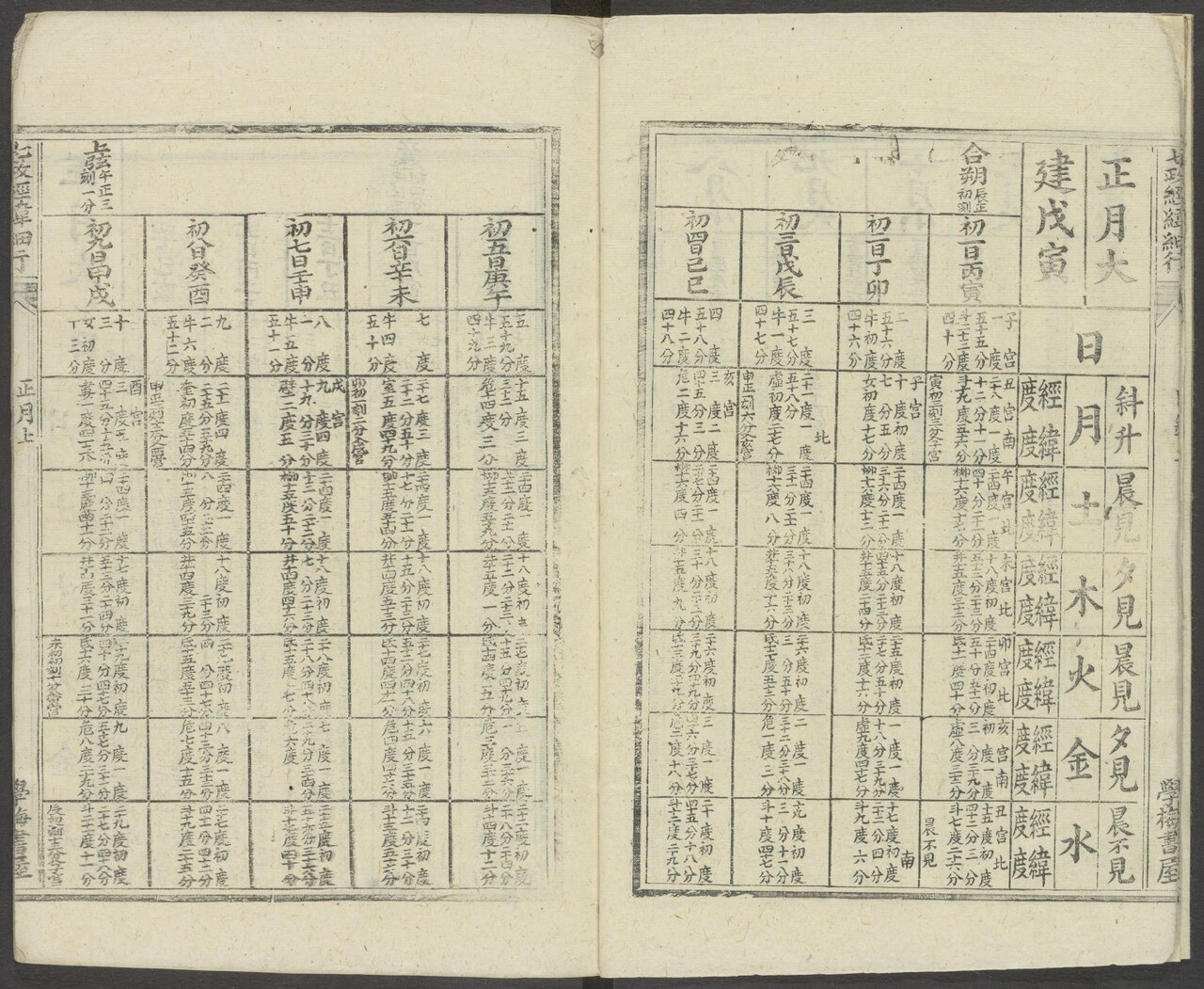
La plus ancienne source que nous avons lue nous-mêmes est le 《三命通會》 (Ming, 萬民英), volume 2 (卷二), dans l’édition du Wikisource chinois. Deux passages comptent pour cette page : le changement de jour autour de l’heure zi et les vers chantés des cinq tigres et des cinq rats.
Le jour et l’heure zi. Dans 〈論時刻〉, on lit ce qui suit. La première partie de l’heure zi se situe avant minuit et appartient à la veille ; la seconde partie se situe après minuit et appartient au jour même. Le jour calendaire change donc à 00:00, au milieu de l’heure zi. C’est le fondement de notre réglage par défaut, l’école B. Aucun des textes classiques que nous avons lus ne place un changement de jour à 23:00. Cette lecture est moderne et découle de la règle des cinq rats, qui rattache toute l’heure zi (de 23:00 à 01:00) à un seul tronc du jour. C’est pourquoi l’école A reste un réglage. Le texte classique ne dit pas quel tronc horaire reçoit l’heure zi tardive ; ce choix (le tronc du jour suivant) est une lecture de l’école B.
Les vers chantés. Dans 〈論遁月時〉, les deux règles figurent comme « 古歌 », un « chant ancien » : les règles sont donc plus anciennes que le livre lui-même. Les noms « cinq tigres » et « cinq rats » n’apparaissent pas dans le texte ; ce sont des appellations plus tardives.
Ce que nous n’avons pas pu confirmer. Que la règle des cinq rats vienne du 《淵海子平》, affirmation souvent entendue, nous ne l’avons pas retrouvé dans l’édition Wikisource de cet ouvrage (un texte partiel). Nous n’avons pas vérifié de source des chants plus ancienne que le 三命通會.
若子時,則上半時在夜半前,屬昨日;下半時在夜半後,屬今日。亦猶冬至得十一月中氣,一陽來復,為天道之初耳。
古歌曰:甲己之年丙作首,乙庚之歲戊為頭,丙辛之歲尋庚上,丁壬壬位順行流,更有戊癸何處起,甲寅之上好追求。
古歌曰:甲己還加甲,乙庚丙作初,丙辛從戊起,丁壬庚子居,戊癸何方發,壬子是直途。
L’édition Wikisource du 四庫全書 écrit 甲巳 et 嵗 là où d’autres impressions ont 甲己 et 歲 ; nous donnons ici les caractères courants. Les deux éditions lisent 壬子是直途.
The day master, ten gods, hidden stems and nayin
The day master (日主) is the stem of the day pillar. The ten gods (十神) give for every other stem its relation to the day master: the same element is 比肩 (same polarity) or 劫財 (other); what the day master produces is 食神 (same) or 傷官 (other); what it controls is 偏財 (same) or 正財 (other); what controls it is 七殺 (same) or 正官 (other); what produces it is 偏印 (same) or 正印 (other). The names are traditional designations and not meant literally.
The hidden stems (藏干) are the one to three stems that each earthly branch 'hides'; the first is the main qi (本氣). Example: 寅 hides 甲, 丙 and 戊. We use the standard table.
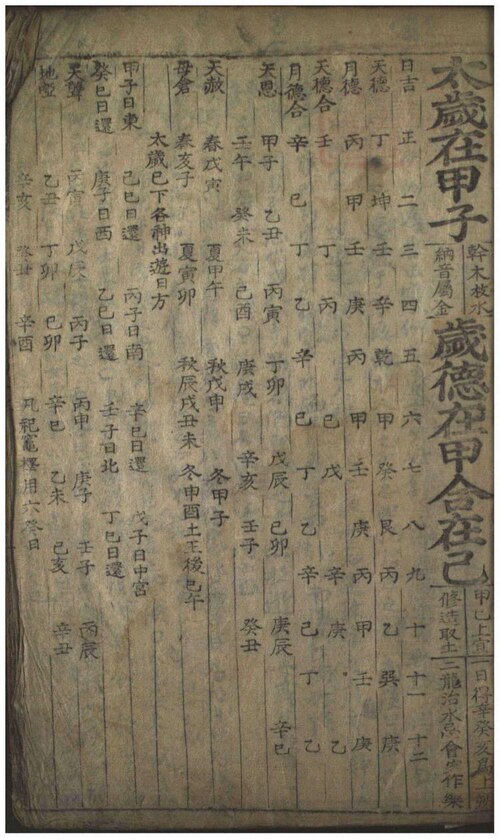
The nayin (納音, 'tonal element') gives every pair of consecutive pillars of the sixty-cycle a name from a list of thirty, for example 甲子 and 乙丑 together 海中金, 'sea metal'. The system comes from the classical texts (the work 三命通會 describes it) and is traditionally attributed to 鬼谷子 and 東方朔.
Our calculator also counts how often each element appears in the eight visible characters. That is a count without weighting; we do not judge whether a day master is 'strong' or 'weak'.
The luck periods
The luck periods (大運) are periods of ten years. They follow each other in the order of the sixty-cycle, starting from the month pillar. The direction depends on the stem of the year and the gender: with a yang year stem (甲 丙 戊 庚 壬) and a male, and with a yin year stem and a female, the series runs forwards; otherwise backwards (陽男陰女順排).
The starting age follows from the time between birth and the next jie (forwards) or the previous jie (backwards): three days is one year, one day is four months, one hour is five days. See the choices above for the rounding.
Origin
The first step, according to the Chinese Wikipedia, was oriented to the year. In the Tang period 李虛中 (762 to 813) calculates with year, month and day ('three pillars') and with the nayin; the writer 韓愈 praises him in an epitaph. In the Song period 徐子平 is named as the one who adds the hour pillar, giving four pillars, and the method is therefore called 子平法; the life of 徐子平 is not confirmed in the standard histories, so his role is tradition.
From the Song also come 徐大升, who handed on his teaching in the work later called 淵海子平, and 廖中 with 五行精紀. In the Ming period 萬民英 compiles the encyclopedia 三命通會, which is included in the 四庫全書; 張楠 writes 神峰通考. In the Qing period 沈孝瞻 writes 子平真詮 ('the month leads') and 任鐵樵 annotates 滴天髓闡微, the source of the modern reading of strength and balance. In the Republican period (1912 to 1949) 徐樂吾 and 袁樹珊, among others, modernize and popularize the teaching.
This is what the Chinese Wikipedia and its sources say; we have not read the primary classical texts ourselves.
Check it yourself: January 1, 2000, 12:00 in Beijing
Year. Lìchūn 2000 fell on February 4, after this date. So we are still in BaZi year 1999: (1999 − 4) modulo 60 = 15, the combination 己卯.
Month. The last jie before January 1, 2000 was Dàxuě (solar longitude 255°, around December 7, 1999): the month branch is 子. With year stem 己 the first month (寅) starts with 丙; 子 is the tenth month after 寅, so the stem is 丙 plus 10 = 丙. Month pillar: 丙子.
Day. The Julian day number of January 1, 2000 is 2,451,545. Stem = 1 + mod(2,451,544, 10) = 5 (戊), branch = 1 + mod(2,451,546, 12) = 7 (午). Day pillar: 戊午.
Hour. 12:00 on the clock in Beijing is about 11:42 in true solar time: still the double hour 午 (11:00 to 13:00). With day stem 戊, 子 starts with 壬; 午 is the seventh hour, so the stem is 壬 plus 6 = 戊. Hour pillar: 戊午.
So the four pillars are 己卯, 丙子, 戊午, 戊午. You can verify this with the calculator.
What BaZi is not
BaZi is a traditional system, not scientific research, and these pages make no prediction. A single pillar fixes nothing about a life. We give no medical, financial or relationship advice and do not judge what a chart 'means' for your choices.
We recalculate every example we use ourselves: in our research we found example charts on a teaching site whose day pillar does not agree with the sixty-cycle.
Frequently asked questions
What is my BaZi year pillar if I was born in January or early February?
That depends on the exact moment of Lìchūn (around February 4). Anyone born before it still belongs to the previous BaZi year, even if the calendar year has already changed. The calculator shows the moment of Lìchūn of your year.
Why does my chart differ from another BaZi site?
Usually for one of these reasons: the time (clock against true solar time), the zi hour (day change at 23:00 or 00:00), the year boundary (Lìchūn against New Year), another table for the hidden stems, or an error on the other site. Our chart names the rules used and shows the other result when there is a difference.
What is true solar time and why do you use it?
True solar time is time by the real position of the Sun at your birthplace: clock minus daylight saving, plus a longitude correction of 4 minutes per degree relative to the standard meridian, plus the equation of time (up to about 16 minutes). It can change the hour block. Many Chinese calculators use clock time; we show both.
What if I do not know my birth time?
Then you get three pillars (year, month and day). We do not assume noon as the birth time. If a jie falls on your birth day, we say that the year or month depends on the hour.
What are the ten gods?
Ten names for the relation of a stem to the day master (same element, what it produces, controls, and so on), in two polarities. They are traditional designations; they say nothing about gods in the literal sense.
Is anything stored or sent?
No. The calculation runs in your browser. We only count anonymously how often the calculator gives a result, never what you enter.
Glossaire
Les hanzi et le pinyin viennent en premier et sont toujours visibles. Les termes anglais sont ceux qui ont cours dans la littérature BaZi en anglais ; les noms français sont nos propres traductions et non une norme fixe : il n’existe pas de liste officielle unique.
| Hanzi | Pinyin | Anglais | Français (notre traduction) |
|---|---|---|---|
| 八字 | bāzì | Eight Characters (BaZi) | Huit caractères (BaZi) |
| 四柱 | sìzhù | Four Pillars | Quatre piliers |
| 天干 | tiāngān | Heavenly Stems | Troncs célestes |
| 地支 | dìzhī | Earthly Branches | Rameaux terrestres |
| 日主 | rìzhǔ | Day Master | Maître du jour |
| 十神 | shíshén | Ten Gods | Dix dieux |
| 藏干 | cánggān | Hidden Stems | Troncs cachés |
| 納音 | nàyīn | Nayin (tonal element) | Nayin (élément sonore) |
| 大運 | dàyùn | Luck Periods | Périodes de chance |
| 節 | jié | jie (month boundary) | jie (limite de mois) |
| 立春 | lìchūn | Lichun, Beginning of Spring | Lichun, début du printemps |
| 子時 | zǐshí | Zi hour (23:00 to 01:00) | Heure zi (de 23:00 à 01:00) |
| 真太陽時 | zhēntàiyángshí | True Solar Time | Temps solaire vrai |
Sources
Checked on November 9, 2026. The calculation rules were verified with an independent implementation; the stories of origin follow the sources named and were not checked against primary texts.
- Wikipedia (zh), 八字命学: https://zh.wikipedia.org/wiki/八字命学
- Wikipedia (zh), 八字: https://zh.wikipedia.org/wiki/八字
- Y.T. Liu, Chinese Calendar: Sexagenary Cycle (the day pillar formula): https://ytliu0.github.io/ChineseCalendar/sexagenary.html
- Hong Kong Observatory, the 24 solar terms (times for 2026): https://www.hko.gov.hk/tc/gts/astronomy/Solar_Term.htm
- Clarify HK, How to calculate the BaZi month pillar: https://clarifyhk.com/learn/bazi/calendar/five-tigers-method
- Buyiju, 八字命理基础知识 (tables, ten gods, hidden stems): https://www.buyiju.com/bzzs/bzml.html
- Yixiangqiankun, 八字排盘时柱怎么推算 (the late zi hour): https://www.yixiangqiankun.com/130852.htm
- bazi-calculator.com, Instructions and What is Real Solar Time?: https://bazi-calculator.com/instructions.php
- OpenFate wiki, Day Pillar Calculation: https://wiki.openfate.ai/en/bazi/calendar/day-pillar-calculation
- Lingxi, Southern Hemisphere Bazi Chart: https://asklingxi.com/en/wiki/bazi/nanbanqiu
- Australian I Ching Association (陈炎枝), 南半球八字: https://www.auiching.com/article_feng_10.html
- Afandream, Lichun or Lunar New Year?: https://afandream.com/en-IN/blog/lichun-or-lunar-new-year
- Buyiju, 什么是十年大运 (luck periods): https://buyiju.com/bzzs/mingli/3401.html
- Wikipedia (en), Wuxing (Chinese philosophy): https://en.wikipedia.org/wiki/Wuxing_(Chinese_philosophy)
- Wikipedia (zh), 納音五行: https://zh.wikipedia.org/wiki/納音五行
- 三命通會 (萬民英, 四庫全書 edition), volume 2, 〈論時刻〉 and 〈論遁月時〉 (Chinese Wikisource): https://zh.wikisource.org/wiki/三命通會_(四庫全書本)/卷02
- Unicode Unihan Database 18.0.0 (traditional forms and pinyin of the nayin and the ten gods): https://www.unicode.org/Public/UCD/latest/ucd/
- Wikipedia (zh), 渊海子平 and 子平真诠: https://zh.wikipedia.org/zh-cn/渊海子平
- IANA Time Zone Database and Wikipedia (en), Time in China: https://en.wikipedia.org/wiki/Time_in_China