The astronomical clock of Saint-Omer
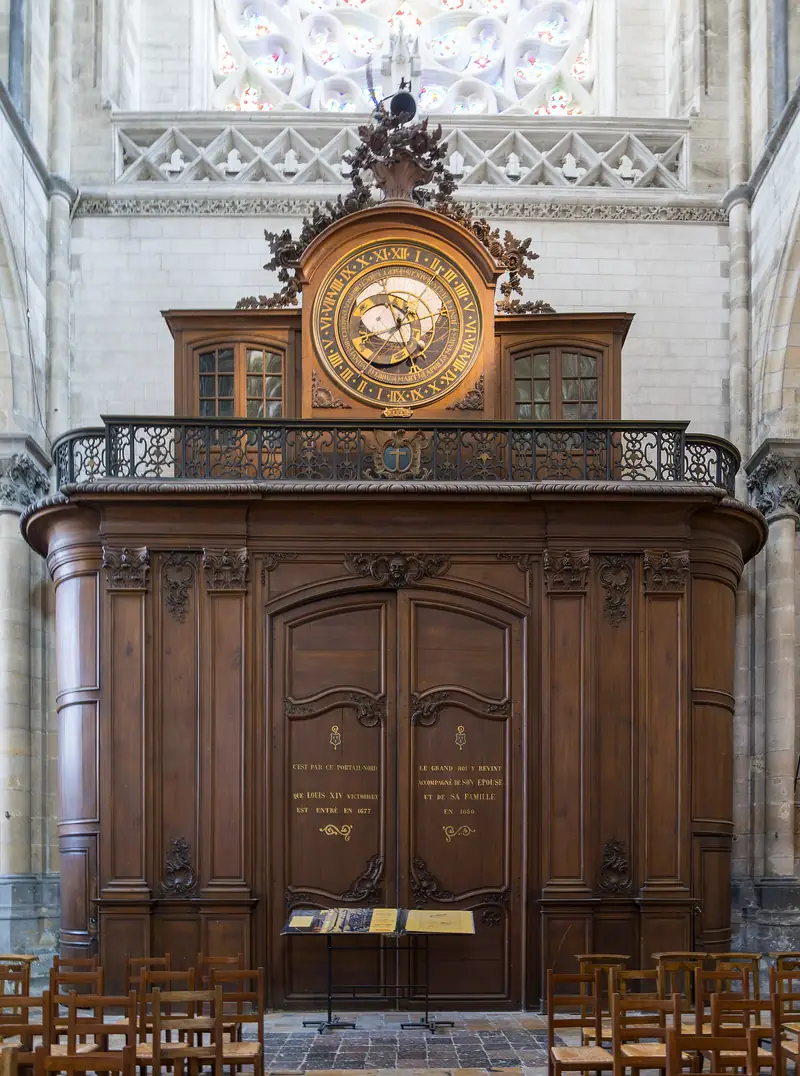
In the cathedral of Notre-Dame in Saint-Omer, in the north of France, a clock hangs above the north door. Its dial is an astrolabe: a fixed plate for the Earth, and over it a turning frame for the sky, with the zodiac, the Sun and the Moon. The clock was ordered in 1555 and bears the date 1558. Here we explain what the dial shows, draw an astrolabe for Saint-Omer for this moment, and tell what the old documents say.
The clock
The dial is just over two meters across and hangs seven and a half meters above the floor, on top of the wooden porch of the north door. That porch was made in 1758 by the cabinetmaker Georges-François Boidart. The clock was listed as a historic monument in 1840.
The clockwork behind the dial has been repaired and renewed more than once. In 1887, it was no more than the movement of a simple wooden clock, and the lines on the dial were partly worn away. In 1911–1913 H. Jullien of Brussels restored the astronomical motions.

What the dial shows
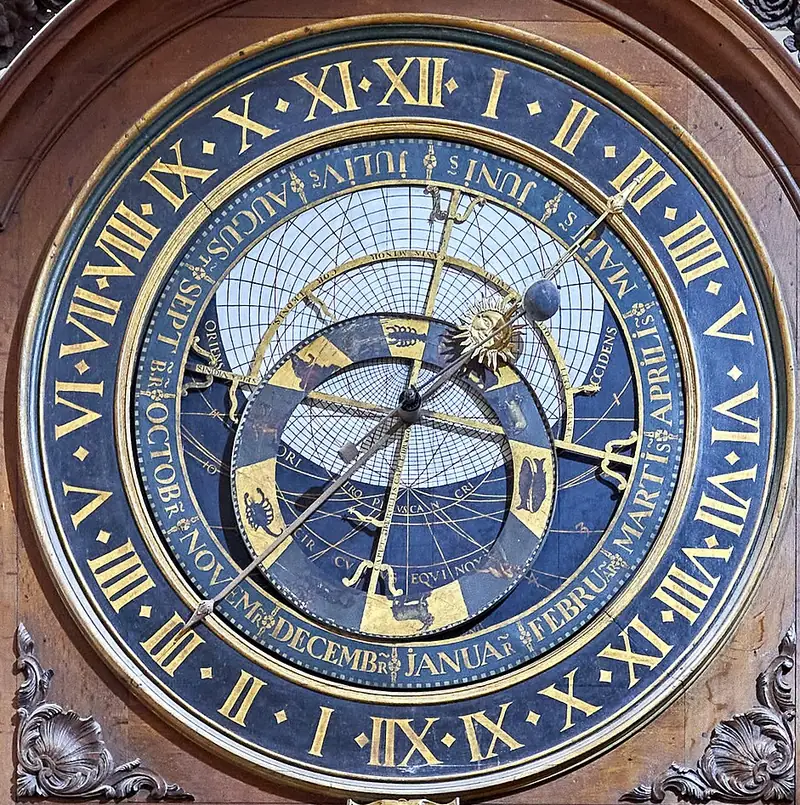
The dial is built like an astrolabe. The fixed plate, the tympanum, stands for the Earth: on it are the horizon and lines of equal height above it. On the clock the part above the horizon is light and the part below it is dark, and the words ORIENS (east) and OCCIDENS (west) stand at the two ends of the horizon.
Over the plate turns an open frame, the rete, which stands for the sky. On it lies a ring with the twelve signs of the zodiac, in compartments that are alternately black and gold. The ring is off-center, as on every astrolabe: in this projection the yearly path of the Sun is a circle whose center is not the pole.
One hand carries the Sun and shows the hour on the outer ring, which runs twice from I to XII; XII at the top is noon. The Moon is a ball, half black and half white. Between the hour ring and the plate runs a ring with the names of the months in Latin.
The pointed tips on the rete mark bright stars. Which stars they are, we have not been able to check on the dial itself.
An astrolabe for Saint-Omer, now
Our own drawing works the same way. The plate is drawn for the latitude of Saint-Omer (50.75° north): the red circle is the horizon, the thin circles inside it are lines of equal height in steps of 10°, and the red dot is the zenith, the point straight overhead. The three circles around the pole are the Tropic of Cancer, the equator and the Tropic of Capricorn. Over the plate lies the rete with the ecliptic (the gold ring), a few bright stars, the Sun and the Moon, in their places at this moment. With the slider you turn the sky through a day.
Calculating the sky…
Here the Moon is where it really is at that moment, with its deviation above or below the zodiac. That position is calculated.
The hand through the Sun shows the solar time: at XII the Sun is due south. Solar time differs from the clock time in Saint-Omer by about an hour and fifty minutes in summer and about fifty minutes in winter, give or take a quarter of an hour, because France keeps Central European Time and Saint-Omer lies just east of Greenwich. Our drawing is not a copy of the dial: the clock has its own lines, stars and pointers.
The Moon that no longer moves up and down
Today the clock shows the position and the phase of the Moon, but not its height: the ball does not slide along its hand, as the Sun does. Could the Moon do that in the past? In an album about the clock from 1910–1913 in the library of Saint-Omer (Ms. 1722), A. Boitel wrote in 1910 that the clock showed three movements of the Moon. For the third he adds himself that it is a suggestion:
Différents mécanismes peuvent être employés pour reproduire les mouvements, il est assez probable que celui qui fut employé dans la construction de l'horloge fut le suivant.
Different mechanisms can be used to reproduce the movements; it is fairly probable that the one used in building the clock was the following.
Enfin le troisième mouvement destiné à faire passer la Lune par ses différentes déclinaisons est obtenu par un mécanisme analogue à celui qui est employé pour produire les différentes hauteurs du soleil. C'est encore un excentrique relié à la sphère qui représente la Lune.
Finally, the third movement, meant to take the Moon through its different declinations, is obtained by a mechanism similar to the one used to produce the different heights of the Sun. It is again an eccentric connected to the ball that represents the Moon.
Of that mechanism Boitel saw only ‘une des dernières traces’ (one of the last traces): a small star in the center of the dial. He calls the dial ‘hélas incomplet aujourd’hui’ (sadly incomplete now). So in 1910 the Moon no longer moved up and down.
H. Jullien, who restored the clock in 1911–1913, deliberately did not bring that movement back. In his plan the new Moon, a wooden ball of about 10 cm, gets only the daily movement and the phases:
Ces deux mouvements seuls sont compatibles avec la construction de l'horloge, l'adjonction de tout autre mouvement exigerait la transformation des pièces encore existantes et entraînerait une innovation au lieu d'une restauration.
Only these two movements are compatible with the construction of the clock; adding any other movement would require altering the parts that still exist and would be an innovation instead of a restoration.
The cathedral’s website says the mechanism ‘probably’ disappeared in 1913. According to the album of 1910 it was gone by then. Whether it was there in 1558, we do not know: it rests on Boitel’s suggestion. The ‘Reconstruction after Boitel (1910)’ button in the drawing above shows how the Moon would move according to that suggestion.
A fixed Earth, as in the first plate of Cellarius
An astrolabe shows the sky as seen from an Earth that stands still: the plate is fixed, the sky turns over it. That is the world of Ptolemy, which Andreas Cellarius drew as the first plate of his Harmonia Macrocosmica (1660). The clock bears the date 1558; Copernicus's book with the Sun at the center had appeared fifteen years earlier, in 1543. For telling the time and following the Sun, the Moon and the stars from one place, the old picture works just as well.
From the contract of 1555 to the restoration of 1913
On August 26, 1555, the chapter of the collegiate church of Saint-Omer made a contract with Pierre Engueran, a clockmaker who lived in the town. The contract was drawn up by two notaries; in 1887 its full text was printed. It asked for a new dial ‘with an astrolabe showing the course of the sun and of the moon’, with a sun and a moon passing through the twelve signs of the zodiac. The price was 130 florins, and Engueran could keep the old clock. The new clock was to be delivered on Saint Andrew's Day (November 30), 1556.
On June 12, 1556, a second contract followed with the joiner Jehan Maes, for 73 florins, for the wooden front of the clock. It asked for two figures: a cosmographer holding a sphere, and a second one holding a pair of compasses. By the middle of the eighteenth century these figures had disappeared.
The date 1558 is on the clock. In 1758, the clock received the wooden porch on which it still stands. In 1887, the archaeologist Deschamps de Pas published the contract of 1555. At that time the clock already hung above the door, and a photograph taken before 1893 also shows it there.
In 1911 H. Jullien of Brussels made the drawings for a restoration. On February 5, 1913, his report was read at a meeting of the Société des Antiquaires de la Morinie, the historical society of Saint-Omer: the work had just been finished. Jullien made new wheels and axles for the daily motion and the phases of the Moon, and a new figure of the Sun, and he used only the old holes. During the work the initials P. E. were found, with the year 1558, on the foliot, the swinging bar that regulated the old clockwork.
Who built the clock?
The contract of 1555 names the chapter as a whole. One canon is named: Lambert de Caruel, priest and churchwarden (‘maître de la fabrique’), who was in charge of the building and upkeep of the church. Pierre Engueran was to receive his 130 florins through him. The notaries were Batiste Grisel and Antoine Daens.
Who designed the dial is not recorded anywhere. For its shape and size the contract refers to a drawing that already existed: seven and a half feet square, with a zodiac ring of five and a half feet, made of bronze. In addition, Engueran himself had to make the drawing of the whole dial, to the satisfaction of the chapter; he did not have to supply the wood or the painting.
Item sera tenu de faire le dict caldran de la forme et grandeur du pourtraict qui s'est fait et contient sept pieds demi en carrure.
He shall also make the said dial in the shape and size of the drawing that has been made, which measures seven and a half feet square.
Engueran supplied the clockwork, the hammer and the ironwork, but no bells and no figure that struck the hours. He gave a two-year guarantee and had to keep the old clock running and striking until delivery. If he fell ill, the deadline was extended by as many days as he was ill.
The woodwork came from Jehan Maes, ‘bourgeois et menuzier’. Nothing is left of his case with the cosmographer and the compass. According to Deschamps de Pas it disappeared in the middle of the eighteenth century, when Bishop Valbelle had the choir refitted in the style of Louis XV. The maker’s name is disputed: see below, under what we do not know.
y adjouster deux ymaiges sur les deux cotez d'embas : Assavoir au costé dextre un cosmographe tenant une sphere et du costé senestre ung pareil tenant un compas
Two figures are to be added on the two sides at the bottom: on the right a cosmographer holding a sphere, and on the left a similar one holding a compass.
On December 31, 1558, another contract followed for the bell on which the hours were struck. According to Deschamps de Pas, the clock and the case were finished in 1558, as the date below the dial shows.
Ajoutons enfin que l'horloge et la devanture furent achevées en 1558, ainsi qu'en fait foi cette date conservée audessous du cadran.
Let us add, finally, that the clock and the front were finished in 1558, as the date preserved below the dial attests.
What we do not know
- When was the older clock made? The contract of 1555 mentions an ‘old clock’, which went to Engueran as part of the payment. The website of the cathedral dates a clock to the fourteenth century and sees the astrolabe as Gothic; the contract of 1555 asks for a new dial with an astrolabe. We have found no document for the older date.
- Was anything paid in 1541? The French heritage database (Palissy) says that the clockwork was paid for in 1541, for 130 livres. We found no document for that; the only sum of 130 we know is the 130 florins of the contract of 1555.
- Who made the woodwork? According to Palissy, Jehan de Créqui made the first woodwork in 1556, and in 1599 a Jean Maes (Palissy's spelling) carved the case for 73 livres tournois. The contract of June 12, 1556, however, names Jehan Maes as the joiner, for 73 florins. A document from 1599 has not been found.
- Did the up-and-down movement of the Moon already exist in 1558? A. Boitel described it in 1910 as ‘assez probable’ (fairly probable); by then only a trace was left. We have not found an older source, nor the text of canon Coolen.
- Which stars do the pointers of the rete mark? The website of the cathedral gives eight Latin names; we have not been able to check them on the dial.
- Who was Pierre Engueran? Apart from the contract we know little about him; the website of the cathedral also lists his life as an open question.
- We do not know who made the first drawing of the dial or who decided what the clock should show.
- Was the clock really finished by the end of 1558? The date 1558 is below the dial and on the foliot, but the contract for the bell dates only from December 31, 1558. When that bell was hung, we do not know.
- The sum of 73 for the woodwork appears twice: as 73 florins in the contract of 1556 and as 73 livres tournois in 1599 in the French heritage database. Whether this is the same payment, we do not know.
Sources
- Deschamps de Pas, ‘Marché pour la construction de l'horloge de l'église collégiale de Saint-Omer’, with a report by A. Darcel, Bulletin archéologique du Comité des travaux historiques et scientifiques, 1887, pp. 422–429: the text of the contracts of August 26, 1555 (chapter archives, G. 2786) and June 12, 1556. archive.org
- Ministère de la Culture, Palissy PM62002377, ‘Horloge astronomique’: dimensions, the date 1558, the listing in 1840, and the description of the dial. pop.culture.gouv.fr
- Ministère de la Culture, Mémoire: the drawings of H.-C. Jullien for the restoration (1911) and the porch by G.-F. Boidart (1758, AP80L074909). pop.culture.gouv.fr
- Bulletin historique trimestriel de la Société des Antiquaires de la Morinie, vol. XIII, meeting of February 5, 1913, pp. 161–163: the report of H. Jullien on the restoration.
- Les Amis de la Cathédrale de Saint-Omer (B. Delrue), the page ‘Horloge’ on the website of the cathedral: used only where we say so. cathedrale-saint-omer.com
- Our drawing: own calculation, with the positions of the Sun and the Moon after J. Meeus, Astronomical Algorithms, and the stars from the Yale Bright Star Catalogue.
- Bibliothèque de l’Agglomération du Pays de Saint-Omer, Ms. 1722: the copy of the contract of 1555 and of the communication by Deschamps de Pas (1887), with a note by A. Darcel (images 32–37); read ourselves. bibliotheque-numerique.bibliotheque-agglo-stomer.fr
- Bibliothèque de l’Agglomération du Pays de Saint-Omer, Ms. 1722: album ‘Horloge astronomique de la basilique Notre-Dame de Saint-Omer’ (1910–1913), with the description by A. Boitel (1910) and the plan by H. Jullien (plate IV: the Moon hand). bibliotheque-numerique.bibliotheque-agglo-stomer.fr
Further reading: ‘les 17 660 916 000 Tic Tac de l'horloge de la Cathédrale’ (Les Amis de la Cathédrale de Saint-Omer, 2026, led by Bernard Delrue). We have not read this book.
We keep what the old documents say separate from what later descriptions say. Where only one source gives something, we say so.
More monuments
Also available:
- Newgrange (Ireland)
- Maeshowe (Scotland (Orkney))
- Stonehenge (England)
- The Great Pyramid of Giza (Egypt)
- Nabta Playa (Egypt (Sahara))
- Goseck (Germany)
- Mnajdra (Malta)