The sky in a clockwork
An ordinary clock shows the hours. An astronomical clock also shows the sky: the position of the sun and the moon, sometimes the planets or the tide. The Netherlands has only a few, but they are remarkable.
’s-Hertogenbosch, 1513: the Oordeelspel
From 1513 a large astronomical clock, the Oordeelspel (the Last Judgment play), stood in Saint John’s Cathedral in ’s-Hertogenbosch. It showed the hours and also the position of the sun and the moon; above it, figures played out the Last Judgment. The maker was probably the smith Peter Wouterszoon. [1]
In the seventeenth century the clock fell into decay, and in 1691 the town council gave permission to clear away the remains. Since May 30, 2010, a reconstruction ten meters high has stood in the Jheronimus Bosch Art Center. [1]
An astronomical clock from the same century and the same Habsburg Netherlands still stands in the cathedral of Saint-Omer. Saint-Omer: the astronomical clock →
Leiden, around 1670: the sun in the middle
Rijksmuseum Boerhaave in Leiden holds the Leiden Sphaera: a model of the solar system with the planets around the sun, as Copernicus had proposed, driven by a pendulum clock. The Rotterdam clockmaker Steven Tracy built it, with the mathematician Nicolaes Stampioen, for Adriaen Vroesen, burgomaster of Rotterdam. The model also shows the moon and four moons of Jupiter; in 1710 it came to Leiden University. [2]
According to NRC Handelsblad (1990) it was made around 1670 and is the oldest planetarium in the country built on Copernican principles. The same newspaper reports that the four moons of Saturn were only added in 1710. [3]
Christiaan Huygens, who invented the pendulum clock, had a planetarium made as well. A letter of February 1682 shows that the clockmaker Van Ceulen was working on it in The Hague. [4] According to NRC Handelsblad it stood in Museum Boerhaave in 1985. [5]
The same picture, with the sun in the middle, appears on the plates of Andreas Cellarius’s Harmonia Macrocosmica (1660), beside the systems of Ptolemy and Tycho Brahe.
Moon and tide at home
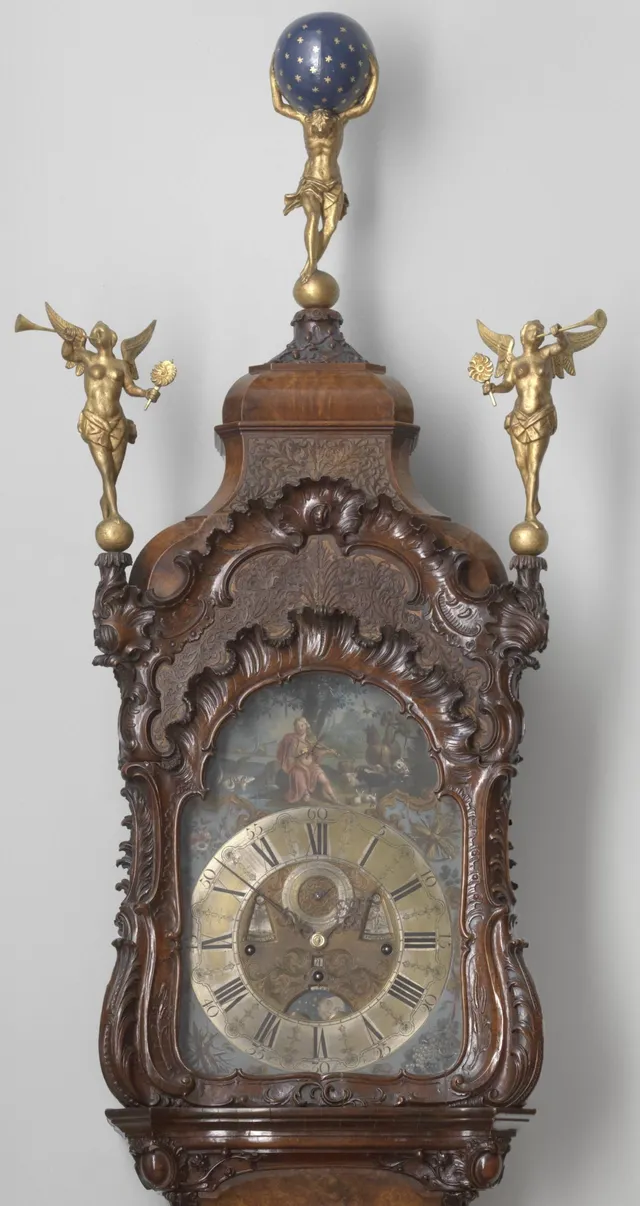
The Rijksmuseum has an Amsterdam longcase clock from around 1755–1765, with a movement by Adam Heijmuijs. According to the museum it shows the date, day, month, the phase of the moon and high water, and plays fourteen tunes; on top, Atlas carries a celestial globe. [6] For a port town such a dial was useful: high water depends on the position of the moon.
Franeker, 1774–1781: Eise Eisinga
In April 1774 unrest broke out in Friesland. On May 8 Mercury, Venus, Mars and Jupiter were due to stand together with the moon in Aries, and a booklet predicted that the planets would collide. The author turned out to be Eelco Alta, a minister from Bozum. [7]
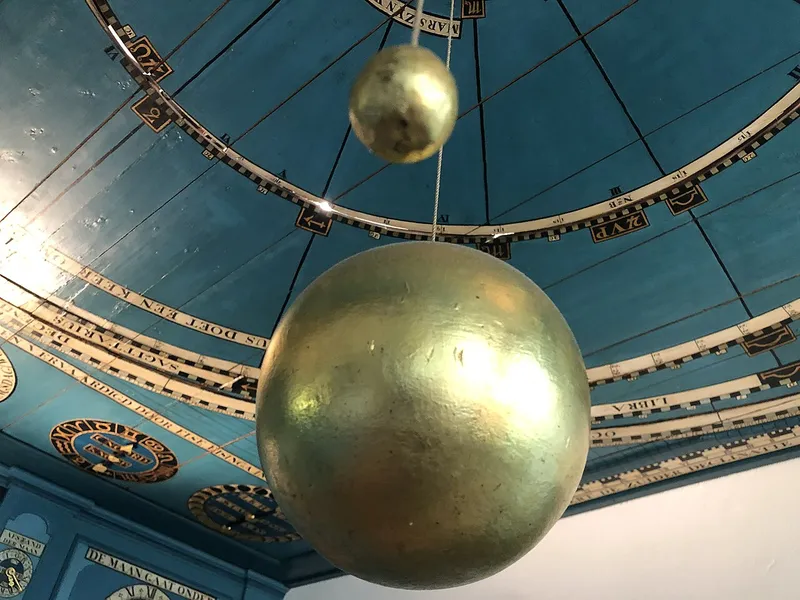
Between 1774 and 1781 Eise Eisinga built a model of the solar system into the ceiling of his house in Franeker. At any moment of the day it shows the positions of the earth, the moon and the five other planets then known, and it still works. Since 2023 it has been on UNESCO’s World Heritage List. [8]
Wier, 1943–1944: a clock in the tower
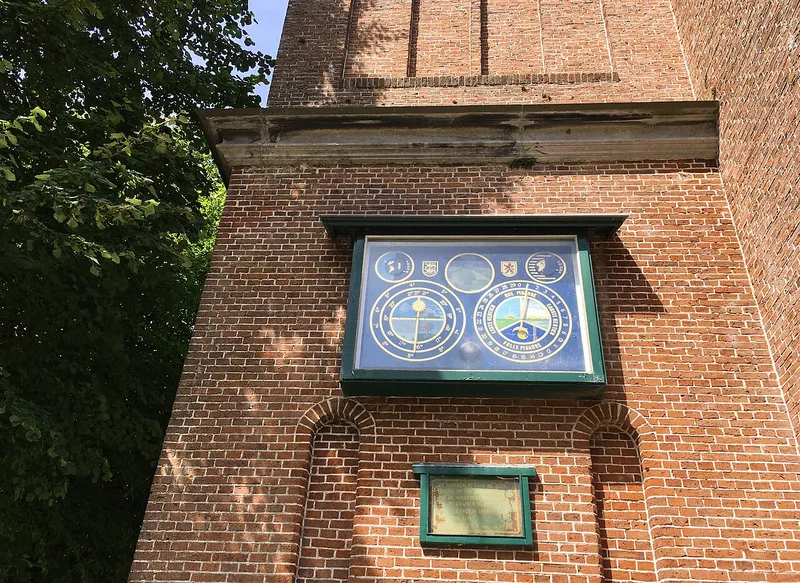
The church tower of Wier, in Friesland, holds an astronomical clock. It was made between July 1943 and June 1944 by a man in hiding, with wheels of plywood. In 1965 nine clockmakers replaced the wooden wheels with copper ones; the village could again see on the tower whether the moon was full, which season it was and whether it was day or night. The Leeuwarder Courant called it ‘het enige astronomisch torenuurwerk in Nederland’, the only astronomical tower clock in the Netherlands. [9]
Asten, 1979: a new astronomical clock
André Lehr, director of the National Carillon Museum in Asten, wanted to make an astronomical clock like the one Saint John’s Cathedral in ’s-Hertogenbosch once had. In 1979 his clock was shown for the first time, in the provincial government building in ’s-Hertogenbosch; it was meant for the museum in Asten. [10] Whether it can be seen there now, we have not been able to find out.
And in Hoorn?
We have found no astronomical clock in Hoorn, nor elsewhere in West Friesland. [11] The East Church has an ordinary clock, with weights you can see hanging in the church, under a wooden vault painted with a sun, a moon and stars. [12]
What we do not know
- What the reconstruction in ’s-Hertogenbosch shows exactly, and whether it works.
- Whether Huygens’s planetarium can be seen in Rijksmuseum Boerhaave now.
- Whether Lehr’s clock stands in Asten now.
- We have not yet consulted André Lehr’s standard work, De geschiedenis van het astronomisch kunstuurwerk (1981).
Sources
- Bossche Encyclopedie, ‘Oordeelspel’, with Hoffman’s article in Bossche Bladen (2011). bossche-encyclopedie.nl
- Rijksmuseum Boerhaave, ‘Leiden Sphaera’. rijksmuseumboerhaave.nl
- NRC Handelsblad, April 10, 1990 (Delpher). resolver.kb.nl
- Christiaan Huygens, Oeuvres complètes XXI, ‘Le planétaire de 1682’, pp. 167–168 (DBNL). dbnl.org
- NRC Handelsblad, March 21, 1985 (Delpher). resolver.kb.nl
- Rijksmuseum, longcase clock BK-1967-144. rijksmuseum.nl
- NRC Handelsblad, March 25, 1994 (Delpher). resolver.kb.nl
- UNESCO Netherlands, ‘Eise Eisinga Planetarium’. unesco.nl
- Leeuwarder Courant, May 6, 1965 (Delpher). resolver.kb.nl
- Het Vrije Volk, November 6, 1979 (Delpher). resolver.kb.nl
- R. Stenvert et al., Monumenten in Nederland. Noord-Holland (2006), Hoorn pp. 380–393 and the other West Frisian towns (DBNL). dbnl.org
- Stichting Oosterkerk Hoorn, Oosterkerk in 128 passen (2024). oosterkerkhoorn.nl