Dark constellations
We connect stars with lines and call the result a constellation. Other peoples read the same sky in a different way: they looked at the dark patches in the Milky Way, clouds of dust that block the light of the stars behind them, and saw animals in them.
Slide the control to see the same Milky Way first with our lines and then with the shadows. Then choose which tradition you read: the Emu in the Sky, known among others to the Kamilaroi and Euahlayi peoples of Australia, or Yacana, the sky llama of the Quechua people in the Andes.
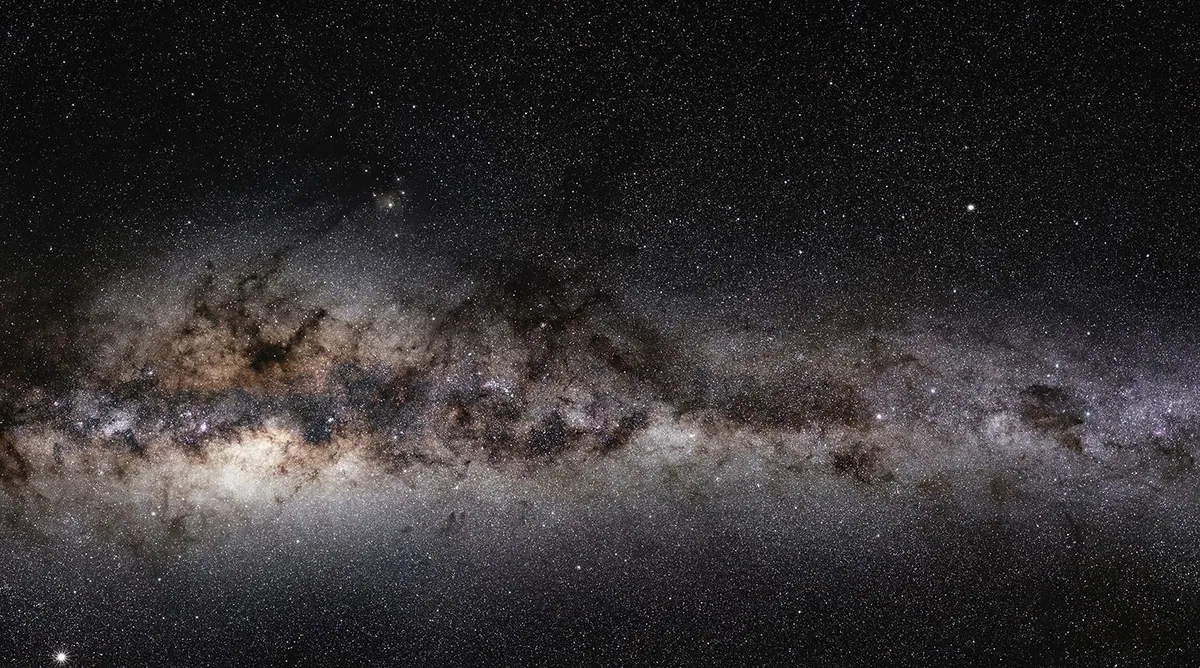
Swipe across the photo to move along the Milky Way.
Western view. The Western view: the Southern Cross, Alpha and Beta Centauri (which point to the Southern Cross) and Scorpius, with the lines we draw between the stars.
Reading the shadow: Emu in the Sky (Australia). The shadow read as the Emu in the Sky: the Coalsack is the head, the neck follows the dark lane from Alpha and Beta Centauri, the body is widest near Scorpius, and the tail runs out toward Sagittarius.
Reading the shadow: Yacana, the sky llama (Andes). The shadow read as Yacana, the llama: Alpha and Beta Centauri are her eyes, her body follows the dark lane toward Scorpius, and her calf runs beneath her. The Coalsack is Yutu, the tinamou, and near Sagittarius runs Atoq, the fox.
Being honest about what you see
The dotted lines are our own sketch of where the dark clouds lie. The traditions themselves have no fixed drawing, and every people tells the story in its own way. These are living traditions: what appears here is a small selection of what has been shared and published openly, without the secret or ceremonial layers.
These figures can only be seen well from the Southern Hemisphere. The Coalsack lies so far south that it never rises above the horizon north of roughly 27 degrees of latitude, so it cannot be seen from Europe or from most of North America.
Read on
- The Emu in the Sky: the Emu as a shadow, with its calendar.
- Yacana, the sky llama: the llama, her calf and the other dark animals of the Andes.
- Why we miss the dark: what the dark patches are, and why our eye skips over them.
Photo: ESO/S. Brunier, cropped and edited, license CC BY 4.0. Lines and dotted outlines: Cellarius.