The winter sky: Orion, Taurus and Gemini
In December and January, three of the most striking constellations are up in the evening: Orion, Taurus and Gemini. This page shows them as Andreas Cellarius had them engraved in 1660, next to a chart of the same stars. You can read when to see them from the Netherlands, where the names of their stars come from and which stories belong to them.
How to find them
Start with Orion. Three bright stars in a short, straight row form his belt. Above it is the orange-red Betelgeuse, below it the blue-white Rigel.
Follow the belt up and to the right. You reach Aldebaran, an orange star in a V of fainter stars: the head of Taurus. Farther in the same direction is a small, tight group: the Pleiades.
From Betelgeuse, look up and to the left. Two bright stars stand side by side there: Castor and Pollux, the Twins of Gemini.
When and where to see them
Calculated for Amsterdam, in Dutch local time. On December 15 it is fully dark at 6:33 PM, on January 15 at 6:59 PM. A month later, each star rises about two hours earlier.
| Star | Date | Rises | Highest in the south | Sets |
|---|---|---|---|---|
| Betelgeuse | December 15 | 6:16 PM, east | 12:58 AM, 45° high | 7:40 AM |
| January 15 | 4:15 PM, east | 10:56 PM, 45° high | 5:38 AM | |
| Rigel | December 15 | 6:57 PM, east | 12:17 AM, 29° high | 5:37 AM |
| January 15 | 4:55 PM, east | 10:15 PM, 29° high | 3:35 AM | |
| Aldebaran | December 15 | 4:05 PM, northeast | 11:39 PM, 54° high | 7:13 AM |
| January 15 | 2:03 PM, northeast | 9:37 PM, 54° high | 5:11 AM | |
| Alcyone | December 15 | 2:25 PM, northeast | 10:51 PM, 62° high | 7:17 AM |
| January 15 | 12:23 PM, northeast | 8:49 PM, 62° high | 5:15 AM | |
| Castor | December 15 | 4:57 PM, northeast | 2:37 AM, 69° high | 12:22 PM |
| January 15 | 2:55 PM, northeast | 12:36 AM, 69° high | 10:16 AM | |
| Pollux | December 15 | 5:50 PM, northeast | 2:48 AM, 66° high | 11:46 AM |
| January 15 | 3:48 PM, northeast | 12:46 AM, 66° high | 9:45 AM |
Rising and setting times are for a flat horizon, without the bending of light in the atmosphere; you only see a star well once it is a few degrees above the horizon. A time during the day, such as the setting of Castor and Pollux, is of course not visible. Elsewhere in the Netherlands the times differ by a few minutes. Calculated with Skyfield (JPL DE440) and the star positions from the Yale Bright Star Catalogue.
Orion
In mid-December Orion rises early in the evening and is highest around midnight, in the south. In mid-January this happens two hours earlier.
The brightest stars
| Name | Brightness (magnitude) | Origin of the name |
|---|---|---|
| Rigel β Ori | 0.1 | Arabic: rijl al-jauzaʾ, “the foot of al-Jauzaʾ.” |
| Betelgeuse α Ori | 0.5 | Arabic: yad al-jauzaʾ, “the hand of al-Jauzaʾ.” A Latin translator read the first letter as a b (bedalgeuze); later this was explained as “armpit,” and so Betelgeuse came about. |
| Bellatrix γ Ori | 1.6 | Latin: “the female warrior.” The name first belonged to Capella and moved to this star in the late Middle Ages, perhaps through the name Bellator (“the warrior”) for Orion. |
| Alnilam ε Ori | 1.7 | Arabic: al-nizam, “the string of pearls,” for the three belt stars together. |
| Alnitak ζ Ori | 2.1 | Arabic: nitaq al-jauza, “the belt of al-Jauzaʾ.” |
| Saiph κ Ori | 2.1 | Arabic: saif al-jabbar, “the sword of the giant.” That name really belonged to the stars of the sword. |
| Mintaka δ Ori | 2.2 | Arabic: mintaqat al-jauzaʾ, also “the belt of al-Jauzaʾ.” |
The story
In his De astronomia (book II, 34) Hyginus gives several stories of how Orion came to the sky. In one of them he hunted on Crete with Diana and boasted that he could kill anything the earth brings forth; the Earth then sent a scorpion against him (II, 26). That is why, Hyginus says, it is arranged so that Orion sets when the Scorpion rises. In another version, which he attributes to Callimachus, Diana killed him with her arrows.
Aratus tells the same story of Artemis and the scorpion in his didactic poem Phaenomena, and ends the same way: when the Scorpion rises in the east, Orion flees at the western edge. He describes Orion “with glittering belt and shining shoulders and trusting in the might of his sword,” set aslant beneath the front of Taurus.
For the Arabs before Islam, al-Jauzaʾ was a female figure in the stars of what is now Orion. Many names in the table come from her: her hand, her foot, her belt. In the Arabic translation of the Almagest, Orion was called al-jabbar, “the giant.”
How Cellarius and his contemporaries drew it
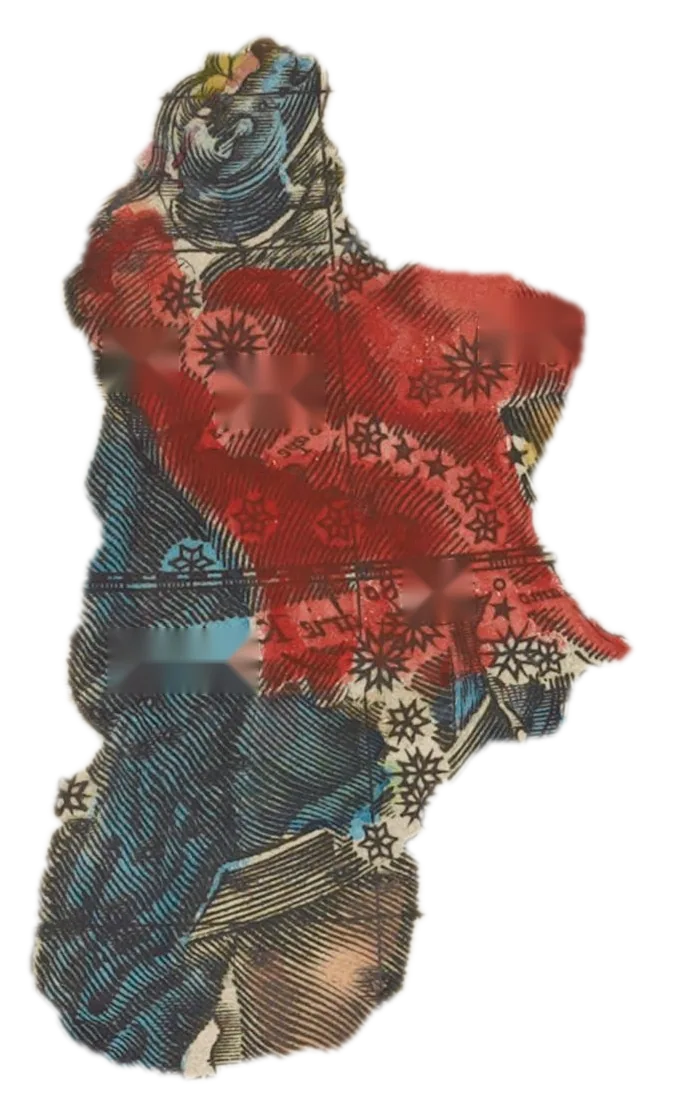
Cellarius’s plate of the northern starry sky is plate 26 of his Harmonia Macrocosmica. As on all star charts in the atlas (plates 22 to 29), the figures are mirrored, as on a celestial globe. Only on this plate are the three belt stars called the “three Kings.” According to Robert van Gent (2000), the figures follow the style that Jan Pietersz. Saenredam created around 1598 for the celestial globes of Willem Jansz. Blaeu; the stars themselves come from the globes that Petrus Plancius published with Pieter van den Keere from 1612.
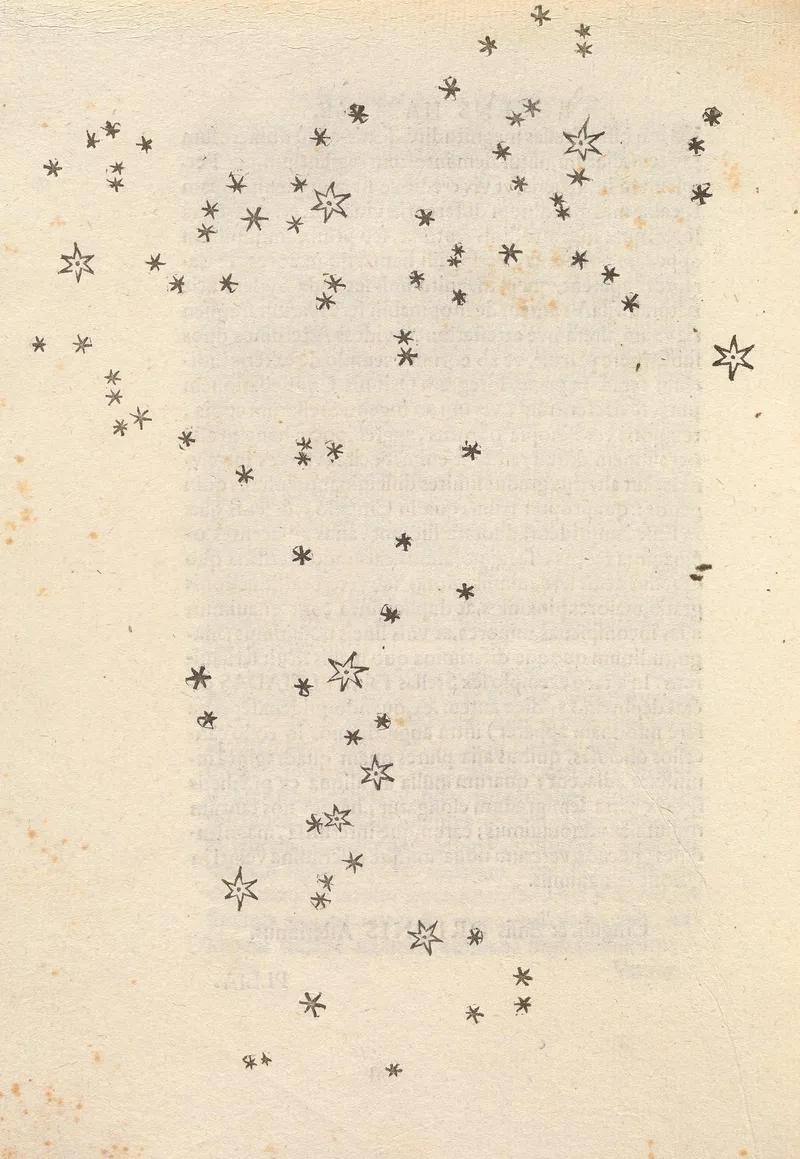
Galileo turned his telescope on Orion. In his Sidereus nuncius (1610) he writes that he had meant to draw the whole constellation, but was overwhelmed by the vast number of stars and short of time: within one or two degrees of the old stars there were more than five hundred. So he drew only the three stars of the belt and the six of the sword, with eighty new stars around them.
Taurus
In mid-December Aldebaran already rises before dark and is highest shortly before midnight, more than fifty degrees above the southern horizon. In mid-January this happens around half past nine in the evening. The Pleiades rise earlier and stand even higher.
The brightest stars
| Name | Brightness (magnitude) | Origin of the name |
|---|---|---|
| Aldebaran α Tau | 0.9 | Arabic: al-dabaran, possibly “the follower,” because the star follows the Pleiades across the sky. One of the oldest Arabic star names in the West, in use since the end of the tenth century. |
| Elnath β Tau | 1.7 | Arabic: al-nath, “the butting (with the horns).” The name really belonged to two stars in Aries; only in recent times was it, as Nath, wrongly given to this star. |
| Alcyone η Tau | 2.9 | Greek: one of the seven daughters of Atlas and Pleione, the Pleiades. The stars only got these names in the early modern period. |
| Ain ε Tau | 3.5 | Arabic: ain al-thaur, “the eye of the bull,” the name of Aldebaran in the Arabic Almagest. |
The story
According to Hyginus (II, 21), the Bull is in the sky because he carried Europa safely to Crete, as Euripides says. Others say that Jupiter placed him there for Io, who had been turned into a cow. Hyginus adds that only the front part can be seen as a bull and that the rest of the body stays faint. Elsewhere (III, 20) he describes Taurus as half an animal that seems to be sinking to its knees.
Aratus mainly gives the position: at the feet of the Charioteer lies the horned Bull, and his head is very clearly marked. According to Hyginus, the stars that form the Bull’s face are the Hyades; more about them below.
How Cellarius and his contemporaries drew it
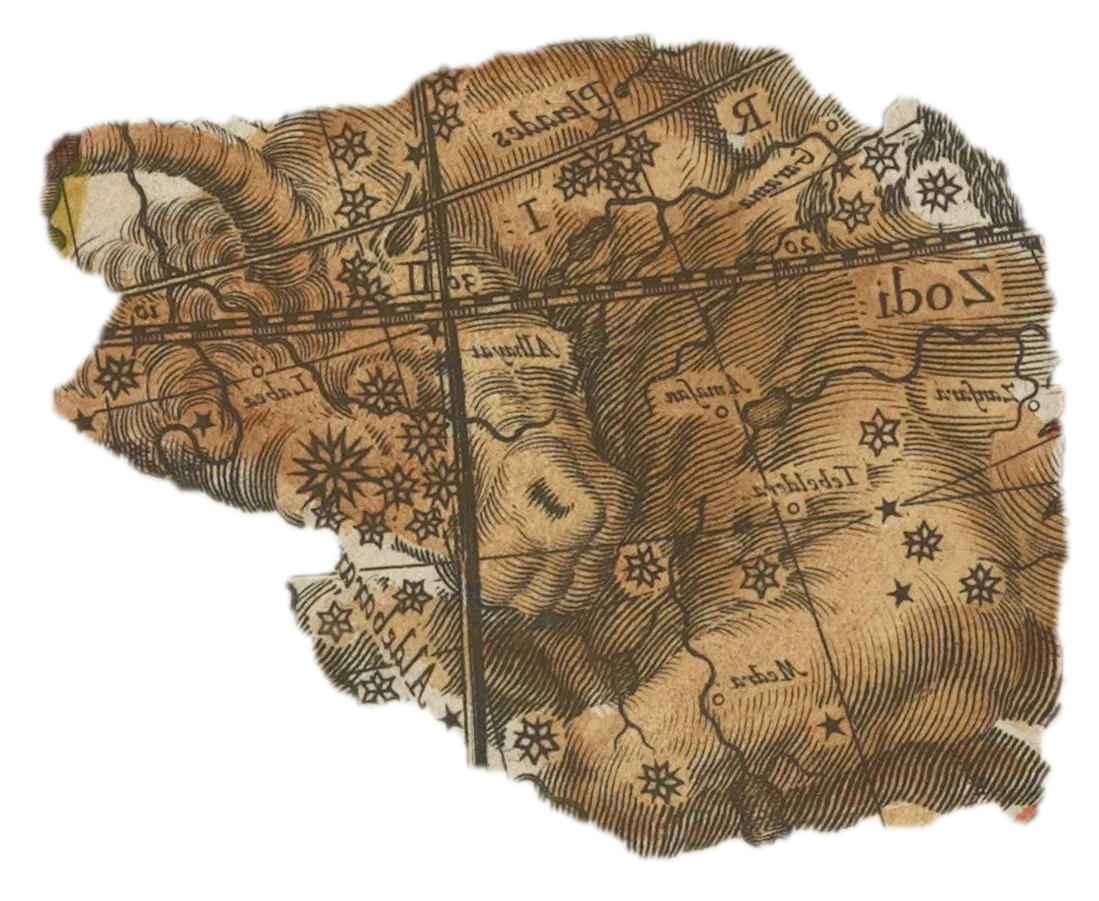
Cellarius, too, draws only the front half of Taurus. Above the animal is the mirrored inscription “Pleiades.”
Beneath the stars, the earth’s hemisphere is engraved, with rivers and place names. The full title of the plate says so: Haemisphaerium stellatum boreale cum subiecto haemisphaerio terrestri, the northern starry sky with the earth’s hemisphere below it. That is why the detail shows lines that have nothing to do with Taurus.
Gemini
In mid-December Gemini rises in the early evening and is highest only long after midnight, almost seventy degrees above the southern horizon. In mid-January that is around midnight. The Twins stay visible until morning twilight.
The brightest stars
| Name | Brightness (magnitude) | Origin of the name |
|---|---|---|
| Pollux β Gem | 1.1 | Latin, from the Greek Polydeukes, the other brother. |
| Alhena γ Gem | 1.9 | Arabic: the name of a lunar mansion, possibly “the mark on the neck of a camel.” |
| Castor α Gem | 2.0 | Greek: Kastor, one of the twin brothers. |
| Tejat μ Gem | 2.9 | Arabic: tihyat, said to be the singular of an old Arabic name whose meaning is unknown. |
| Mebsuta ε Gem | 3.0 | Arabic: from dhiraʿ al-asad al-mabsuta, “the outstretched paw of the lion,” an old Arabic star group. |
| Wasat δ Gem | 3.5 | Arabic: wasat, “middle.” The name came to this star through a confusion between Orion and Gemini. |
The story
Hyginus (II, 22) writes that many astronomers call the Twins Castor and Pollux. They were the brothers who loved each other most: they never fought over power and did nothing without consulting each other. According to Homer, Hyginus says, Pollux gave his brother half of his life, so that they shine on alternate days.
Aratus gives only their position, beneath the head of Helice, the Great Bear. In the Arabic Almagest they were called al-tawʾaman, “the twins.” For the Arabs before Islam, this sign of the zodiac corresponded to al-Jauzaʾ, the figure that now lies in Orion; through a confusion between the two, a star of Gemini got the name Wasat.
How Cellarius and his contemporaries drew it
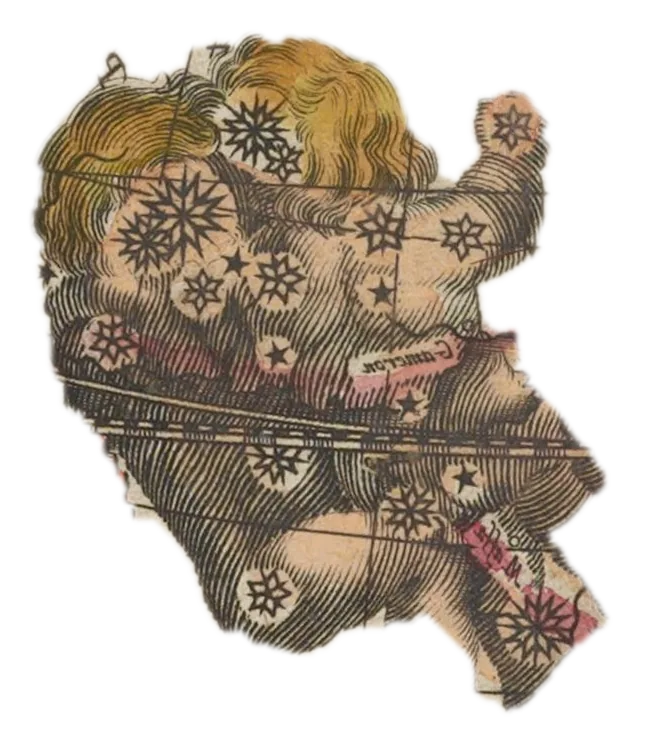
Cellarius draws two boys with blond curls, close together. The same pair also appears on the page about the Geminids, the meteor shower of mid-December.
The Pleiades, the Hyades and the Orion Nebula
The Pleiades (the Seven Sisters)
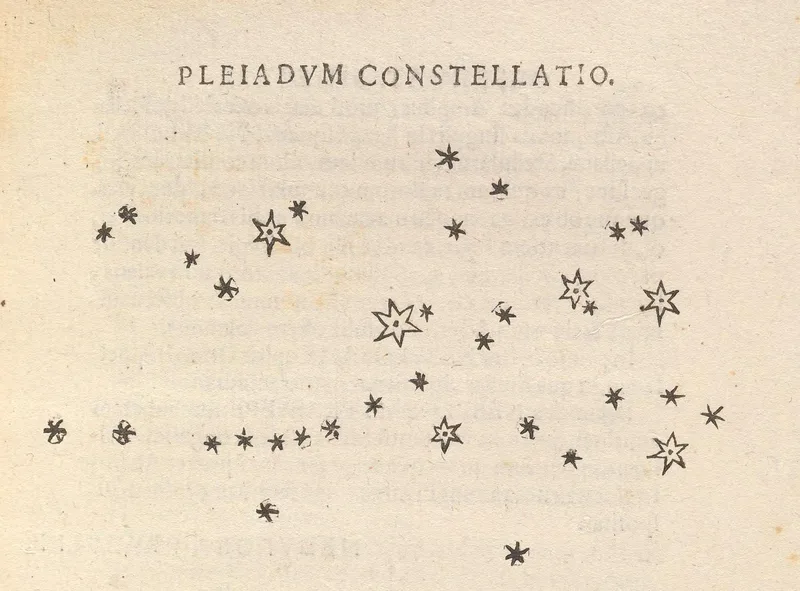
According to Hyginus (II, 21), the Pleiades are the daughters of Atlas and Pleione. They are said to be seven, but no one can see more than six: six married gods and the seventh a mortal, and that is why her star grew fainter. Others say that Electra withdrew in grief after the fall of Troy. Aratus puts it like this: “Seven are they in the songs of men, albeit only six are visible to the eyes.” He also gives their names: Alcyone, Merope, Celaeno, Electra, Sterope, Taygete and Maia.
In his Sidereus nuncius (1610) Galileo writes that the telescope shows more than forty stars near the six known ones, none of them much more than half a degree away; he drew thirty-six. He too speaks of six, “since the seventh is scarcely ever visible.” According to NASA, the Pleiades are about 445 light-years away, though that number is not universally agreed upon; the measurements of the Gaia satellite give about 440 light-years.
The Hyades
According to Hyginus (II, 21), the stars that form the face of Taurus are called the Hyades. Pherecydes called them the seven nurses of Bacchus. Another explanation in Hyginus: they are named after their brother Hyas, who was killed by a lion, after which the sisters died of grief. Aratus says only that their name is often spoken and that they are spread across the forehead of Taurus.
The measurements of Gaia put the Hyades at about 155 light-years, almost three times closer than the Pleiades.
The Orion Nebula
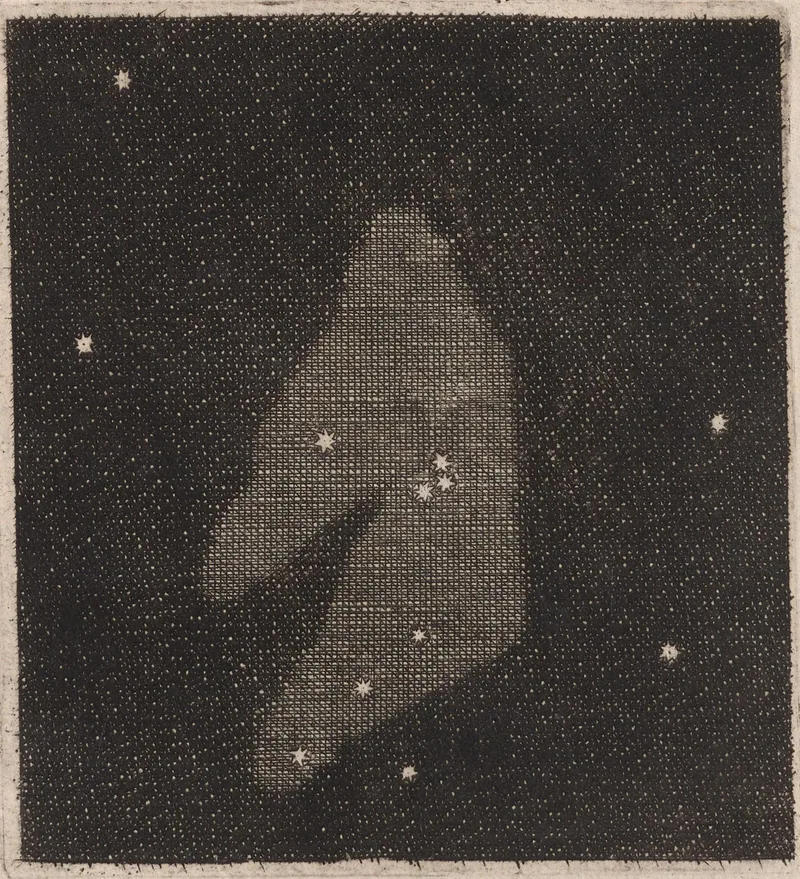
Below Orion’s belt hangs his sword: three stars one above the other. The middle one is not an ordinary star. In 1656 Christiaan Huygens, with his 23-foot telescope, saw twelve stars there instead of one. Three of them almost touched, and these three and four others shone “as through a mist.” The sky around them was much brighter than elsewhere, as if the black sky had an opening there onto a brighter region. In his Systema Saturnium (1659) he wrote that, as far as he knew, no one had noticed it before, and he added an engraving.
The editors of his Oeuvres complètes (volume XV, 1925) call that engraving the first drawing ever made of the Orion Nebula. In 1610 Galileo had resolved “nebulous stars” into groups of stars with his telescope, including the nebula in Orion’s head, but he says nothing about the nebula in the sword.
According to NASA, the Orion Nebula is about 1500 light-years away and is the closest large star-forming region to Earth.
See today’s sky with Cellarius’s figures
What we don’t know
- We don’t know exactly how Cellarius’s engravers arrived at the figures of Orion, Taurus and Gemini. Van Gent names the style of Saenredam and the globes of Plancius and Van den Keere, but we have not compared the figures with those globes ourselves.
- We don’t know who saw the Orion Nebula first. The editors of Huygens’s Oeuvres name Peiresc in 1610 in one place and Cysat in 1619 in another.
- We don’t know where the name al-Jauzaʾ comes from. According to the IAU list this is unclear, as with nearly all old Arabic names from before Islam.
- We don’t know why the name Bellatrix was first used for the star Capella. According to the IAU list, the reason is not yet fully understood.
- We don’t know exactly how far away the Pleiades are. NASA itself says its figure of 445 light-years is not universally agreed upon.
Sources
- IAU Working Group on Star Names (WGSN), IAU Catalog of Star Names, with the origin of the names according to P. Kunitzsch and T. Smart, A Dictionary of Modern Star Names (2nd revised edition, 2006) exopla.net
- Hyginus, De astronomia, book II, chapters 21, 22, 26 and 34, and book III, 20 (Latin text, The Latin Library) thelatinlibrary.com
- Aratus, Phaenomena, translated by G. R. Mair, in: Callimachus, Lycophron, Aratus (Loeb Classical Library, London and New York 1921) archive.org
- Galileo Galilei, Sidereus nuncius (Venice 1610), copy of the Smithsonian Libraries; English translation by E. S. Carlos, The Sidereal Messenger (London 1880) archive.org
- Christiaan Huygens, Systema Saturnium (The Hague 1659), pp. 8 and 9, in: Oeuvres complètes, volume XV (The Hague 1925), pp. 236 and 237, with the introductions on pp. 50 and 191 (DBNL) dbnl.org
- R. H. van Gent, “De hemelatlas van Andreas Cellarius: Het meesterwerk van een vergeten Hollandse kosmograaf,” Caert-Thresoor 19 (2000) no. 1, pp. 9 to 25 (see our page The makers)
- NASA, Hubble’s Messier Catalog: Messier 42 (the Orion Nebula) science.nasa.gov
- NASA, Hubble’s Messier Catalog: Messier 45 (the Pleiades) science.nasa.gov
- Gaia Collaboration, C. Babusiaux et al., “Gaia Data Release 2: Observational Hertzsprung-Russell diagrams,” Astronomy & Astrophysics 616 (2018), A10, table A.3 (the parallaxes of the Hyades and the Pleiades; converted to light-years by us) arxiv.org
- D. Hoffleit and W. H. Warren Jr., The Bright Star Catalogue, 5th revised edition (Yale University Observatory, 1991), via the CDS (V/50): positions and brightness cdsarc.cds.unistra.fr