Andreas Cellarius, rector in Hoorn (1637–1664)
From 1637 until the end of 1664 Andreas Cellarius was rector of the Latin School in Hoorn. This page follows the town archives as reported by Van Zoonen (2018), alongside Van Gent (2000, and his website), and says where they disagree.
What the sources say
- The Latin School of Hoorn was founded in 1575 and closed in 1868. According to Van Zoonen it was housed from the start in the buildings of the former Cecilia convent, where a school complex stood before 1600; Van Gent puts the move at the beginning of the seventeenth century, to the former Cecilia convent where the old town hall and police station later stood. [1], [2]
- On January 15, 1637 the burgomasters and council discussed letters from burgomaster Jan van Foreest, who was also a scholarch, and from the sheriff Albertus Sonck, who both recommended Cellarius of The Hague. He was offered 800 guilders a year, exemption from house rent and a single payment of 400 guilders for his costs. Van Gent gives a salary of 200 guilders. [1], [2]
- Cellarius had been fourth master at the Latin School in The Hague since May 20, 1633. Debts forced him to leave that city in the spring of 1637, and in April he moved to Hoorn. [1], [2]
- On January 31, 1637 he wrote the scholarchs a long Latin letter in which he asked to replace the three sub-masters, whose negligence, he had heard, had run the school down. At the end of April the burgomasters appointed a new staff: conrector Pieter Over ’t Water (500 guilders), third master Petrus Dircksz Blochovius (400) and fourth master Anthony Simonsz van der Eyck (350). In August his request to double the tuition from 15 to 30 stuivers a quarter was granted. [1]
- In November 1648 a committee reported that authority, order and conduct were lacking in the school. It wrote that the rector had so far been occupied more with alchemy and with writing books that did not matter for his profession, and with private teaching of youths who did not attend the school, and that he should be told he would be dismissed if he went on neglecting the school; to keep his family he could keep 500 guilders net. The council then adopted a school order in Latin: four classes of two levels each, and in the three highest classes only Latin to be spoken. [1]
- In April 1649 the new conrector Henricus Bruno came from Rhenen; Van Gent dates his conrectorship from 1650 to 1660. In November 1649 Cellarius was allowed to add his eldest son Andreas as a fifth master, at 100 guilders a year. [1], [2]
- In 1655 Cellarius complained about his pay: he had been hired in 1637 at a preacher’s salary, 800 guilders, which had since risen to 1,000, while his own had been lowered to 500 in 1648/49. The burgomasters put off a decision. [1]
- In the spring of 1660 a committee found the rector and the sub-masters Tiesbeeck and Cellarius junior satisfactory, but not Bruno, whose pupils made no progress; he was dismissed. The committee’s only reproach to Cellarius was that he had given Bruno too little guidance. In the same year the Harmonia Macrocosmica was published in Amsterdam. In May 1660 Dominicus Sminckius became conrector. [1]
- The family lived on the “Cruysstraet” next to the school. The marriage record of Cellarius’s eldest son Andreas dates from January 20, 1657 according to Van Gent; Van Zoonen has the wedding on February 4, 1657, and says the couple lived in the Kruisstraat. [1], [2]
- Cellarius died at the end of 1664, almost seventy years old. According to the burial register (DTB 82) as reported by Van Zoonen, he was buried on December 30, 1664 on the choir of the Grote Kerk in a rented grave, number 61, for eight guilders. On March 14, 1665 the council authorized the search for a new rector. [1]
- Henricus Cellarius, a younger brother of Andreas junior, applied in early April 1665 and was turned down. On April 20, 1665 the council appointed Dr. Joannes van Brienen, doctor in both laws, who was rector until his death in October 1668; Van Gent calls him Briemer and dates the appointment April 14. Andreas junior died in the autumn of 1665 and was buried on October 21 in a rented grave on the choir, number 135; his brother Henricus succeeded him as a master and made his profession of faith in January 1666. [1], [2]
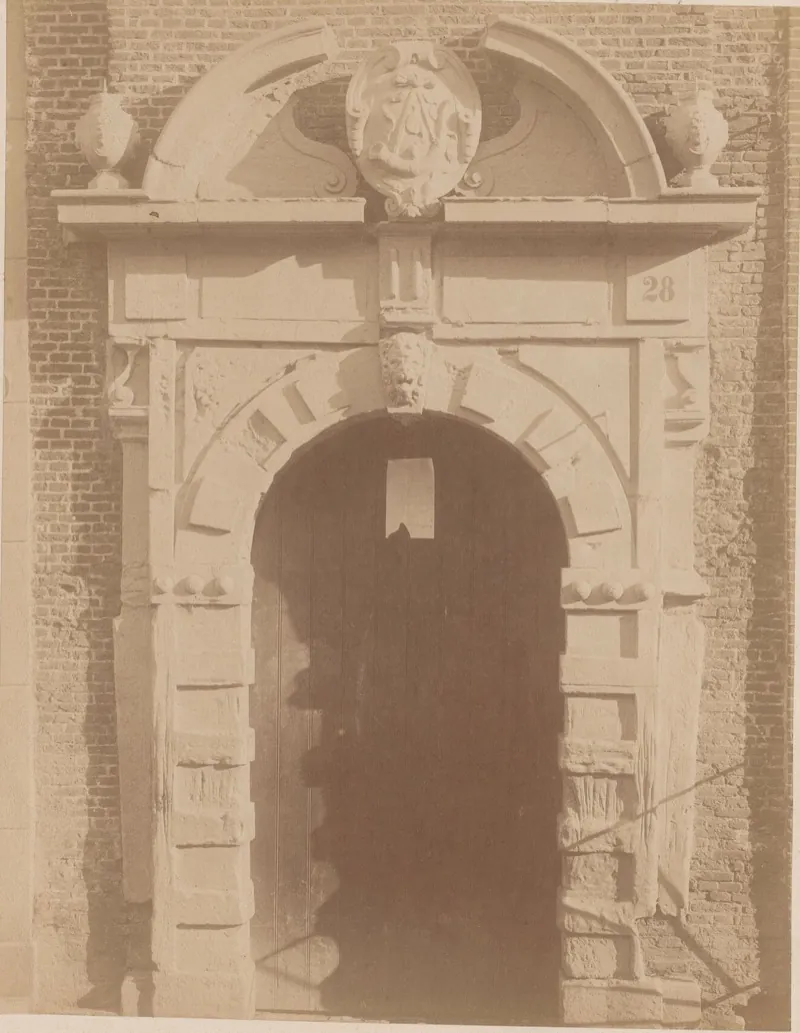
The inscriptions on the gate
- The gate of the Latin School (now the entrance to Claas Stapel’s Hof on the Munnickenveld, national monument 22487) bears two Latin inscriptions and the arms of Hoorn: “CHRISTO DVCE ET AVSPICE CHRISTO”, “With Christ as leader and under Christ’s protection”, and “CAELO MVSA BEAT”, “The Muse grants heaven”. [6], [5]
- The second line comes from Horace, Odes IV 8, line 29: “Dignum laude virum Musa vetat mori, / caelo Musa beat” (the Muse does not let the man worthy of praise die; the Muse blesses him with heaven). We checked the Latin text. So it is a Christian motto with a classical ending, which suits a school where the Christian faith and the Latin poets were taught side by side. [7]
- The inscription is recorded in the Oud Hoorn city walk, which reads the motto as one sentence (“Christ as leader and under Christ’s blessing the Muse brings heavenly happiness”). We did not find it in the national monument register (22487) or in Van Zoonen (2018). The photographs for this page will follow from our own visit. [6], [5], [1]
Where the sources differ on his death
- Van Zoonen (2018), citing the burial register: Cellarius died at the end of 1664 and was buried on December 30, 1664 in rented grave 61. His son Andreas junior was buried on October 21, 1665 in grave 135. [1]
- Van Gent’s article (2000): Cellarius resigned in early 1665, died a few days before November 22, 1665 and was buried on November 21 in a rented grave near the choir of the Grote Kerk; his brother Hendricus was appointed his successor on November 22. [2]
- Van Gent’s website: Cellarius died in February or March 1665 and his grave is unknown; his eldest son Andreas died in November 1665 and was buried in a rented grave near the choir. [3]
- Van Zoonen’s account rests on a burial register and fits the council’s decision of March 14, 1665 to look for a new rector. We have not seen the register ourselves, and we cannot tell whether Van Gent’s article or his website is the later one. So we write: the sources differ; the best-documented date of his burial is December 30, 1664. [1], [2], [3]
What we do not know
- Which of the three accounts of his death is right: we have not seen the burial register (DTB 82) ourselves.
- Why Van Gent gives a salary of 200 guilders and Van Zoonen 800 guilders a year.
- How many pupils the school had in his time: we found no figures.
- Whether “Van Brienen” and “Briemer” are one man: Van Zoonen uses both names for the rector of 1665 to 1668.
- When the inscriptions were added and whether the school chose them itself: none of our sources says.
Sources
- Arie van Zoonen and Jannie van Zoonen-Zielman, Zeshonderd jaar scholen en schoolmeesters in Hoorn 1396–1996, vol. 1 (Vereniging Oud Hoorn and Publicatiestichting Bas Baltus, Hoorn 2018), pp. 135 to 148 (chapters 3.12 and 3.13) We read these pages and their footnotes in the pdf of Oud Hoorn. The town archives (Westfries Archief) and the burial register DTB 82 that it cites, we did not see ourselves.
- R.H. van Gent, “De hemelatlas van Andreas Cellarius: Het meesterwerk van een vergeten Hollandse kosmograaf”, Caert-Thresoor 19 (2000) no. 1, pp. 9 to 25 (scan on Van Gent’s website) The scan has no text layer; we read printed pages 9, 10, 13 and 14 ourselves, not the rest.
- Robert H. van Gent, Andreas Cellarius – Biography (Utrecht University) The web biography carries no date; we cannot say whether it is older or newer than the article.
- Rijksmuseum, Entrance of the former Latin School at Kruisstraat 28 in Hoorn (photograph, November 1893), RP-F-00-2116 Object page read: attributed to Monumentenzorg and possibly A.J.M. Mulder; the file on Wikimedia Commons states CC0.
- Rijksmonumentenregister, no. 22487: Klaes Stapel’s Hof, Munnickenveld 15, Hoorn Register entry read: the gate of the former Latin School was placed there in 1956.
- Oud Hoorn, city walk Religious images: motto above the gate of the Latin School Page read: gives the inscription and a translation. It does not date the inscription.
- Horace, Carmina IV (The Latin Library) Latin text read: ‘Dignum laude virum Musa vetat mori, caelo Musa beat’ is Odes IV 8, lines 28 and 29.
Every statement above carries the number of its source. Read on October 26, 2026. What we could not confirm in a source is left out.