Goseck: what the gates do and do not tell us
Goseck lies in Saxony-Anhalt, above the valley of the Saale. Around 4900 BC a circular ditch was dug there, with two palisades of wooden posts inside it, broken by gates and narrow openings. According to the excavators, two gates point to the rising and the setting of the sun at midwinter. Here we measure those openings ourselves, calculate with the horizon, and test how often something like this happens by chance.
What was found
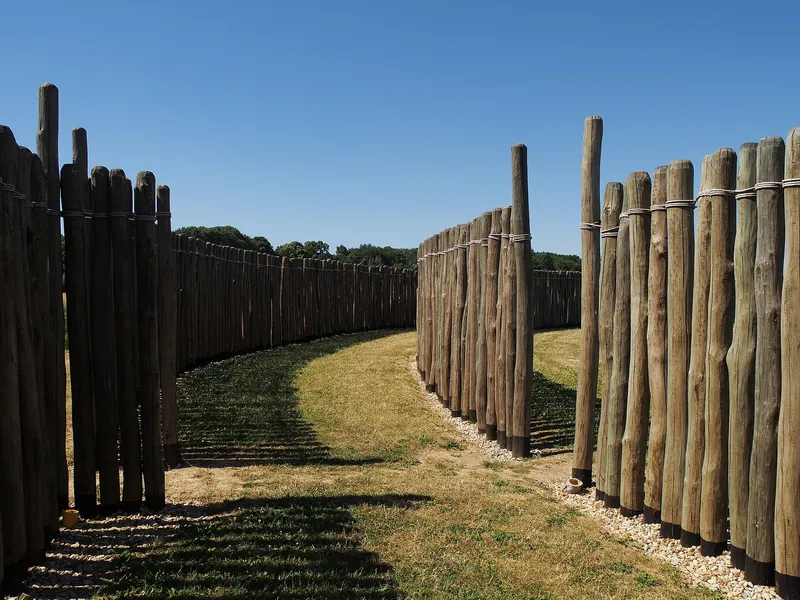
The ditch was at most 75 meters across, V-shaped and about 2 meters wide. According to the eMuseum Himmelswege, the main period of use was between 4900/4850 and 4700 BC; around 4650/4550 BC the ditch was finally filled in. Inside the ditch stood two palisades of wooden posts.
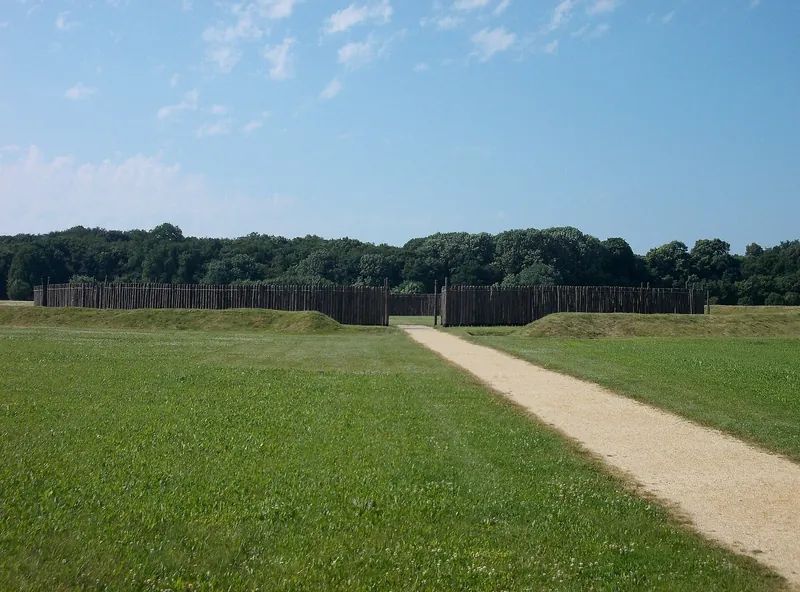
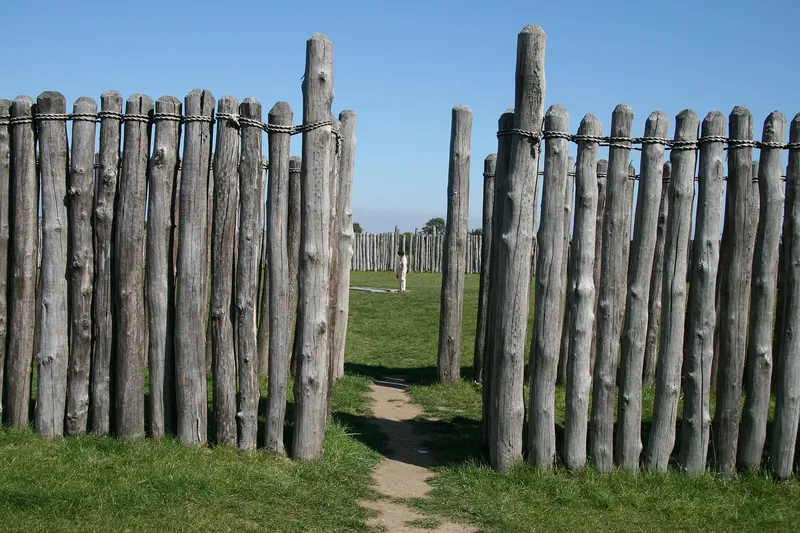
The enclosure was discovered from the air by Otto Braasch and then excavated by the State Office for Heritage Management and Archaeology Saxony-Anhalt (LDA). A reconstruction now stands on the site, for which 1,758 wooden posts were set into the ground. The drawing on this page is our own, made from our measurements; we do not use photographs or plans from the LDA.

See for yourself: the openings and the sky
The drawing shows the two palisades with their openings, drawn from our own measurements, with north at the top. Choose a horizon and which directions you want to see. Drag the observer to see how the windows shift.
Observer at the center
Openings with a hit: 1 of 7.
- north 3.9–10.6°: no hit (nearest: sun, summer solstice, rising, 37.4° off)
- northeast 51.0–52.3°: no hit (nearest: sun, summer solstice, rising, 3.0° off)
- east-northeast 66.3–68.6°: no hit (nearest: sun, April 29, rising, 0.8° off)
- southeast 124.0–126.6°: no hit (nearest: sun, winter solstice, rising, 3.4° off)
- southwest 227.7–231.0°: sun, winter solstice, setting
- west-northwest 295.9–299.1°: no hit (nearest: sun, April 29, setting, 0.4° off)
- northwest 311.4–314.2°: no hit (nearest: sun, summer solstice, setting, 0.5° off)
What we know and what we don't
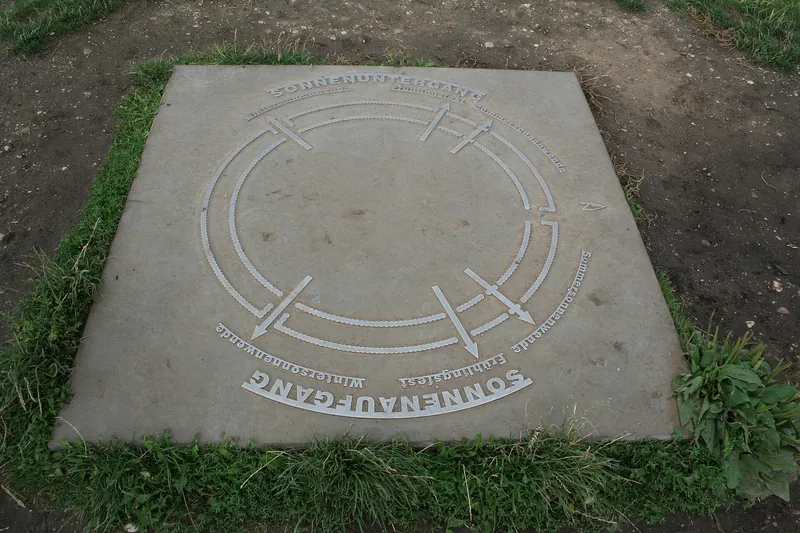
- According to Bertemes and Northe (2007, p. 161), the southeast and southwest gates are aligned on the rising and the setting of the sun at the winter solstice. According to them, Wolfhard Schlosser, taking the shape of the terrain into account, also worked out the other openings: toward the summer solstice and toward April 29.
- The eMuseum Himmelswege writes that the observation point was not at the center but slightly offset to the northwest, and that this made it possible to predict and observe the solstice to within a few days.
- What holds: from the center, the midwinter sunset falls inside the window of the southwest gate, with either horizon (with or without the ridge).
- What does not hold: from the center, the midwinter sunrise lies outside the window of the southeast gate: 3.4° without the ridge, 5.2° with it.
- What does not hold: an observer to the northwest does not make it better. Both midwinter gates work only for an observer 2 to 3 meters northeast of the center.
- We have not read Schlosser's own calculations (2006 and 2008) or the full publication of the excavation (Henkel 2023). They contain his directions, his horizon and his observation point.
Our measurement
We found no published directions for the openings. So we measured them ourselves on the LDA's excavation plan (plan: A. Northe, adapted by N. Henkel), using the plan's scale bar. That plan has no north arrow; on an aerial photograph with true north (DOP20 from the LVermGeo Saxony-Anhalt, taken over the reconstruction), the plan's orientation is correct to within about 1°.
The table gives the window for each opening: the directions in which you look through both palisades from the center, with half a degree of measurement uncertainty on each side. In the west-northwest and the northwest only the outer palisade survives, so the window there is wider.
| Opening | Window from the center |
|---|---|
| north | 3.9–10.6° |
| northeast | 51.0–52.3° |
| east-northeast | 66.3–68.6° |
| southeast | 124.0–126.6° |
| southwest | 227.7–231.0° |
| west-northwest | 295.9–299.1° |
| northwest | 311.4–314.2° |
Two horizons
Where the sun rises depends on how high the horizon is: a higher horizon moves the midwinter sunrise to the south. We calculated the horizon from OpenDTM-DE, a terrain model without buildings and trees, including the curvature of the earth and refraction.
If you leave out the terrain within the first 1.5 kilometers, the horizon in the southeast is 0.34° high: those are the hills across the Saale valley, 4 to 5 kilometers away. The midwinter sun then rises at 130.0°, 3.4° outside the window of the southeast gate.
But 400 to 800 meters to the southeast there is a ridge, about 13 meters higher than the enclosure. With that ridge included, the horizon there is 1.24° high and the sun rises at 131.8°: 5.2° outside the window. So the ridge makes the difference larger, not smaller.
We do not know what that ridge looked like 7,000 years ago. The area is intensively farmed, and soil scientists have studied how the landscape developed, but we have not read their results. That is why we show both horizons.
For the southwest gate it makes little difference: with and without the ridge, the midwinter sunset falls inside the window.
The test: how often does this happen by chance?
Before calculating anything, we fixed what we would test: the seven openings, and as targets the sun (rising and setting at both solstices and on April 29), the Moon at the major and minor lunar standstill, the extreme points of Venus, and the rising and setting of ten bright stars, around 4850 BC (with 150 years before and after). A hit is a target that falls inside the window of an opening.
Then we placed the seven windows, each with its own width, 100,000 times at random positions around the horizon, and each time counted how many openings had a hit. The probability by chance is the proportion of those runs in which at least as many openings had a hit as at Goseck.
| Targets | Openings with a hit at Goseck | Probability by chance | ||
|---|---|---|---|---|
| without ridge | with ridge | without ridge | with ridge | |
| The sun only (6 directions) | 1/7 | 1/7 | 0.387 | 0.388 |
| Moon, Venus and stars (30) | 3/7 | 3/7 | 0.387 | 0.398 |
| Moon, Venus and stars, with visibility (30) | 3/7 | 3/7 | 0.359 | 0.361 |
| All together (54) | 5/7 | 5/7 | 0.08 | 0.08 |
Of the six sun directions, one falls inside an opening from the center: the midwinter sunset in the southwest gate. Four others lie less than one and a half degrees outside a window; the midwinter sunrise lies farthest outside the window of the southeast gate.
The Moon, Venus and the stars produce no more hits than chance. With all 54 targets together, the probability of five or more openings with a hit is about 0.08: with that many targets, almost every opening has something in its window.
An observer away from the center
Afterward, and so not fixed in advance, we looked for where an observer would have to stand for both midwinter gates to work. That is a small area 2 to 3 meters northeast of the center. To the northwest, where the eMuseum places the observation point, the window of the southwest gate turns away from the sunset instead. Try it yourself in the drawing.
If you can choose the observer's position afterward, hits are easier to find. Taking that into account, with the horizon without the ridge, the probability by chance for the four solstice directions is 0.195: nothing exceptional. Only with April 29 added does the probability become small (0.003), but Schlosser assigned that date to exactly these openings, so the target is not independent of what is being tested.
How we calculate
The directions of the openings are our own measurements: on the excavation plan, with the scale from the scale bar, and on the aerial photograph for north and the center (51.198231° N, 11.864632° E). A window is what you see from the observer through the inner palisade (radius 25.3 m) and the outer palisade (radius 29.1 m), with a margin of half a degree on each side.
The horizon comes from OpenDTM-DE (1 meter, averaged to 5 meters for the calculation, 20 by 20 kilometers around the enclosure), with an eye height of 1.6 meters, the curvature of the earth and refraction (k = 0.13). The sun counts as risen at the first glimpse of its upper limb, with refraction according to Bennett.
We calculate the tilt of the earth's axis (from 24.16° to 24.15° between 4999 and 4699 BC) and the positions of the stars with the models of the International Astronomical Union (ERFA) and the Hipparcos catalog; the extreme points of Venus come from the JPL ephemerides DE441. For the Moon at the standstills we add 5.145° to the tilt or subtract it, with parallax and semidiameter.
What we do not know
- What the horizon looked like around 4850 BC, especially the ridge to the southeast.
- Where the observer stood, and whether there was one fixed spot.
- Whether the openings changed over time: the ditch was cleaned out and renewed several times.
- Why Schlosser does find the solstice: his figures are in publications we have not read.
- How precise our directions are: they are our own measurements on a plan and an aerial photograph, with an uncertainty of about a degree at the edges.
- Whether the builders intended the sun: a geometric test says nothing about that.
Sources
- eMuseum Himmelswege, ‘Features’ (the Goseck excavation): dating, ditch, openings in the palisades and the observation point. emuseum-himmelswege.de
- eMuseum Himmelswege, ‘Research history’: the discovery by Otto Braasch, the excavation by the LDA and the land use. emuseum-himmelswege.de
- François Bertemes and Andreas Northe (2007), ‘Der Kreisgraben von Goseck’, in K. Schmotz (ed.), Vorträge des 25. Niederbayerischen Archäologentages, pp. 137–168 (the directions according to Schlosser on p. 161, fig. 14). academia.edu
- Excavation plan of the LDA Saxony-Anhalt (A. Northe, adapted by N. Henkel), as shown by the eMuseum Himmelswege: used only to measure the directions of the openings.
- Digital aerial photographs DOP20 from the LVermGeo Saxony-Anhalt: used only to measure north and the center. lvermgeo.sachsen-anhalt.de
- OpenDTM-DE (opendem.info), 1-meter terrain model based on © 2024 Geodatenportal Sachsen-Anhalt, dl-de/by-2-0: the horizon. opendem.info
- Copernicus GLO-30 (ESA): for comparison with the horizon from OpenDTM-DE. doi.org
- Hipparcos, the new reduction (F. van Leeuwen, 2007), via VizieR; JPL ephemerides DE441; ERFA (IAU SOFA): the stars, Venus and the tilt of the axis. vizier.cfa.harvard.edu
- Not read: Norma Henkel (2023), Die mittelneolithische Kreisgrabenanlage von Goseck; Wolfhard Schlosser (2006), Archäologie in Sachsen-Anhalt NF 4, 2, pp. 282–284; Wolfhard Schlosser (2008), Acta Praehistorica et Archaeologica 40, pp. 57–60.
With thanks to the State Office for Heritage Management and Archaeology Saxony-Anhalt for permission to publish our own drawing of Goseck, and for recommending the sources.
We keep what the sources say separate from what we measure and calculate ourselves. Our calculation is a geometric test, not evidence for or against an intention of the builders.
More monuments
Also available:
- Newgrange (Ireland)
- Maeshowe (Scotland (Orkney))
- Stonehenge (England)
- The Great Pyramid of Giza (Egypt)
- Nabta Playa (Egypt (Sahara))
- Saint-Omer (France)
- Mnajdra (Malta)
Want us to check something?
Do you know of a place said to line up with the Sun, the Moon or a star? A stone circle, a burial mound, a church, an old road? We can calculate whether that holds. We use the same method as on these pages: the real horizon, the sky of the time, and honesty about what we do not know.
Send us:
- the place (coordinates or a map link);
- the direction you measured and how you measured it (did you use a compass? Say so, and we will correct for magnetic declination);
- where you stood when you measured;
- the claim: which body, which event (for example, sunrise at midsummer) and for which period;
- where the claim comes from (a book, article, website or local story).
Do you have photos showing the viewing direction, an estimate of the horizon height or a sketch? Send those too; they help.
Let us know whether we may put your request and the result on the site. We only name you if you want us to.
We check everything, even when the result does not confirm the claim. Then we show the numbers, without judgment of the builders.
Email calculate@cellariushoroscope.com. We cannot promise how quickly we will reply. What we do with your email is described in the privacy statement.