The new star of 1572: Tycho, Kepler and a hole in the Milky Way
On the evening of November 11, 1572, the Danish astronomer Tycho Brahe saw a bright star almost straight overhead, where there had been none before. His measurements showed that it stood far beyond the Moon, among the fixed stars. Thirty years later he wrote that a dark opening could still be seen in the Milky Way at that place. Here we follow the story in the books of Tycho and Kepler themselves.
What the sources say
- Tycho described the new star in 1573 in a small book printed in Copenhagen, De nova et nullius aevi memoria prius visa stella: on the new star, never seen before in anyone's life or memory. [1]
- Thirty years later he treated the star again at length in his Astronomiae instauratae progymnasmata (Prague 1602), a book that is largely built around it. [2]
The evening of November 11
- On November 11, 1572, in the evening after sunset, Tycho was looking at the stars as usual and noticed a new, unusual star close to the point straight above his head, far brighter than the others. He was then staying with his uncle Steen Bille at Herrevad, a royal estate that had once been a monastery, as he writes in the Progymnasmata (p. 298). [1]
- Others noticed the star as well. Cornelius Gemma, whose book about it appeared in Antwerp in 1575, made his own first measurement on November 26. [5]
ANNO PRAECEDENTE, MENSE Nouembrj, die eiusdem vndecimo, vesperi post Solis occasum, cùm meo more sidera coelo sereno contemplarer, nouam quandam & inusitatam, praeque aliis admodum conspicuam, iuxta capitis verticem, animaduerti fulgere Stellam.
Above the Moon
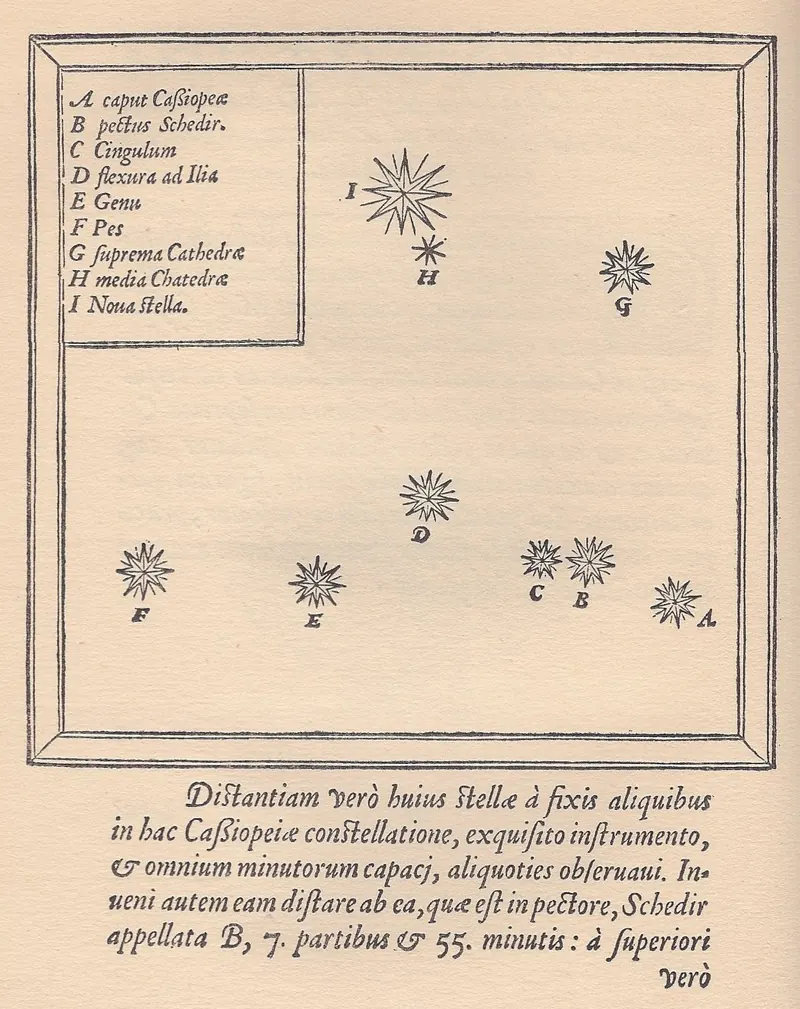
- Tycho measured the distance from the new star to Schedir, the star in the breast of Cassiopeia, once when the new star stood near the zenith and once when it stood near the horizon. Both times he found 7°55′. [1]
- If the star had been close to the Earth, like the Moon, its place among the stars would have shifted between those two moments. That shift is called parallax; for the Moon it amounts to about a degree near the horizon.
- Tycho found no shift. His conclusion: the new star does not stand in the region of the elements below the Moon, nor in the spheres of the seven planets, but in the eighth sphere among the other fixed stars. So it is not a comet, nor any other fiery phenomenon of the air. [1]
- After six months he still found no motion of the star of its own. [1]
… vnde hanc nouam stellam nullam habere aspectus diuersitatem, etiam Horizontj vicinam, concludo.
Quapropter haec stella noua nec in Elementari regione infra Lunam, nec in orbibus septem errantium siderum, sed in octaua sphaera inter reliquas fixas locum habet, Quod erat demonstrandum.
Tycho's map
- In the same book Tycho printed a woodcut map of Cassiopeia (sheet B1v). The letters A to H mark the stars of the figure; the letter I is the new star. Below the map he gives the distance to Schedir: 7 degrees and 55 minutes. [1]
- In 1573 Tycho wrote only that the star stood near the edges of the Milky Way, between Cassiopeia and Cepheus. He did not mention an opening there. [1]
Est itaque locus eius circulo, quem Colurum aequinoctiorum vocant, ferme coincidens: idque iuxta limites viae lacteae, Cassiopeiae, & Cepheo interiectos.
An opening in the Milky Way
- In the Progymnasmata (1602) Tycho went further. In the conclusion (p. 795) he writes that at the place in the Milky Way where the star had stood, an opening could still be seen, about the size of a half Moon, and that he did not remember ever seeing it there before the star appeared. According to him it could be seen on clear winter nights when the Moon was down. [2]
- Tycho used the opening for his theory: the star had formed from the heavenly matter of the Milky Way, and when that matter was used up, an empty place remained. Kepler summarizes the idea in the same way in 1606. [2], [3]
Quin et adhuc hiatus quidam in eo ipso Galaxiae loco cernitur, ubi Stella haec suas sedes obtinuit: idque ad quantitatem quasi semiplenae Lunae … Quem certè hiatum non recordor me unquam anteà, quàm extiterat haec Stella, ibidem deprehendisse.
Fabricius and Kepler
- In a letter to Kepler of January 14, 1605, written in Osteel in East Frisia, David Fabricius gave another explanation: the dark spot was the body of the star of 1572 itself, still there but giving no light. [4]
- Kepler discussed this in his book on the new star of 1604, De stella nova (Prague 1606, p. 103), and referred to page 795 of Tycho. His answer was sober: every empty place in the Milky Way looks like a hole, even where no star ever shone. A dark spot surrounded on all sides by a light rim seems to be a pit; the Greeks called that a chasma. [3]
- Kepler did note that the new star of 1604 also stood at the edge of the Milky Way (pp. 110–111). [3]
Ego puto corpus illius stellae etiamnum istic permanere, nisi quod non luceat.
Illud diligenter considerare jubeo, omnem in via lactea lacunam, hiatum videri; etsi nulla unquam ibi stella fulserit.
What is there now
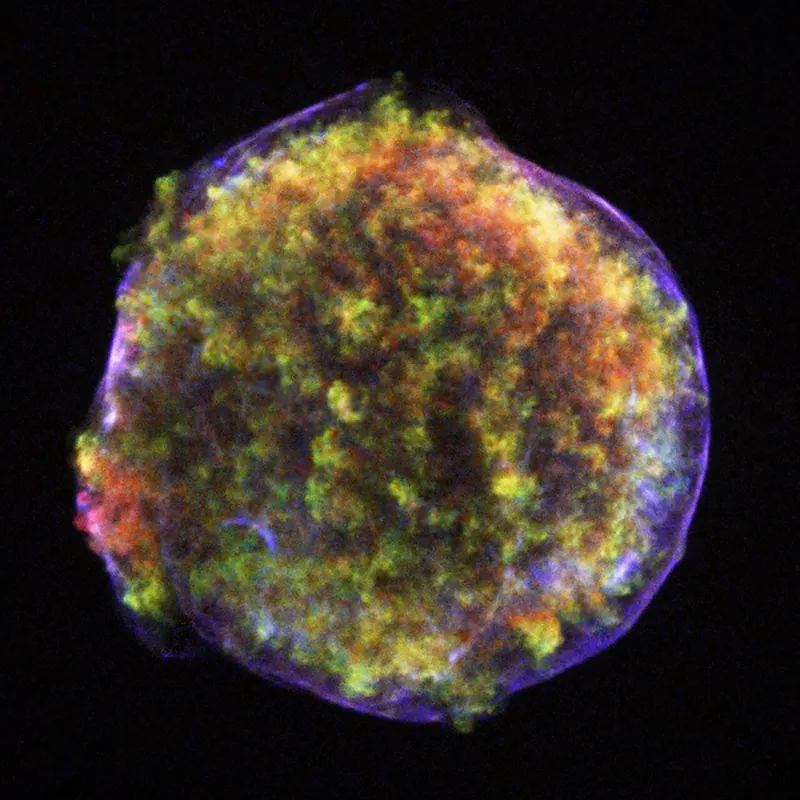
- Today the star of 1572 is known as a supernova, and its remains as Tycho's supernova remnant. The Chandra X-ray Observatory observed the expanding cloud of hot gas for 41 hours in April 2003; according to Chandra it lies about thirteen thousand light years away. [6]
- The place lies in Cassiopeia, which never sets as seen from the Netherlands. [6]
In the atlas of Cellarius
- In the Harmonia Macrocosmica (1660) Andreas Cellarius drew the world system of Tycho, with the Earth at the center, the Sun and the Moon around it, and the other planets around the Sun. One of those plates is the Planisphaerium Braheum. [7]
What we do not know
- Did others see the star earlier? Cornelius Gemma (1575) writes that those who wanted to be first gave November 9, that some noted November 2 or 3, and that many said ordinary people saw it even before the end of October; his own first measurement is of November 26. We have not checked these reports.
- What did Tycho really see as an opening? Kepler already doubted it, and we have not looked for a modern explanation of the dark spot.
- What does M. A. Granada write about the opening in his chapter on Kepler and Fabricius (2011)? We could not read the chapter itself.
- Does the map from the facsimile of 1901 shown here match the original of 1573 in every detail? We have not compared them line by line.
Sources
- Tycho Brahe, De nova et nullius aevi memoria prius visa stella (Copenhagen: Laurentius Benedicti, 1573), copy of the Royal Danish Library Read on the scan: sheets A1r, B1v, B4v, C1v and C4r.
- Tycho Brahe, Astronomiae instauratae progymnasmata (Prague 1602), Frankfurt title issue of 1610 with the same sheets, copy of the Biblioteca Nazionale Centrale di Firenze Read on the scan: pp. 298 and 795.
- Johannes Kepler, De stella nova in pede Serpentarii (Prague: Paulus Sessius, 1606), Bavarian State Library Read on the scan: pp. 103 and 110–111.
- Johannes Kepler, Gesammelte Werke, vol. XV: Briefe 1604–1607, ed. Max Caspar (Munich 1951), Bavarian Academy of Sciences Letter no. 319, David Fabricius to Kepler, January 14, 1605, p. 118.
- Cornelius Gemma, De naturae divinis characterismis (Antwerp: Plantin, 1575), copy of the Getty Research Institute Read on the scan: book II, chapter III, pp. 113–114.
- Chandra X-ray Observatory, Tycho's Supernova Remnant (2005) Observation of April 29, 2003, distance and image.
- Andreas Cellarius, Harmonia Macrocosmica (Amsterdam 1660), Planisphaerium Braheum, Stanford University Libraries We used the Planisphaerium Braheum in the Stanford copy. We checked the titles of the plates of Cellarius that show Tycho's system in the Rijksmuseum copies on Commons.
Every statement above carries the number of its source. Read on November 18 and 19, 2026. The translations of the Latin are our own. What we could not confirm in a source is left out.