Other traditions
Vedic Astrology (Jyotisha)
Jyotisha is the Indian tradition of reading the sky. The word comes from jyotis, "light" or "luminous body". This page explains how it measures the zodiac, what the nakshatras and grahas are, and where we calculate things ourselves.
What the word covers
In the tradition, Jyotisha covers both what we would call astronomy, the calculation of positions and calendars, and astrology, the interpretation of the sky. It is usually described in three branches: Siddhanta (mathematical astronomy and the calendar), Samhita (general phenomena and omens) and Hora (the birth chart and its interpretation).
On this site we describe the tradition and calculate positions. When we mention what something is said to mean, we write "according to the tradition". We do not present astrology as science and we do not make predictions.
Sidereal signs: the rashi
Vedic astrology uses the sidereal zodiac. The zero point of the first sign, Mesha, is fixed against the stars with an ayanamsa, and each of the twelve rashi is an equal 30° from there. We use the Lahiri (Chitrapaksha) ayanamsa, the standard in India; it places the star Spica (Chitra) at 180°. It was 24°13′ on January 1, 2026.
That is why your Sun sign often differs from the Western one: for about the first 24 days of a tropical sign the Sun is, in the sidereal zodiac, still in the previous sign. In the Vedic tradition the Moon sign and the Moon's nakshatra weigh more than the Sun sign.
- मेष Meṣa (Aries)
- वृषभ Vṛṣabha (Taurus)
- मिथुन Mithuna (Gemini)
- कर्क Karkaṭa (Cancer)
- सिंह Siṃha (Leo)
- कन्या Kanyā (Virgo)
- तुला Tulā (Libra)
- वृश्चिक Vṛścika (Scorpio)
- धनु Dhanus (Sagittarius)
- मकर Makara (Capricorn)
- कुम्भ Kumbha (Aquarius)
- मीन Mīna (Pisces)
The ring of the zodiac
The ring shows the twelve rashi on the outside and the 27 nakshatras inside, numbered from 1 (Ashvini), with 0° at the top. The stars are six well-known yogatara, the stars the tradition links to a nakshatra, at their sidereal longitude on January 1, 2026 with the Lahiri ayanamsa.
Not all of them lie in the part of the ring that carries the number of their nakshatra. In our calculation Aldebaran (Rohini, 4), Regulus (Magha, 10) and Spica (Chitra, 14) do. Betelgeuse (Ardra, 6) lies 1.8° short of the start of its nakshatra and so in Mrigashira (5), Arcturus (Svati, 15) lies 6.3° short and so in Chitra (14), and Antares (Jyeshtha, 18) lies 0.8° short and so in Anuradha (17). The equal division and the traditional identification of the stars do not line up exactly. We draw only these six, because for the other nakshatras the sources disagree on which star it is.
The 27 nakshatras
The Moon's path is divided into 27 nakshatras of 13°20′, each with four padas. The nakshatra the Moon was in at your birth is called the janma nakshatra, and it also decides where the dasha system begins. You can find yours with the calculator.
Enter your birth details and see the nakshatra, the pada and the sidereal signs.
The nine grahas
The traditional list has nine grahas: the Sun, Moon, Mars, Mercury, Jupiter, Venus and Saturn, plus Rahu and Ketu. Rahu and Ketu are not bodies. They are the ascending and descending node of the Moon's orbit, the points where it crosses the ecliptic, the path of the Sun. Practice differs on whether to use the mean node or the true node; we use the mean node by default.
- Sun · Sūrya
- Moon · Candra
- Mars · Maṅgala
- Mercury · Budha
- Jupiter · Bṛhaspati (Guru)
- Venus · Śukra
- Saturn · Śani
- Rahu · Rāhu
- Ketu · Ketu
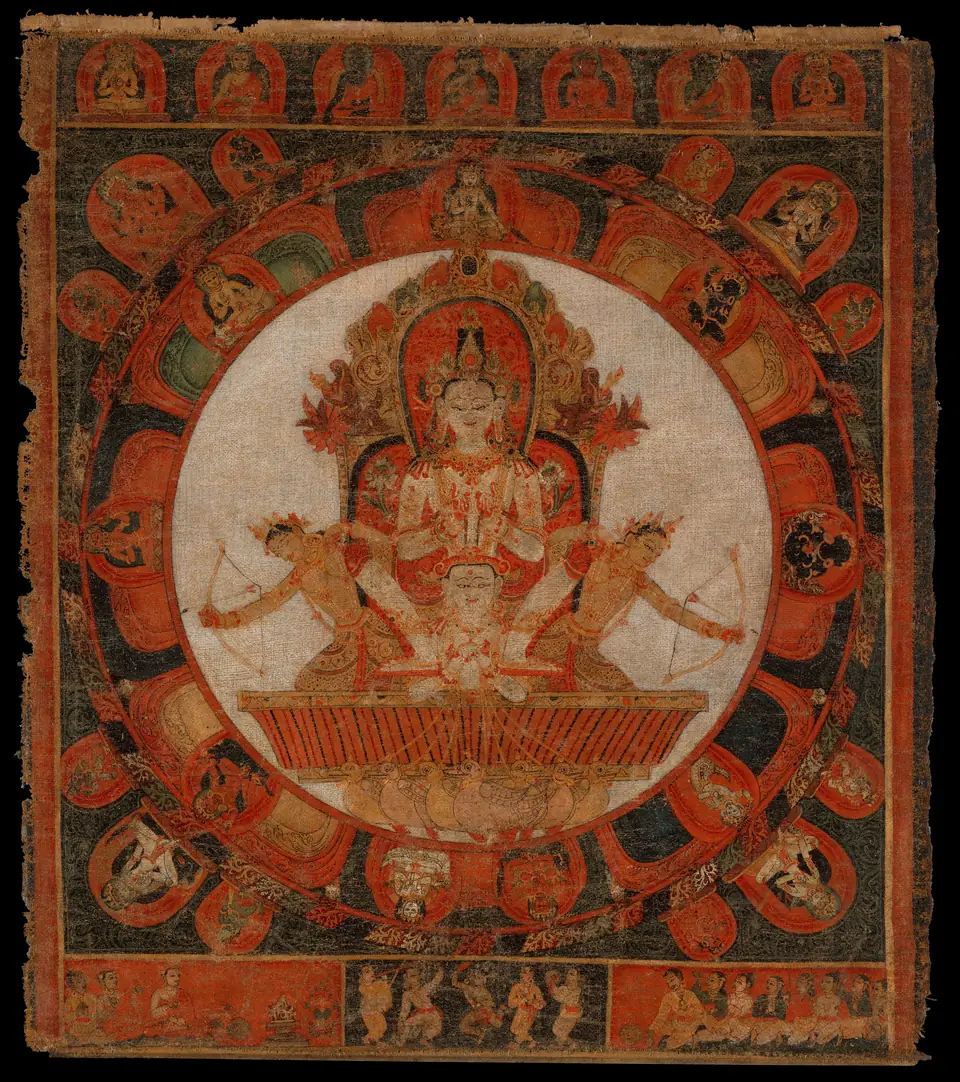
Vimshottari dasha
The best-known timing system is the Vimshottari dasha: a cycle of 120 years divided among nine lords in the order Ketu, Venus, Sun, Moon, Mars, Rahu, Jupiter, Saturn and Mercury, with periods of 7, 20, 6, 10, 7, 18, 16, 19 and 17 years. According to the tradition, the cycle begins with the lord of the Moon's nakshatra at birth. The same sequence of nine lords runs three times through the 27 nakshatras. We do not calculate dasha periods yet.
What we leave out
We do not offer compatibility scores such as Guna Milan, and we do not interpret the chart as a prediction. The traditions around marriage and fate are part of a living culture, and we would rather give you the positions and the sources than a verdict.
Sources and further reading
- Kim Plofker, Mathematics in India (Princeton University Press, 2009).
- David Pingree, Jyotiḥśāstra: Astral and Mathematical Literature (Otto Harrassowitz, 1981).
- Ebenezer Burgess, Translation of the Sûrya-Siddhânta, Journal of the American Oriental Society 6 (1860), pp. 141–498 (public domain).