Comets over Holland
In the seventeenth century a comet was a sign from God: a rod of punishment, a call to repentance. A hundred and fifty years later its orbit was being calculated. This page follows that change in Holland, starting with the two comets that stood over Hoorn in November 1618.
Reports of 23 comet appearances in Europe have come down to us from the seventeenth century (Verkuyl, p. 31). Early in that century scholars in the Dutch Republic already argued that a comet is a body in the sky that follows a regular path. Even so, it long remained 'a disastrous sign from God, a harbinger of all kinds of misfortune', as Marijke Meijer Drees sums it up (p. 237).
1618: two comets over Hoorn
In November 1618 two comets appeared in the sky one shortly after the other. The first grazed the Sun on November 8; from Hoorn at most a low tail could be seen before sunrise. The second, much larger, appeared in the southeast at the end of November and stayed visible for weeks. It moved from Libra toward the tail of the Great Bear. The chronicles mix the two up.
Velius: 'appeared here'
Anno 1618. den 18. November / verscheen hier een vreeselijke Comeet / dewelke staende in 't Oosten / sijn steert (die uptermaten lang was) naer het Westen toe was strekkende. Hy begon 's Morgens ten vijf uren / en scheen voorts tot aen den Dageraed toe.
On November 18, 1618, a terrible comet appeared here. It stood in the east, and its tail, which was exceedingly long, stretched toward the west. It began at five in the morning and shone on until daybreak.
Which of the two did Velius mean? Probably the large one, with a date in the Old (Julian) Style: November 18 Old Style is November 28 in our calendar. At five o'clock the head is then just below the eastern horizon, the tail already reaches some 47 degrees high, and the comet stays for weeks. Read the date in the New Style, which Holland had used since 1583, and it can only have been the low tail of the first comet. That the dates from Coevorden, Hoorn and Groningen fit together in the Old Style (November 16, 18 and 19) makes the Old Style the most likely.
The professor in Groningen
Nicolaus Mulerius, professor at Groningen, described the comet in his Hemelsche Trompet ('Heavenly Trumpet') before 1618 was out. He followed it with instruments and dated in the Old Style, as Groningen still did at the time.
Dese grote Comeet hebben wy voor de eerste mael gesien den 19. Novembris oude stijls, smorgens te ses uyren staende int Suydoosten dicht by de sterren vande Waechschael, in signo Scorpij
We first saw this great comet on November 19 Old Style, at six in the morning, in the southeast, close to the stars of Libra, in the sign of Scorpio.
gaende over de 64 graden in 18. dagen tijts, alle daghen 3. ofte 4. graden winnende op haer cours van N. Noordwest. Haer voorschijnsel was langh 54. graed. ofte meer
It covered more than 64 degrees in 18 days, gaining 3 or 4 degrees each day on its course to the north-northwest. Its tail was 54 degrees long or more.
We recalculated this with the modern orbit. On December 8 Old Style, Mulerius says, the comet stood 'in a straight line between the front horse of the wagon and the shoulder of Boötes' (p. 13). For December 18 in our calendar that is right to a fraction of a degree; on December 8 New Style the comet would be 9 degrees off that line. His November 19 Old Style is November 29 in our calendar: at six o'clock the comet is then 10 degrees high in the southeast, in Libra. Only his speed, 64 degrees in 18 days, is about a fifth too high.
Fire in Coevorden
Die hooghgheleerden Man Ioannes Vossius Doctor inde Medecynen binnen Coevorden, schrijft dat de Wacht aldaer dese Comeet gesien heeft den 16. Novembris, ende eer niet. Int opgaen was se root ende glandich als een vuyr, also dat de wacht meende datter ergens brant ware.
The most learned Ioannes Vossius, doctor of medicine at Coevorden, writes that the watchmen there saw this comet on November 16, and not before. As it rose it was red and glowing like a fire, so that the watchmen thought there was a fire somewhere.
This too is probably Old Style: November 26 in our calendar, when the great comet rose low and red in the southeast. On the first morning, November 27, Willebrord Snellius in Leiden saw the same glow before sunrise, as if a hut were burning in the distance (Descriptio cometae, 1619, p. 5). That Coevorden still reckoned in the Old Style in 1618 we have not yet been able to confirm from a source.
On the Old and New Style in the Dutch Republic: Two calendars in one Republic →
Twisck in Hoorn: what he copied and what is his own
Pieter Jansz. Twisck of Hoorn described the comet six years later in his Comeet-Boecxken ('Little Comet Book', Hoorn 1624, pp. 110–111). Almost all of it he copied from Mulerius, sometimes word for word: the path, the 64 degrees in 18 days, the tail of 54 degrees, the watch at Coevorden and Vossius. He does name Mulerius on the same page, but only for another comet, that of 1607.
| Mulerius, Groningen 1618 (p. 11) | Twisck, Hoorn 1624 (pp. 110–111) |
|---|---|
| hebben wy voor de eerste mael gesien den 19. Novembris oude stijls | die wy selve meer dan eenmael met Wijf en kinderen ghesien hebben / staende in 't Zuydt-Oost |
| Int opgaen was se root ende glandich als een vuyr, also dat de wacht meende datter ergens brant ware | In 't opgaen was hy roodt ende glandigh als een vyer/ alsoo dat de wacht te Coevoorden meende […] datter brandt ware |
| gaende over de 64 graden in 18. dagen tijts, alle daghen 3. ofte 4. graden winnende | gaende over de 64. graden / in 18. daghen tijdts/ alle dagen drie ofte vier graden winnende |
| Haer voorschijnsel was langh 54. graed. ofte meer | haer voorschijnsel was 54. graden ofte meer |
Twisck's own are:
- that he saw the comet 'more than once with wife and children' ('meer dan eenmael met Wijf en kinderen'), where Mulerius writes about his own first sighting;
- the tail 'like a rod' ('roedts maniere');
- the note in the margin 'therefore something special may well befall us now' ('daerom mocht ons nu wel wat bysonders voorvallen');
- the 'High German historian' Sigismundus, who is said to have seen the comet 'from November 9 to December 24'.
According to Penner (1971), Twisck already wrote in 1620, in his Chroniick (vol. II, p. 1771), that he saw the comet with his family; we have not seen that original. His verdict is elsewhere in the booklet: the comet of 1577 'might well have been called the Star with the rod', just like this one (p. 99).
The path, recalculated
The chart shows where the head of the great comet stood each morning at five o'clock, seen from Hoorn, from November 26 to December 26, 1618, New Style. Every five days the direction of the tail is drawn, away from the Sun. The comet runs as Twisck and Mulerius write: 'from the Scales straight to the tail of the Great Bear'. Snellius in Leiden measured five positions (Descriptio cometae, p. 14); they lie within 2 degrees of this path.
Our own calculation: orbit of C/1618 W1 from the catalog of Marsden and Williams (JPL), Sun and Earth from DE441; stars from the Yale Bright Star Catalogue. East is to the left, as in the sky.
Mulerius's figure lived on for a long time. In 1692 Balthasar Bekker gives the same 64 degrees in 18 days (Ondersoek, p. 17) and asks: 'What comet has the world ever seen whose tail surpassed that of the years 1618 and 1681?' (p. 19).
Twisck summed up his verdict in a short verse in his Chroniick (vol. II, 1620, p. 1773). We know it only as Penner (1971) quotes it; we have not seen the original.
'Tis genoech voor ons te weten, / Dat de steerten der Comeeten / Voor ghewis ons beelden af / Teyckens van des Heeren straf.
It is enough for us to know that the tails of the comets surely show us signs of the Lord's punishment.
What is still open
- Which comet Velius meant. Probably the large one, with a date in the Old Style.
- Whether Coevorden reckoned in the Old Style in 1618. Probably, but not yet confirmed from a source.
- Who 'Sigismundus, a High German historian' is. His November 9 fits the first comet, his December 24 the second.
- The comet that Mulerius and Twisck mention in the summer of 1618, 'between St John's and St James's day'. No known comet orbit fits it.
A pamphlet from Middelburg
Elsewhere in the Republic the pamphlet Aenmerckinghe op de tegenwoordige steert-sterre ('Observation on the present tailed star', Middelburg, 1618–1619) appeared, attributed to Jacob Cats, with the print below after a design by Adriaen van de Venne. In it, comets are signs of God's punishment (Spies, p. 124). A poem from the same time links the comet to the Synod of Dort (Alberdingk Thijm, pp. 123–124).
1624: the aftermath in Hoorn
Twisck wrote his Comeet-Boecxken in 1624, and that was a hard year for Hoorn. In late summer there were fevers and sickness in most houses 'in our native town of Hoorn', at first without many deaths; then dysentery, 'taking away about a hundred persons a week' (pp. 125–126). Twisck fears it will turn into plague, and he wonders whether this is 'the working of this terrible comet', which 'has not yet run its course' (p. 126). Noordegraaf and Valk also call 1624 a plague year (p. 107).
He closes the year with 'a special kind of fish, caught at the Neck outside Hoorn', with 'two protruding open bow guns': in the fish he sees a warship, another omen (p. 126).
1664: Amsterdam
In December 1664 Amsterdam saw a new comet. A sheet from the printer Paulus Matthysz reports:
tot Amsterdam is deselve gesien in 't zuyden, op den 21 December, des morgens ten vijf en ses uuren; op den 27. dito des morgens ten 1, 2, en 3 uuren
In Amsterdam it was seen in the south, on December 21 in the morning at five and six o'clock, and on December 27 in the morning at one, two and three o'clock.
We recalculated it: on December 21 at half past five the comet stood 11.6 degrees high in the south over Amsterdam, and on December 27 at two o'clock 9 degrees high, due south. The sheet is right. “What this will mean, God knows,” it also says (p. 34).
The sheet carries a poem by the Amsterdam poet Six van Chandelier:
Men siet verbaast van verre / Haar ooster schorpioen, die bleek gestaarte sterre, / Die duisend mylen lang / Haar straalen uitschiet, naa des sonnen ondergang, / Voorspellende veel roeden, / Waar van dat meenich kroon, en Holland licht zal bloeden.
One sees, amazed, from afar her eastern scorpion, that pale tailed star, which shoots her rays a thousand miles long after sunset, foretelling many rods, from which many a crown, and perhaps Holland, will bleed.
Its meaning was disputed; at least eight pamphlets appeared in the Republic about this comet (Meijer Drees, p. 237). For Voetius and his followers a comet was 'a warning signal from almighty God', from which people should not derive precise events (p. 238). In the plague year it was taken as a bad omen (Noordegraaf and Valk, p. 108).
1680: from the rod to praise of the Creator
At the end of 1680 'a comet appeared over almost all of Europe, whose tail at times covered about 70 degrees' (Van der Aa, p. 281). On December 22 it was drawn over Beverwijk, with the tail standing like a column above the horizon. Jan Luyken later etched a crowd looking at the comet.
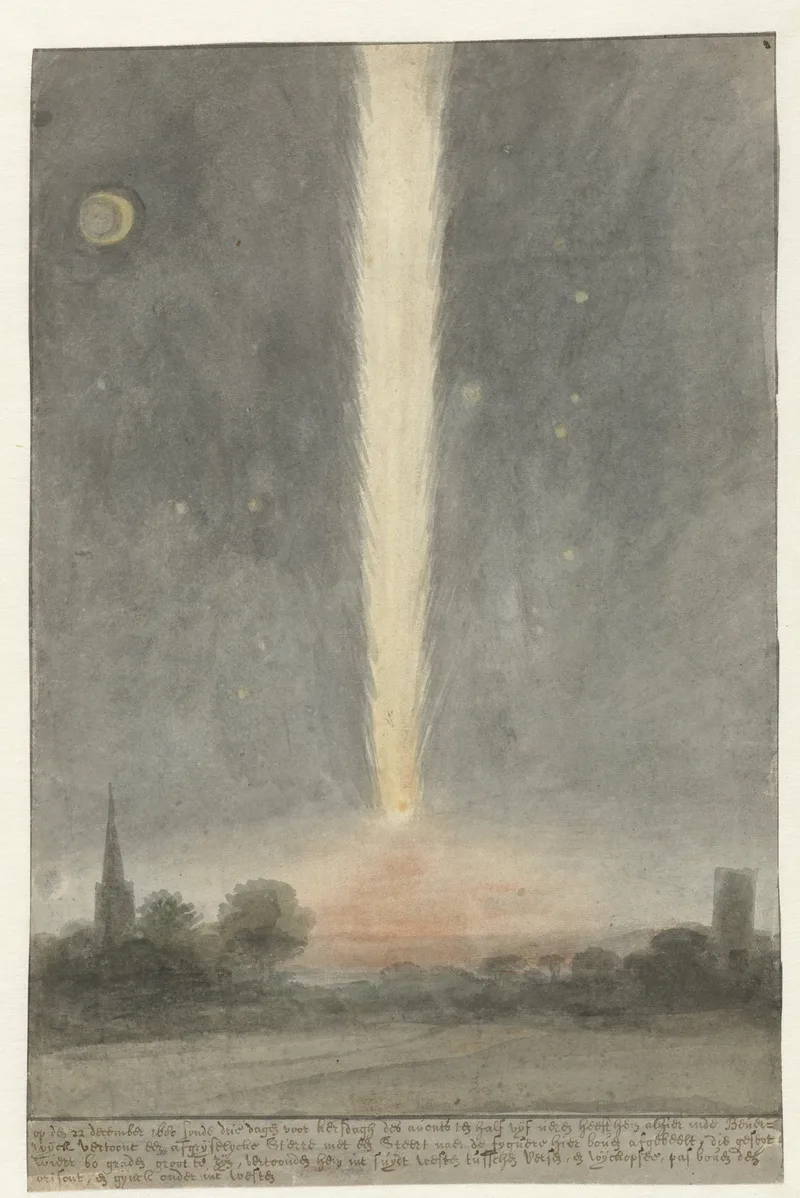
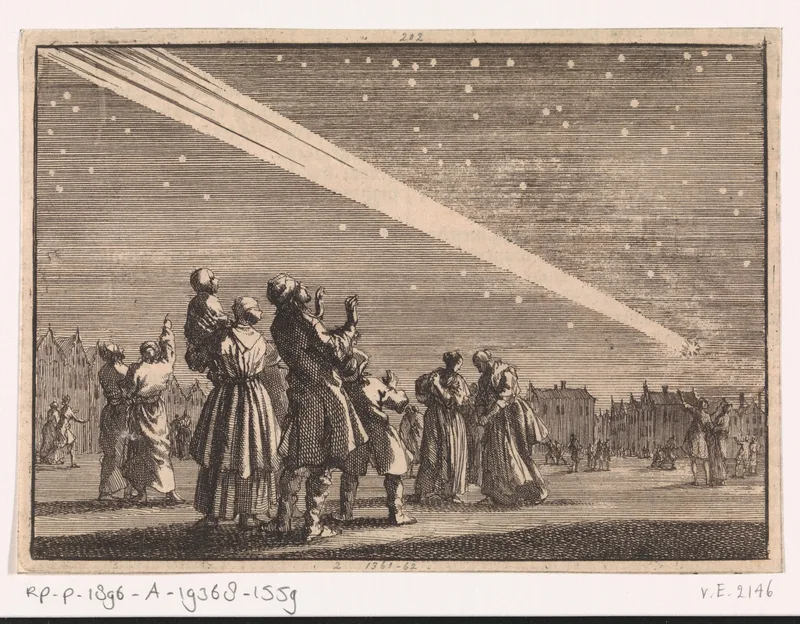
The Amsterdam minister Balthasar Bekker wrote a book about it, the Ondersoek van de betekeninge der kometen ('Inquiry into the meaning of comets', 1683). Comets, he argued, are not harbingers of good or evil, but bodies in the sky that the Creator has subjected to 'fixed, constant laws', as Van der Aa summarizes (p. 281). He watched himself, with his children:
Mijne kinderkens / niet geen vooroordeel ingenomen zijnde / verheugden sigh over het aanschouwen van de Staarster / en die konden nauwelikx gerust te slapen gaan sonder die eerst te sien. Voor my ik beschouwd deselve met vermaak en verwondering / tot heerlikheid des Scheppers; gelijk David Psal. 8.
My little children, who had taken in no prejudice, rejoiced at the sight of the tailed star and could hardly go to sleep in peace without seeing it first. For my part, I looked at it with pleasure and wonder, to the glory of the Creator, as David did in Psalm 8.
Twisck and Bekker were both believers, and both watched with their families. For Twisck the comet was a rod, a call to repentance. For Bekker it was a reason to praise the Creator. Bekker was attacked for it, among others by Jacobus Koelman, who quoted Bekker's sentence in shortened form: without the children who would not go to sleep, and without 'wonder, to the glory of the Creator' and Psalm 8 (De Gids, 1866, pp. 37–38).
1744: through the telescope
The comet of 1744 was observed through a telescope in Leiden. The print by Johannes de Groot (II) shows it above a farmhouse, with at the top the comet as it was seen on February 16, 1744, in the observatory in Leiden 'with Newton's telescope', as the Rijksmuseum describes it.
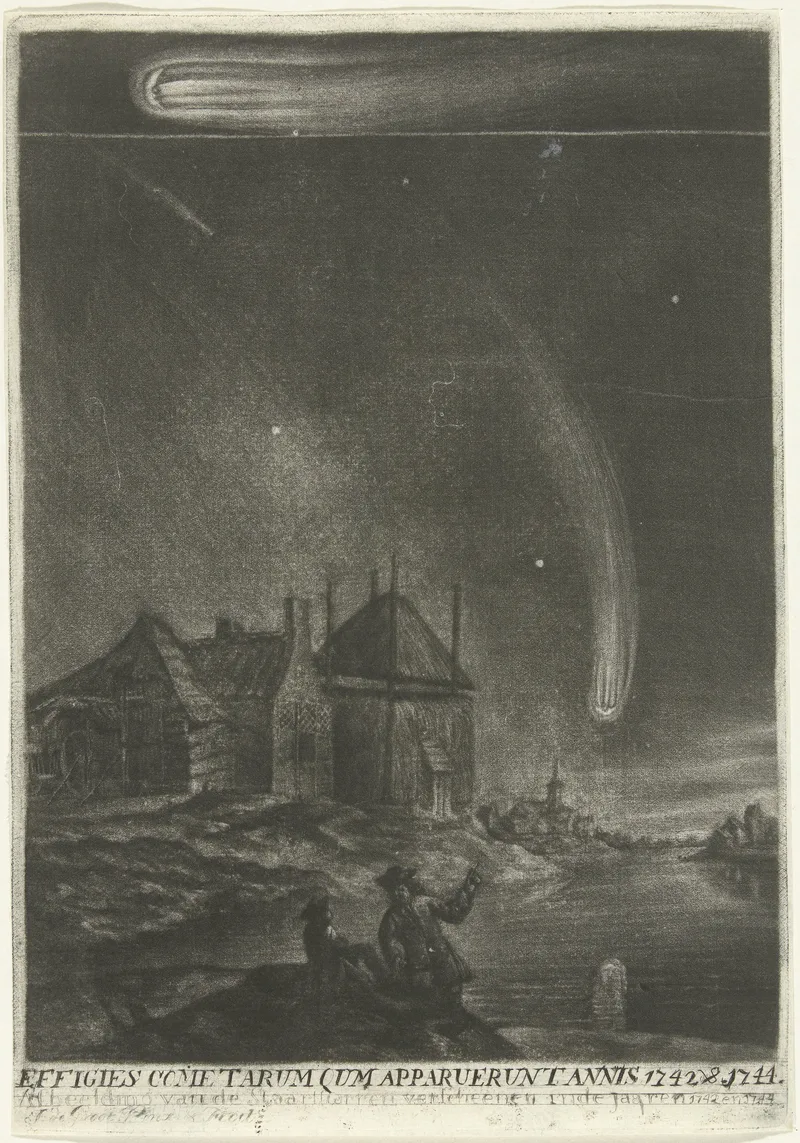
The poet Petronella Johanna de Timmerman wrote a poem on this comet. In it, according to the editors of Met en zonder lauwerkrans, she expresses her trust in the calculations that can describe the comet's place and path, and rejects all superstition about such bodies (p. 585). Her cousin praised her for having freed 'the whole land from star-divining' ('al 't land voor starrewichlarij', p. 585).
How we calculate
The orbits come from the catalog of Marsden and Williams (Smithsonian Astrophysical Observatory), via JPL's Small-Body Database: parabolic orbits with rounded figures. Sun and Earth come from JPL's DE441 ephemeris. For comets of four centuries ago the orbits are uncertain; positions may be off by a few degrees. Dates are in the New (Gregorian) Style unless 'Old Style' is stated.
Sources
- Theodorus Velius, Chronyk van Hoorn, edition with notes by Sebastiaan Centen (Hoorn 1740), p. 569 (Bavarian State Library). digitale-sammlungen.de
- Nicolaus Mulerius, Hemelsche Trompet Morgenwecker, ofte Comeet met een Langebaert (Groningen 1618), ch. IV, pp. 10–13 (DBNL). dbnl.org
- Pieter Jansz. Twisck, Comeet-Boecxken (Hoorn 1624), pp. 99, 110–111 and 125–126; copy of the University of Amsterdam (Allard Pierson).
- Archie Penner, Pieter Jansz. Twisck (PhD thesis, University of Iowa, 1971): the verse and Chroniick II pp. 1771 and 1773 (not seen ourselves). iro.uiowa.edu
- Willebrord Snellius, Descriptio cometae (Leiden 1619), pp. 5–7 and 14 (Bavarian State Library). digitale-sammlungen.de
- Balthasar Bekker, Ondersoek van de betekeninge der kometen, 2nd edition (Amsterdam 1692), pp. 17 and 19.
- P.E.L. Verkuyl, 'Een dichterlijk pamflet naar aanleiding van de komeet van 1664', Tijdschrift voor Nederlandse Taal- en Letterkunde 112 (1996), pp. 31–40 (DBNL). dbnl.org
- Marijke Meijer Drees, 'Godt doet groote dingen, ende wij en begrijpense niet', Nederlandse Letterkunde 9 (2004), pp. 237–242 (DBNL). dbnl.org
- Leo Noordegraaf and Gerrit Valk, De gave Gods. De pest in Holland vanaf de late middeleeuwen (1990), pp. 107–108 (DBNL). dbnl.org
- M. Spies, review of Aenmerckinghe op de tegenwoordige steert-sterre, De Zeventiende Eeuw 2 (1986), p. 124 (DBNL). dbnl.org
- J.A. Alberdingk Thijm, Gedichten uit de verschillende tijdperken der Noord- en Zuid-Nederlandsche literatuur, vol. 2 (1852), pp. 123–124 (DBNL). dbnl.org
- A.J. van der Aa, Biographisch woordenboek der Nederlanden, vol. 2 (1854), p. 281 (DBNL). dbnl.org
- De Gids 30 (1866), pp. 37–38 (DBNL). dbnl.org
- Met en zonder lauwerkrans. Schrijvende vrouwen uit de vroegmoderne tijd 1550–1850, pp. 585–586 (DBNL). dbnl.org
- JPL Small-Body Database (orbits of C/1618 W1 and C/1664 W1, catalog of Marsden and Williams) and the DE441 ephemeris. ssd.jpl.nasa.gov