The history of the compass
The compass began in China, and there it pointed south. This page follows the oldest texts: a word, a spoon we are unsure about, the geomancers’ needle, the deviation Shen Kuo wrote down, and the compass at sea. Then the first sources in Europe.
A needle that points south
A compass needle has two ends. In China people read the end that points south: a compass there is still called 指南針, “needle that points south.” In Europe people read the north end.
The needle almost never points exactly to true north or south. The difference is called magnetic declination, or variation. It differs from place to place and changes over time. How seamen measured it in Hoorn is told on The Golden Compass of Hoorn.
Sinan: a word older than the compass
The oldest word is sinan (司南), “what indicates the south.” It already appears in the Han Feizi, a book on government from the third century B.C.:
故先王立司南以端朝夕。
Therefore the former kings set up a sinan to fix east and west.
That is an image for the law: a ruler needs a fixed direction. An old commentary in the edition of the Siku quanshu says that the sinan here is the south-pointing chariot. A compass is not mentioned. The Guiguzi also uses the word: the people of Zheng took “the chariot of the sinan” with them when they went to fetch jade, so as not to lose their way.
In the first century A.D., the philosopher Wang Chong wrote in the Lunheng:
司南之杓,投之於地,其柢指南。
The spoon of the sinan, placed on the ground, points south with its foot.
Wang Chong gives this as an example of something that points by its own nature. Whether it was a spoon of lodestone is disputed. No working spoon from that time has been found; the spoon on a board shown in museums is a twentieth-century reconstruction. According to the historian Wen Renjun (2017, in a newspaper article), “ground” (地) should read “basin” (池): a basin of mercury in which the spoon turned. We have not read his book.
The geomancers’ needle
In 1044 a military handbook, the Wujing zongyao, describes a small iron fish. You heat it red-hot and let it cool in water with its tail toward the north. Then it floats in a bowl of water and points south. The army used it when it was dark or cloudy.
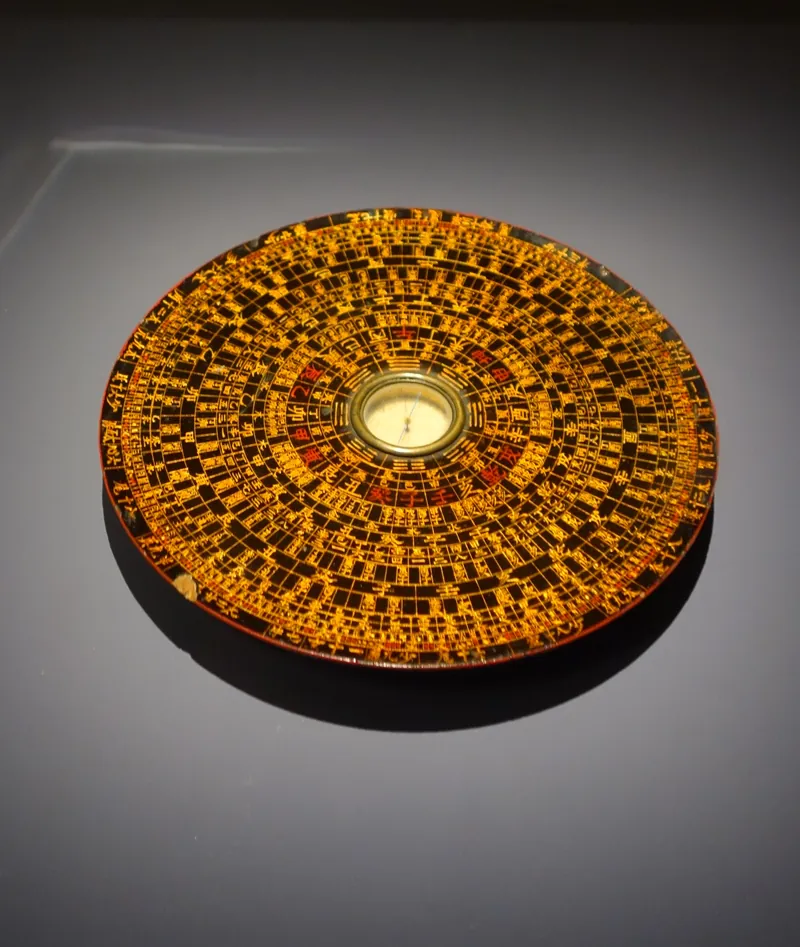
About forty years later Shen Kuo writes that “experts” (方家) magnetize needles. That they were geomancers is the usual reading; Shen Kuo does not say so himself. Geomancers (堪輿, kanyu), known in the West as feng shui, believed that the position of houses and graves in relation to the directions brings good or bad fortune. Later they used a compass board with many rings for this, the luopan. That the position makes a difference is a belief; it has not been shown.

Shen Kuo: the needle deviates
The scholar Shen Kuo wrote the Mengxi bitan at the end of his life, around 1088, a book of short pieces on all kinds of subjects; he died in 1095. In it, he writes:
方家以磁石磨針鋒,則能指南,然常微偏東,不全南也
The experts rub the point of a needle with a lodestone; then it can point south. But it always deviates a little to the east and does not point fully south.
Shen Kuo compares four ways to let the needle turn. Floating on water, it sways a lot. On a fingernail or on the rim of a bowl it turns easily, but falls off just as easily. Best is to hang it from a single silk thread, fixed with a bit of wax the size of a mustard seed. He also has needles that point north, and he writes that no one can find the reason.
floating
on a nail
on a bowl
on a thread
the best
What does “deviates to the east” mean? Shen Kuo used the south end of the needle. If that points a little to the east, the north end points a little to the west. In the language of the seamen in Hoorn, that is a westerly variation. He gives no number.
This is the oldest mention of the deviation that is certain and that we have read ourselves, more than four centuries before Columbus. According to Wen Renjun, the court astronomer Yang Weide wrote as early as 1041, in the Yingyuan zonglu, that you must adjust the needle after it stops swinging. We have not been able to check that text or its date.
The compass at sea
The oldest known mention of a compass on a ship is in the Pingzhou ketan by Zhu Yu. He describes what his father saw around 1100 in the port of Guangzhou:
舟師識地理,夜則觀星,晝則觀日,陰晦觀指南針,或以十丈繩鈎,取海底泥嗅之,便知所至。
The pilots know the lie of the land. At night, they look at the stars, by day at the sun, and when it is cloudy and dark at the south-pointing needle. Or they bring up mud from the seabed with a hook on a rope ten zhang long and smell it; then they know where they are.
So the compass was a backup for when the stars could not be seen. The book was written around 1119 or shortly after. The text we have was put together again in the eighteenth century from quotations in a large fifteenth-century encyclopedia, the Yongle dadian.
The compass in Europe
In Europe the English scholar Alexander Neckam describes the same use at the end of the twelfth century. When seamen in cloudy weather or at night do not know where the bow is heading, “they place a needle on the magnet” (acum super magnetem ponunt). It turns until its point faces north. In another book he lists a needle on a pivot among a ship’s equipment; the manuscripts have “east” there, and the editors changed it to “north.”
Around 1205 the French poet Guyot de Provins writes about a needle in a piece of cork, rubbed on a lodestone, floating in a vessel of water: where the point turns, there is the Pole Star. Around 1218 Jacques de Vitry calls the needle “very necessary for those who sail the sea.”
In the Islamic world, the Persian writer Awfi tells of a voyage in 1232–33 on the Red Sea or the Persian Gulf: an iron fish, rubbed with a lodestone, turns in a bowl of water until it points south. More about astronomy in that world is on Arabic astronomy.
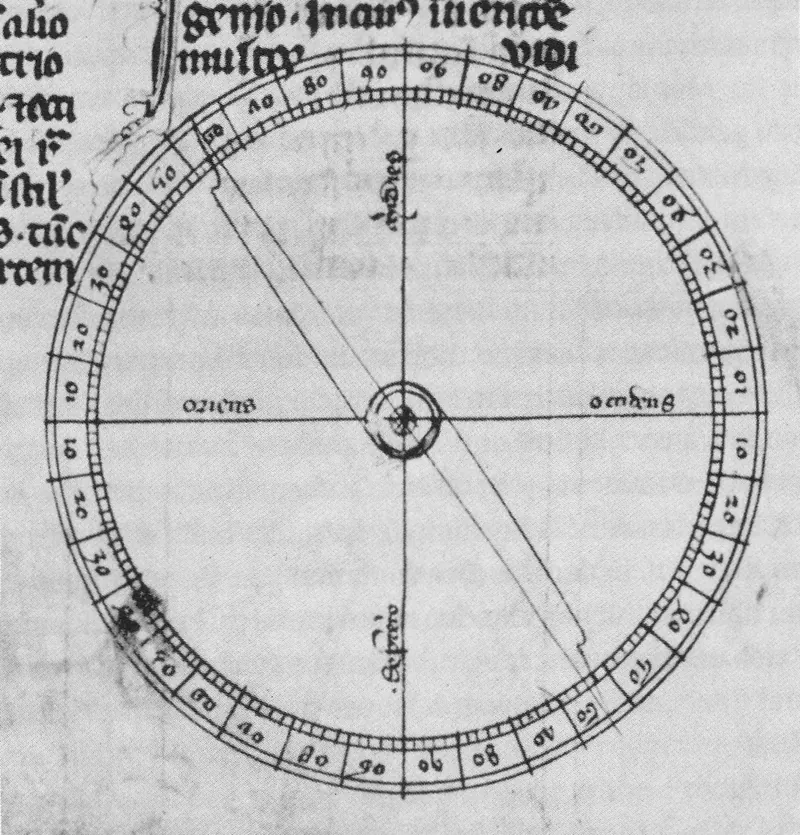
In August 1269, at the siege of Lucera in southern Italy, Petrus Peregrinus writes a letter on the magnet. He describes a floating compass with a circle of 360 parts and a rule to measure the direction of the sun or a star, and a needle on an axis in a box with a glass lid. With it, he says, you can set your course “by land or sea.” He thought the needle pointed exactly to the pole of the sky; he did not know about declination.

Did the compass come from China to Europe? We don’t know. No text links Shen Kuo with Neckam, and the oldest Arabic and Persian witnesses are later than Neckam. It may have come over land, by sea, through the Islamic world, or been invented again in Europe.
From direction to measurement
In 1492 Columbus saw on the Atlantic that his needles pointed in a different direction from the Pole Star (see Columbus and the stars). A century later Plancius, Van Twisch and Stevin measured the variation to find their position with it: see The Golden Compass of Hoorn and Longitude. What was a puzzle for Shen Kuo became a measurement.
Where did the needle point?
Choose a place and a year. The calculator gives the declination according to gufm1, a model of Earth’s magnetic field from 1590 to 1990. It is built mostly from measurements by seamen on merchant and naval ships; for the period before 1800 alone there are more than 83,000. For today, we use the World Magnetic Model 2025.
Choose a year from 1590 through 1990, or “Today.”
A model result, not a measurement; at sea the needle could point a degree or two differently. Before 1590 gufm1 has no data, so we give no number for Shen Kuo (1088) or Columbus (1492).
What we don’t know
- Whether the sinan of the Han Feizi and Wang Chong’s spoon had anything to do with magnetism.
- When and by whom a needle was first magnetized.
- Whether the Yingyuan zonglu (1041) mentions the deviation before Shen Kuo, and how old that text really is.
- How large the deviation was that Shen Kuo saw: he gives no number, and we have no reliable model for that time.
- When Chinese ships first used the compass: around 1100 Zhu Yu describes a custom that already existed.
- Whether the compass came from China to Europe, or was invented again in Europe.
Sources
- Han Feizi, chapter 有度 (Youdu), and the Siku quanshu edition with the old commentary (卷02), on Wikisource. zh.wikisource.org
- Guiguzi, chapter 謀篇 (卷中), on Wikisource. zh.wikisource.org
- Wang Chong, Lunheng, chapter 是應 (52), on Wikisource. zh.wikisource.org
- Wujing zongyao (1044), 前集 卷十五, the south-pointing fish, on Wikisource. zh.wikisource.org
- Shen Kuo, Mengxi bitan, 卷二十四, on Wikisource. zh.wikisource.org
- Zhu Yu, Pingzhou ketan, 卷二, on Wikisource; with the preface of the Siku editors (1781) on the reconstruction from the Yongle dadian. zh.wikisource.org
- Thomas Wright (ed.), Alexandri Neckam De naturis rerum (London, 1863): Book II, chapter 98 (p. 183), and in the introduction (pp. xxxiv–xxxviii) De utensilibus, Guyot de Provins and Jacques de Vitry. Scan on the Internet Archive. archive.org
- Brother Arnold (trans.), The Letter of Petrus Peregrinus on the Magnet, A.D. 1269 (New York, 1904), Part I, chapter 10, and Part II, chapters 1 and 2. On the Internet Archive. archive.org
- Petra G. Schmidl, “Two Early Arabic Sources on the Magnetic Compass,” Journal of Arabic and Islamic Studies 1 (1996–97), pp. 81–132: Awfi on p. 83. doi.org
- Wen Renjun, “中国古人是怎么发明指南针的” (How the ancient Chinese invented the compass), Beijing Chenbao, March 26, 2017, via Huanqiu: the mercury reading, the Yingyuan zonglu (1041) and the figurine from a grave at Linchuan (1198). We have not read his book 《考工司南》. china.huanqiu.com
- A. Jackson, A. R. T. Jonkers and M. R. Walker, “Four centuries of geomagnetic secular variation from historical records,” Philosophical Transactions of the Royal Society A 358 (2000), pp. 957–990: the gufm1 model (1590–1990); the coefficients from the University of Colorado, with the author’s permission (doi:10.1098/rsta.2000.0569). geomag.colorado.edu
- NOAA NCEI and British Geological Survey, World Magnetic Model 2025 (WMM2025), for “Today.” ncei.noaa.gov
- Joseph Needham, Science and Civilisation in China, vol. IV:1 (1962), on magnetism and the compass: not consulted. The translations on this page are our own.