The almanac makers of Hoorn
For a century and a half, the tables of the tides and of the rising and setting of the moon in many Dutch almanacs were calculated by one family from Nieuwe Niedorp and Hoorn: Dirck Rembrantsz van Nierop and his heirs, the Van Dams. The almanacs themselves were mostly printed in Amsterdam. This page follows what the sources say about the almanacs of Hoorn, about how an almanac was put together, about the patents that protected the calculations and about the mockery, and it says what we do not know. The astrological predictions in the old almanacs appear here only as part of their history.
What the sources say
- Almanacs with the tides and the rising and setting of the moon were, in the words of the editor of Van Nierop’s letters, “of vital importance to the shipping trade”; until far into the eighteenth century they often also contained fables and astrological predictions. [1]
- Dirck Rembrantsz van Nierop started calculating astronomical and tide tables for almanacs in 1654, and the business stayed in the family until the beginning of the nineteenth century. [2]
- The last almanac with the name of Meyndert van Dam on the title page was published in 1802, for the year 1803. [2]
Almanacs from Hoorn before 1700
- Up to 1700, 347 books are known to have been printed or published in Hoorn. Among them are “nuttige boekjes zoals een almanak, een boekje over de astrologie” (useful booklets such as an almanac and a booklet on astrology). [3]
- The first printer and bookseller in Hoorn who can be assumed to have had a business there was Ewout Cornelisz. Muller from Amsterdam, who worked in Hoorn from 1589 to 1591. [3]
- There was probably also a prognostication (a booklet of predictions for the coming year) from Hoorn: the bibliography Typographia Batava lists “Een prognosticatie ofte voorsegginghe op de …” by Muller in Hoorn, 1590. We saw this only as a fragment in a search index, not the entry itself, so we call it probable. [4]
The calculations of the Van Nierop and Van Dam family
- Dirck Rembrantsz van Nierop (1610–1682), a shoemaker in Nieuwe Niedorp, started calculating astronomical and tide tables for almanacs in 1654. In 1675 a tax register calls him “een schoenmaker ende estronomist” (a shoemaker and astronomer). [2]
- His almanacs covered several years at once. The bibliography of his works lists, for example, an “Almanach, Nae den Nieuwen Stijl Van Neghen achter-een-volghende Jaren / van het Jaer 1655. tot 1663.”, set “op de Meridiaen deser Stadt Amstelredam” (on the meridian of this city of Amsterdam). [1]
- An almanac for 1693 to 1700 describes all the eclipses of the sun and moon, both for these lands and for the whole globe, and calls itself “seer nut en vermakelijk voor alle Schippers / Stuur-lieden” (very useful and entertaining for all skippers and navigators). [1]
- The calculations came from Nieuwe Niedorp and Hoorn; the almanacs in the bibliography were printed in Amsterdam, by booksellers such as Gerrit van Goedesbergh, Hendrik Doncker and Gillis Joosten Saagman. [1]
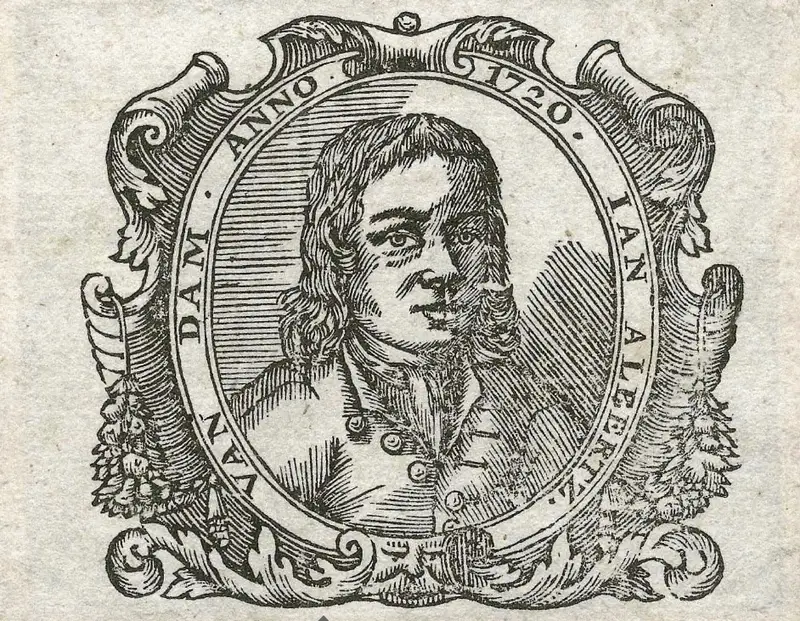
- After Dirck’s death in 1682 his nephew and pupil Pieter Rembrantsz van Nierop continued the calculations. After him came Jan Albertsz van Dam (from 1709), his son Dirk Jansz van Dam (after 1747) and his grandson Meyndert van Dam (1781 to 1802), all in Hoorn. [2]
- Several publishers kept Dirk Jansz van Dam’s name on their title pages until 1800, perhaps as an alias for other heirs; some three hundred different almanacs appeared under his name. Meyndert van Dam issued more than 230. [2]
- Zuidervaart estimates that the family produced the tables for more than a thousand different almanacs. That is an estimate, not a count. [2]
- In 1803 the almanacs said they were calculated by “beminnaren der wiskundige weetenschappen” (lovers of the mathematical sciences); in 1804 the Rotterdam mathematician Jacob de Gelder took over as the main calculator. [2]
- Dirck Rembrantsz van Nierop (1610–1682) Nieuwe Niedorp; almanac tables from 1654
- Pieter Rembrantsz van Nierop (c. 1640–1708) nephew and pupil; patent of 1693, renewed in 1708
- Jan Albertsz van Dam (c. 1672–1746) Hoorn; patent of 1709, renewed in 1724 and 1743
- Dirk Jansz van Dam (1705–1780) Hoorn; almanacs after 1747; patent renewed in 1756
- Meyndert van Dam (1730–c. 1812) Hoorn; almanacs from 1781 to 1802; patent renewed in 1780
How an almanac was put together
- The calculator supplied the tides and the rising and setting of the moon. The predictions came from elsewhere: “Standard and well-known were the astrological predictions by Antonio Magino”, a professor of mathematics in Bologna who died in 1617. [1]
- An example: in an Alkmaar almanac of 1710 the sixth quire (a gathering of printed sheets) consists of Magino’s predictions, and the fifth contains a method by Van Nierop to calculate the tides. [1]
- Almanacs were hugely popular, for practical use and as a pastime; through them, Dirck’s fame reached people who otherwise had no interest in mathematics or astronomy. [1]
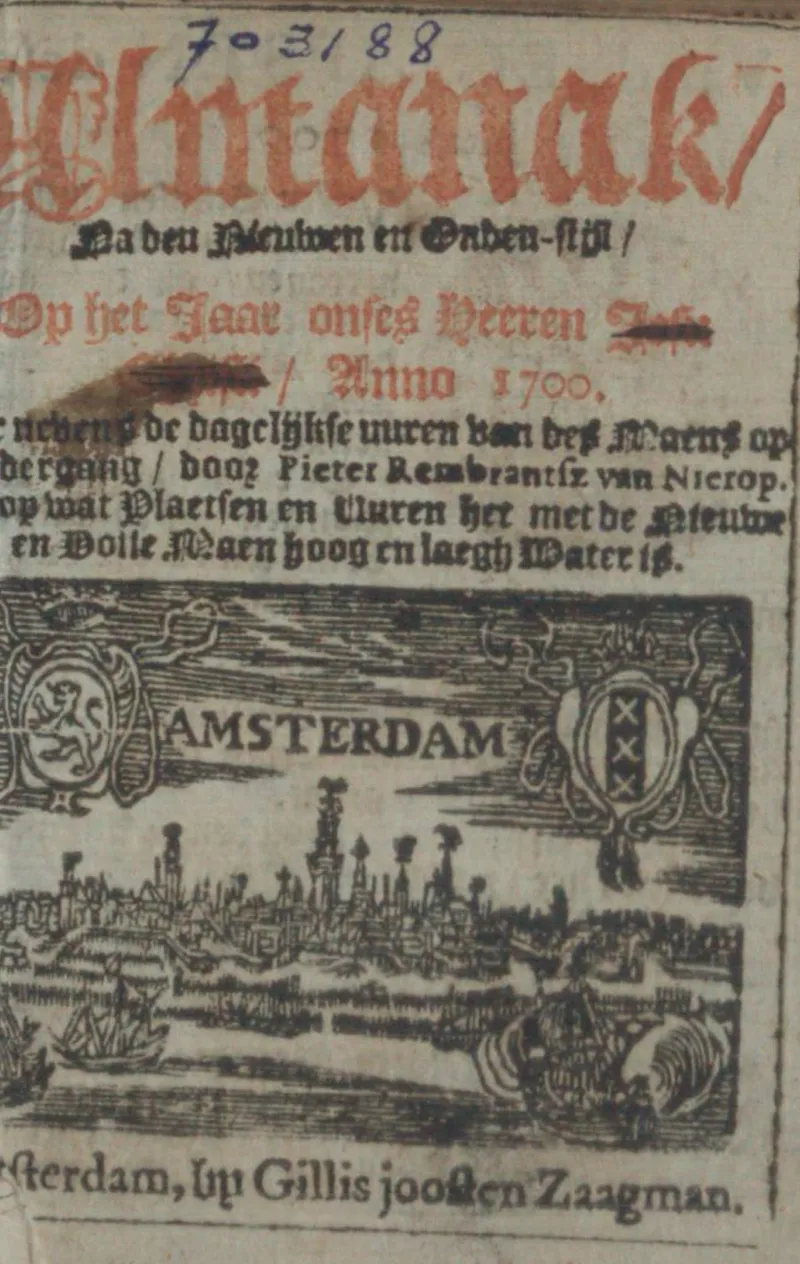
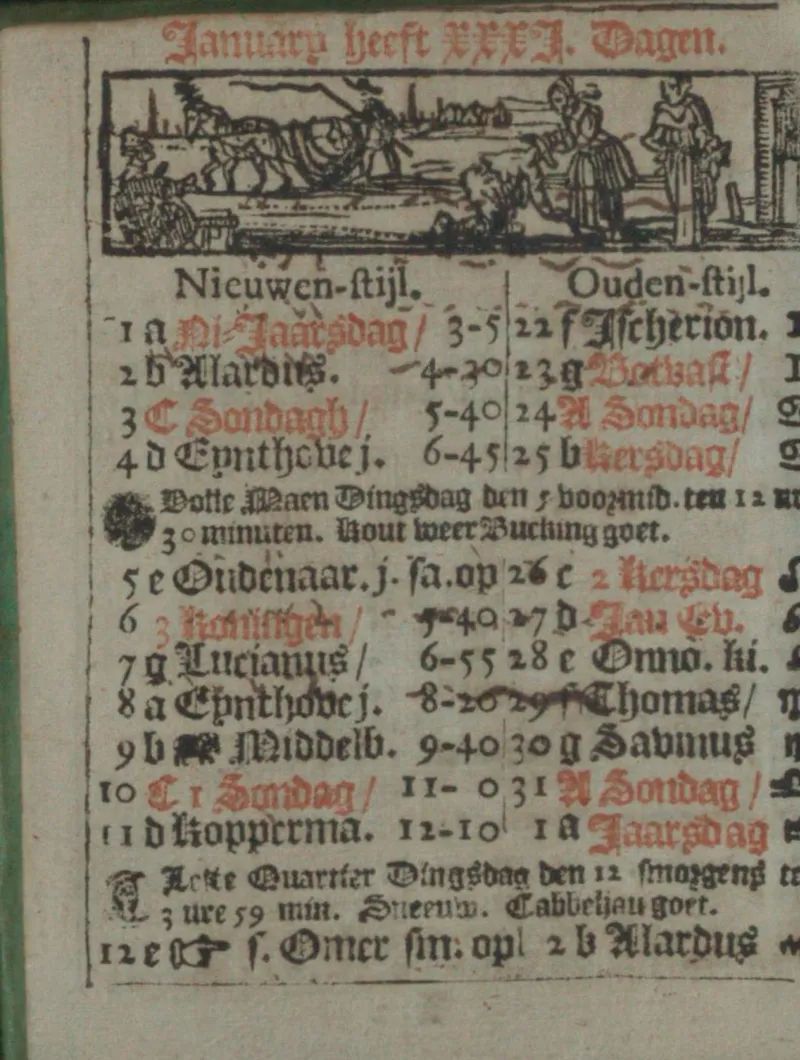
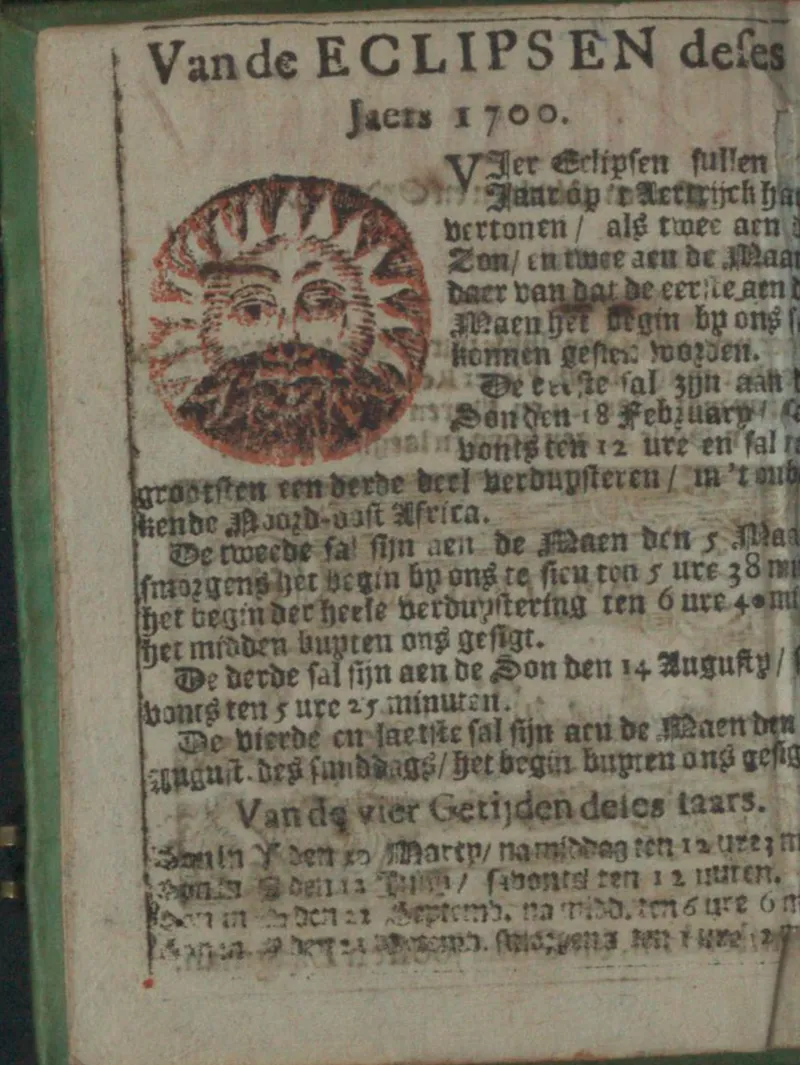
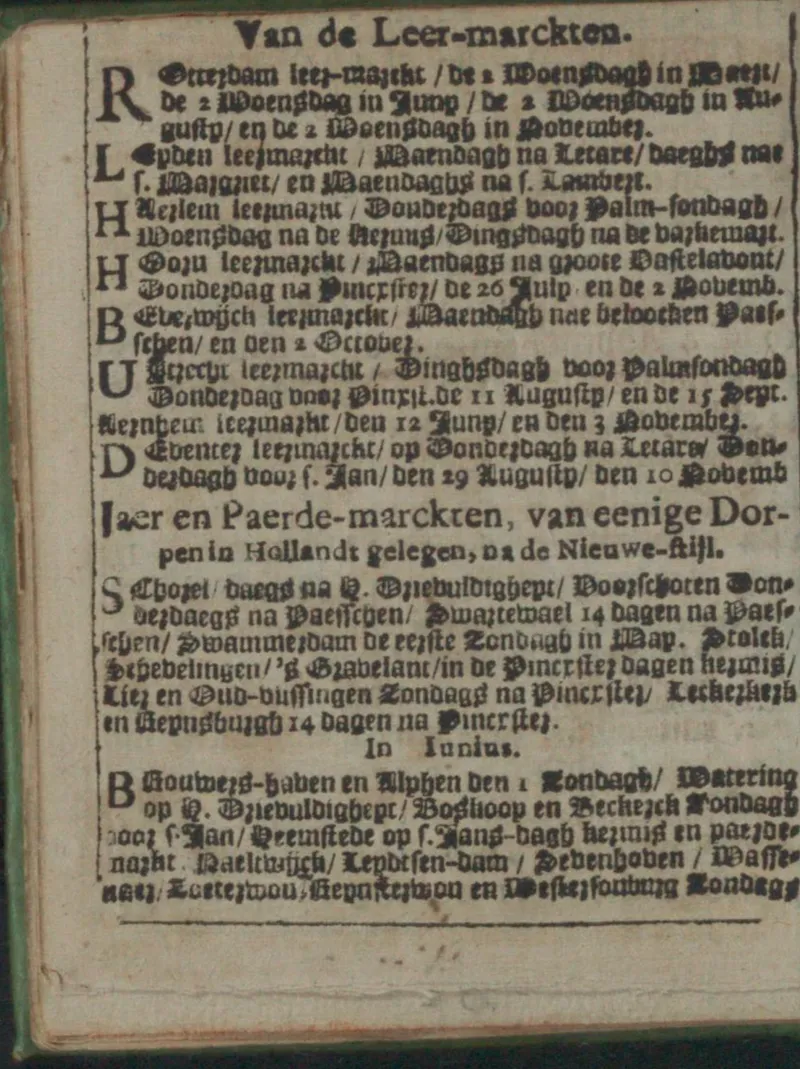
- One almanac calculated by Pieter Rembrantsz van Nierop survives complete in the Koninklijke Bibliotheek: the almanac for 1700, printed in Amsterdam by Gillis Joosten Zaagman. Its title page promises the daily hours of the rising and setting of the moon, and at what places and hours it is high and low water at new and full moon. Each month has a woodcut, the new and the old style side by side, and the phases of the moon with day and hour. We found no tide table in the scanned copy. [7]
- We recalculated some of its figures for Amsterdam, in apparent solar time. The moon’s hours in January 1700 differ from our calculation by 10 to 25 minutes, and the time the almanac gives for the solar eclipse of February 18, “savonts ten 12 ure”, is within 6 minutes of ours. [7]
The dispute over the patent (1682–1692)
- Dirck apparently never applied for a patent on the rising and setting of the moon, because his authority was undisputed. [1]
- Isaac Haringhuysen (1640–1692), a surveyor in Alkmaar, had held a patent since March 1676 on a table of the tides “tot gerief van alle zeevarende luijden” (for the convenience of all seafaring people). [1]
- On November 28, 1682, three weeks after Dirck’s death, Haringhuysen was also granted a patent on the rising and setting of the moon. In his request he wrote that Dirck had published those times in his almanacs “door het uijtpassen op een astrolabium” (by measuring them out on an astrolabe). He asked for twenty-five years and was granted ten. [1]
- When the Amsterdam publisher Gillis Joosten Saagman announced an almanac with Pieter Rembrantsz’s moon tables in November 1683, Haringhuysen summoned him to withdraw it. Under a settlement, Saagman produced two almanacs in 1685: one with Haringhuysen’s tables and one with Pieter’s. [1]
- In the end Pieter had to assist Haringhuysen; until Haringhuysen’s death in 1692, some of their joint work appeared as Haringhuysens Nieropper Almanach. Pieter, then living in Hoorn, obtained a patent of his own on September 22, 1693. [1]
The patent of May 14, 1709
- After Pieter’s death in the autumn of 1708, the States of Holland and West Friesland granted the patent to Jan Albertsz van Dam, “Geadmitteerde Lantmeter en Liefhebber der Mathematische konsten binnen de Stad Hoorn” (admitted surveyor and lover of the mathematical arts in the city of Hoorn). The original is in the National Archives in The Hague; the edition of Van Nierop’s letters prints it in full. [1]
- It protected three things for fifteen years: “de Uitrekening der watergetyden, mitsgaders des Maans op- en ondergang” (the calculation of the tides and of the rising and setting of the moon); the books of Dirck and Pieter, from the Nederduytse Astronomia to the Nieroper Schatkamer; and Van Dam’s own Nieuwe Hoornse Schatkamer. [1]
- Anyone who reprinted them paid a fine of 300 guilders: a third for the officer who brought the charge, a third for the poor of the place and a third for Van Dam. He in turn had to deliver a bound copy of the books to the library of the University of Leiden. [1]
- The patent says that Pieter received his patent “in den jare 1693 op den 23 September”; the patent of 1693 itself is dated September 22. We give both dates. [1]
- The patent does not explain what “'t verschil des tyds” means. In the same period, the same words head a table that gives, for each day, the hour at which the moon stands in the south: “Tafel van 't verschil des tijds tusschen Zon en Maan, Anno 1690” (table of the difference of time between sun and moon). [8]
- Further patents followed in 1724, 1743, 1756 and 1780; the system ended with the Republic in 1795. As late as 1792, according to Van Eeghen, three illegal competitors had to pay a fine of 9,000 guilders. [1], [2]
… en wel besonder de bewuste Uytrekeninge der Watergetyden,
mitsgaders de Maans op en ondergang nabootsen,
sonder eenige reflectie op 't verschil des tyds te maken,
't welk onvermydelyk vele grove misstellinge soude na sig slepen,
en groote onordentelykheden daar uit volgen …
Gedaan in den Haage, … den veertiende May,
in 't jaar onses Heeren en Saligmakers, seventien hondert negen.
Gietermaker’s table “Van 't verschil des tijds tusschen Zon en Maan” gives, for each day, the hour at which the moon stands in the south. We calculated the same for Hoorn, in apparent solar time. The difference is about 12 minutes on average; every half month it grows to almost half an hour and jumps back around new and full moon.
All values as a table
| day | table (hour) | calculated (hour) | difference (min) |
|---|---|---|---|
| 1 | 5.09 | 5.01 | +8 |
| 2 | 5.45 | 5.42 | +3 |
| 3 | 6.29 | 6.23 | +6 |
| 4 | 7.14 | 7.05 | +9 |
| 5 | 7.56 | 7.48 | +8 |
| 6 | 8.39 | 8.34 | +5 |
| 7 | 9.24 | 9.22 | +2 |
| 8 | 10.14 | 10.13 | +1 |
| 9 | 11.06 | 11.05 | +1 |
| 10 | 11.55 | 11.56 | -1 |
| 11 | 12.44 | 12.47 | -3 |
| 12 | 13.29 | 13.35 | -6 |
| 13 | 14.11 | 14.20 | -9 |
| 14 | 14.54 | 15.04 | -10 |
| 15 | 15.37 | 15.48 | -11 |
| 16 | 16.21 | 16.31 | -10 |
| 17 | 17.05 | 17.17 | -12 |
| 18 | 17.51 | 18.06 | -15 |
| 19 | 18.40 | 18.59 | -19 |
| 20 | 19.35 | 19.58 | -23 |
| 21 | 20.38 | 21.02 | -24 |
| 22 | 21.42 | 22.08 | -26 |
| 23 | 22.45 | 23.13 | -28 |
| 24 | 23.44 | 0.13 | -29 |
| 25 | 0.37 | 0.13 | +24 |
| 26 | 1.26 | 1.08 | +18 |
| 27 | 2.12 | 1.57 | +15 |
| 28 | 2.55 | 2.43 | +12 |
| 29 | 3.37 | 3.27 | +10 |
| 30 | 4.17 | 4.09 | +8 |
| 31 | 4.59 | 4.51 | +8 |
| day | table (hour) | calculated (hour) | difference (min) |
|---|---|---|---|
| 1 | 7.09 | 7.01 | +8 |
| 2 | 8.01 | 7.53 | +8 |
| 3 | 8.59 | 8.51 | +8 |
| 4 | 10.01 | 9.54 | +7 |
| 5 | 11.02 | 11.02 | 0 |
| 6 | 12.05 | 12.09 | -4 |
| 7 | 13.05 | 13.13 | -8 |
| 8 | 14.01 | 14.11 | -10 |
| 9 | 14.53 | 15.03 | -10 |
| 10 | 15.40 | 15.51 | -11 |
| 11 | 16.25 | 16.36 | -11 |
| 12 | 17.07 | 17.19 | -12 |
| 13 | 17.51 | 18.03 | -12 |
| 14 | 18.34 | 18.47 | -13 |
| 15 | 19.20 | 19.33 | -13 |
| 16 | 20.07 | 20.21 | -14 |
| 17 | 20.56 | 21.11 | -15 |
| 18 | 21.41 | 22.02 | -21 |
| 19 | 22.31 | 22.54 | -23 |
| 20 | 23.19 | 23.44 | -25 |
| 21 | 0.06 | 23.44 | +22 |
| 22 | 0.52 | 0.32 | +20 |
| 23 | 1.34 | 1.18 | +16 |
| 24 | 2.15 | 2.01 | +14 |
| 25 | 2.56 | 2.44 | +12 |
| 26 | 3.40 | 3.26 | +14 |
| 27 | 4.21 | 4.09 | +12 |
| 28 | 5.04 | 4.54 | +10 |
| 29 | 5.52 | 5.43 | +9 |
| 30 | 6.44 | 6.36 | +8 |
| 31 | 7.41 | 7.36 | +5 |
Mockery and praise
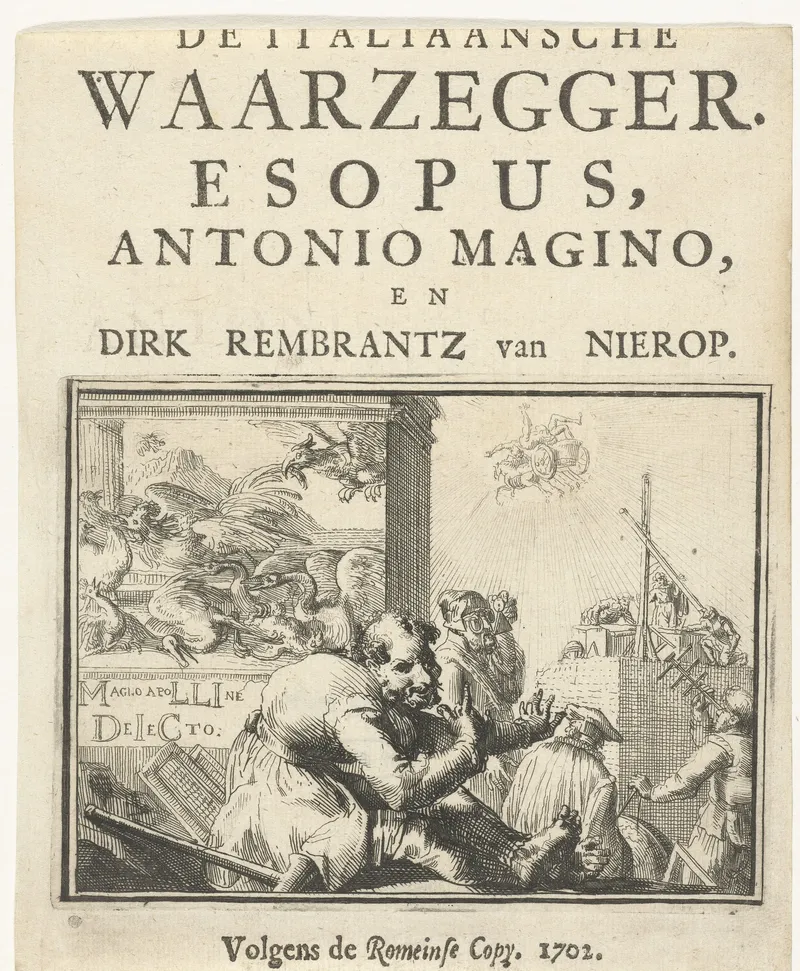
- In 1701 the writer and engraver Romeyn de Hooghe (1645–1708) published the pamphlet De Italiaansche waarzegger. Esopus, Antonio Magino, en Dirk Rembrantsz van Nierop (The Italian fortune-teller), which puts the three of them on stage. The edition of Van Nierop’s letters gives 1701 in its text and 1702 in the caption of the title print; we give both years. [1]
- In the pamphlet, Esopus mocks Magino and Dirck as fortune-tellers, “since astrological predictions were widely available in all kinds of popular almanachs”, and compares them with the oracle priests of ancient Greece. Magino answers that astronomy and astrology do not tell fables but give “prognoses” for the future. [1]
- De Hooghe describes Dirck as “een Boertje” (a simple farmer) who learned the course of the heavens “onder het schoenen lappen” (while patching shoes). [1]
- Others praised him. In the eighteenth century François Valentyn, Nicolaas Struyck and Jacob Oostwoud gave him much credit, and Struyck mentions his reputation as an almanac maker. [1]
- The family was mocked again later: in 1770 Hendrick Numan published a satire on the “astronomist” Dirk Jansz van Dam. The story behind it is unknown. [2]
The neighbor: the Enkhuizer Almanak
- In the first half of the eighteenth century Agnes ter Hell, the widow of C. Stichter, published the Enkhuizer Almanak in Amsterdam for many years, first alone and later with the heirs. [5]
- Its present publisher dates the first edition to around 1595 and the oldest surviving copy to 1680, printed by the Pottjen firm in Enkhuizen. It explains that the water levels at Enkhuizen mattered to anyone who wanted to reach Amsterdam by ship. These dates come from the publisher; we have not found them in a historical study. [6]
What we do not know
- We do not know the titles, years and printers of the almanac and the astrology booklet from Hoorn before 1700. We have not consulted the catalogue of books printed in Hoorn (Gruys and De Wolf, 1979) or the Short-Title Catalogue, Netherlands (STCN).
- We do not know whether Hoorn had an almanac series of its own in the seventeenth or eighteenth century.
- We do not know which almanacs the family actually calculated and which only carried its name, especially after Dirk Jansz van Dam’s death.
- We do not know whether the family’s tables also appeared in the Enkhuizer Almanak; we have not found that in a source we read.
- The bibliography lists an almanac printed in Amsterdam by Jacob Theunisz Lootsman in 1651 whose last two chapter titles carry Dirck’s name, while the edition dates the start of his almanac work to 1654 (“in the early 1650’s”). How that fits, we do not know.
- We do not know whether these almanacs gave advice on health or on bloodletting according to the moon. We have not found it for these almanacs, and we do not suggest it.
Sources
- M. Rijks (ed.), The Correspondence of Dirck Rembrantsz van Nierop (1610–1682), Huygens ING, The Hague 2012 (pdf of the whole volume) We read the introduction (pp. 1–35, with the section “Almanachs and patents”, pp. 10–11), the request of Haringhuysen and the patents of 1693 and 1709 in the appendix (pp. 333–341) and the almanacs in the bibliography by Klaas Hoogendoorn. Van Eeghen, Hazewinkel and Salman, cited there, we did not read.
- H.J. Zuidervaart, “The Van Nierop & Van Dam Dynasty of Mathematical Practitioners”, in the same volume, pp. 387–399 (PDF) A genealogy built on notarial and tax records in the regional archive of Alkmaar. We read the genealogy, not the records it cites.
- R.E.O. Ekkart, J.A. Gruys and C. de Wolf, Wilt Hooren ’t Woort. Boekdrukkerij en uitgeverij in Hoorn voor het jaar 1700 (The Hague 1979), pdf at Oud Hoorn Exhibition text. We read the passages on Muller and on the 347 books; the exhibition text does not name the almanac or the astrology booklet.
- P. Valkema Blouw, Typographia Batava 1541–1600 (Nieuwkoop 1998), entry for Hoorn 1590 (Brill) We saw only a fragment in a search index; the page itself is behind bot protection. That is why we say “probably”.
- M. Smolenaars, “Gildezusters en andere vrouwen in het boekenvak”, De Boekenwereld 29 (2012–2013) (DBNL) We read the article; for the Stichter firm it relies on Van Eeghen, Jaarboek Amstelodamum 75 (1983), which we did not read.
- Enkhuizer Almanak, “Historie” (the publisher’s website) The publisher’s own account, without sources; we use it only for what the publisher says about its almanac.
- Almanak, na den nieuwen en ouden-stijl, op het jaar 1700, calculated by Pieter Rembrantsz van Nierop (Amsterdam, Gillis Joosten Zaagman), Koninklijke Bibliotheek, The Hague, 141 E 18; scan on Wikimedia Commons We looked at all 41 pages of the scan and recalculated the moon’s hours of January and the eclipses ourselves (astronomy-engine). Public domain according to Commons.
- C.H. Gietermaker, ’t Vergulde licht der zeevaart (Amsterdam, Hendrik Doncker, 1690), digitized by Google Books (copy of the University of Amsterdam, via the KB) We read the tables “Anno 1690” to 1695 (pp. 27–28, running head “De Zeemans Wegh-wijser”) on screenshots. Whether that part belongs to ’t Vergulde licht or is a separate work, we could not see.
Every statement above carries the number of its source. Read on November 14, 2026. What we could not confirm in a source we read is left out or listed under what we do not know.
All pages about the seafarers of Hoorn