Mnajdra: does the temple face the equinox?
On the south coast of Malta, above the sea, stand three Stone Age temples. The lowest, the South Temple, has its entrance to the east. On the days of the equinox the sun rises there almost exactly in line with the passage, and its light falls through the entrance to the back of the temple. Did the builders intend this? Here is what has been measured, what we recalculate ourselves and what remains open.
What stands there
Mnajdra consists of three temples around a shared forecourt. The smallest and oldest is the North Temple, from the Ġgantija phase. The South Temple, the subject of this page, took its present form in the early Tarxien phase, according to the archaeologists Evans and Trump. There are two schemes for these phases: Ġgantija 3600–3000 and Tarxien 3000–2500 BC, or, according to the more recent FRAGSUS research project, 3600–3150 and 3150–2500 BC.
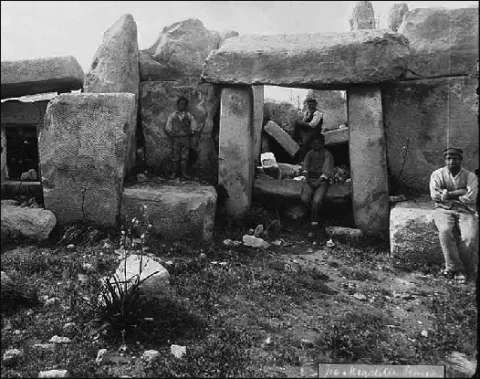
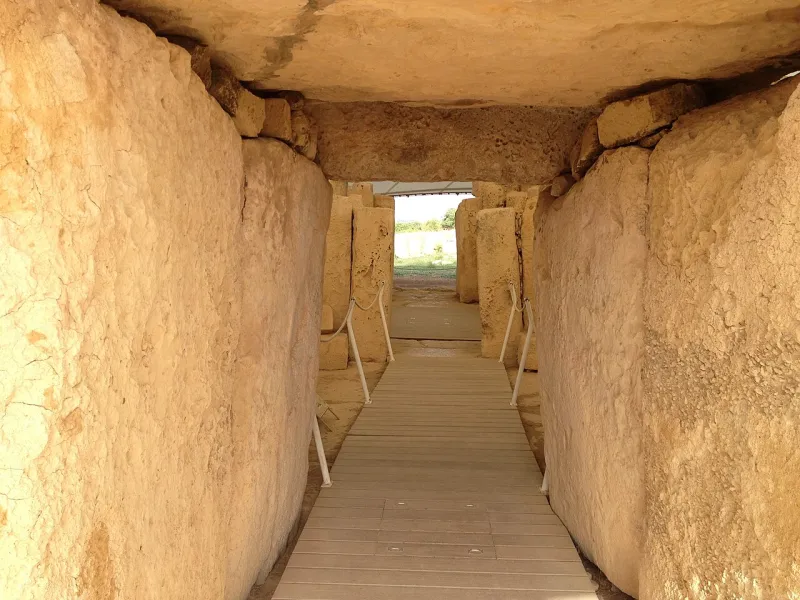
The South Temple has four semicircular rooms (apses) on either side of a single central passage. That passage runs about 15.5 meters from the front to the back wall of a niche, probably an altar. The entrance itself is a passage about 3 meters long, 1.8 meters wide and 2 meters high. The temples were restored between 1948 and 1956; the photograph below shows the South Temple before that.

What is claimed
Heritage Malta, which manages the temples, writes that on the days of the equinox the sun shines through the doorway into the inner rooms, and that at the solstices the first light touches the edge of a large stone: on the left in June, on the right in December. It adds that it is not known for certain whether this was intended, but that it is probable.
Tore Lomsdalen photographed the light at the equinox and saw it reach the altar at the back. He finds that Mnajdra has ‘too many alignments for them to be considered coincidental’. That is his interpretation, not a proven fact.
The physicist Frank Ventura, who measured the direction with George Agius in 1979–80, remained more cautious. Together they found that the axis pointed exactly toward the equinox sunrise, but they called it no more than chance as long as there was no other evidence.
The measurements
The axis of the South Temple has been published five times. The values lie between 92.0° and 93.0°, measured from north through east. East is exactly 90°.
| Who | Direction of the axis | Height of the skyline | Source |
|---|---|---|---|
| Micallef e.a. 1980 | 92°35.65′ | – | Barratt 2022, Table 1 |
| Agius & Ventura 1981 | 92.7° | – | Barratt 2022, Table 1 |
| Foderà Serio, Hoskin & Ventura 1992 | 92.7° | 3.72° | the article itself, Table 1 |
| Cox 2001 | 93° | 3.72° | Barratt 2022, Table 1 |
| Lomsdalen 2014 | 92.0° | 4.00° | Barratt 2022, Table 1 |
Ventura and Agius measured with a theodolite in the winter of 1979–80. Their axis is the best straight line through the middle of the entrance, the inner doorway and the altar niche. Ventura later wrote that they found ‘azimuth 92½°’, with the skyline at a height of 4°; their revised publication of 1981 gives 92.7°.
In 1992 Giorgia Foderà Serio, Michael Hoskin and Frank Ventura measured all the temples of Malta and Gozo again: from a pole at the back, midway between the side walls, to a pole at the middle of the entrance. Their table lists the South Temple as ‘Mnajdra I’ with direction 92.7°, skyline 3.72° and declination 0.0°. Declination is the height above or below the celestial equator, where the sun stands at the equinox. For that declination they deliberately left out the bending of light in the air (refraction).
Mnajdra I is listed in their table, but it was left out of their own calculation. They wrote: ‘here Mnajdra I is taken to be exceptional and is not further considered’. They examined fourteen other temple axes, all between 125.5° and 204°, and said such a concentration could not be chance. About Mnajdra I itself they wrote only: ‘whether by accident or design, it faces the equinox sunrise with great precision’.
They added that such a direction should not be read as an exact line: ‘not as a precise orientation, but as a guide to the direction in which the monument was intended to look’. Anyone standing inside also sees, through the entrance, what lies to the left and right of the axis.
See for yourself
A sketch of the South Temple seen from above, with east on the right. Choose a year and a day and see where the sun rises and how far its light falls through the entrance. The sketch shows only the main shape; it is not a survey.
The sun rises at 93.0°, 0.3° right of the axis. The light falls through the entrance all the way to the back niche.
What we recalculate ourselves
- On the day of the equinox, around 3000–2500 BC, the sun rises over the 3.72° skyline at 92.3° (first light) to 92.7° (the whole disk above the skyline). That is exactly the direction of the axis.
- If we calculate as Foderà Serio and her colleagues did, without refraction, 92.7° corresponds to a declination of −0.01°: their 0.0°. With refraction, it is −0.12°. The difference is about a quarter of a day of the sun’s motion.
- Anyone who wanted to find the equinox without calculation could count the days between the solstices and halve them. That middle day then fell less than a day after the equinox, and the sun rose at 92.3° to 92.4°: also within the measured axis.
- Day and night are not exactly equal on the equinox itself: because the air bends the light and the sun is a disk rather than a point, the day with equal day and night falls about 3.7 days before the equinox (with a flat skyline). The sun then rose at 94.5°, and that is not the direction of the axis.
- Around the equinox the place of sunrise shifts by about half a degree a day. The five measurements together therefore lie within about two days; the axis does not mark the equinox more precisely than to about a day.
- A direction cannot date the building. The solstices shift by less than 0.1° in 500 years.
The test: how often does this happen by chance?
A temple that faces ‘something’ in the sky means little if almost every direction faces something. So before we calculated anything, we fixed what we would count: the axis 92.7° with the spread of the measurements (92.0°–93.0°); nine targets rising in the years 3000–2500 BC: the sun at the equinox and the two solstices, the moon at its four extreme positions, the Pleiades and Sirius; and a window of ±3.8°.
That window comes from the temple itself. From the back niche, 15.5 meters from the entrance, you see through an opening 1.8 meters wide ±3.3° to the left and right. To that we add the spread of the measurements, ±0.5°. For the skyline we use only the published points, with straight lines between them; we have no elevation model of the landscape.
| Target | Rising (3000–2500 BC) | Within the window of the axis? |
|---|---|---|
| Sun, equinox | 92.4–92.7° | yes |
| Sun, summer solstice | 63.1–63.6° | no |
| Sun, winter solstice | 119.4–119.9° | no |
| Moon, major standstill north | 57.9° | no |
| Moon, major standstill south | 127.2° | no |
| Moon, minor standstill north | 70.3° | no |
| Moon, minor standstill south | 114.5° | no |
| Pleiades (Alcyone) | 89.6–93.0° | yes |
| Sirius | 116.1–117.9° | no |
The axis of Mnajdra hits two of the nine targets: the sun at the equinox and the Pleiades. How unusual is that? Take a random direction on the eastern side (0°–180°): it hits at least one target in 28.7% of cases, and at least two in 11.8%. Take a random direction of the kind the temples of Malta actually have (92.7°–204°, the fifteen axes of 1992): at least one target in 22.1%, at least two in 12.4%.
So two hits happen by chance about one time in eight. That is striking, but it is not proof. Using a different method over 23 temples, Rob Barratt reached a similarly cautious judgment. By his calculation, in 26.4% of cases exactly one of the 23 temples lines up this well with a target; the chance of at least one is about 32%. Of Mnajdra he wrote that the South Temple shows ‘an excellent alignment’, but that the evidence is ‘inconclusive’.
The postholes on the skyline
In 1981 Agius and Ventura searched the skyline along the directions of the solstices. They found two holes in the rock. One lies exactly on the skyline where the sun rose on the shortest day (declination −24°15′; we recalculate this). The other lies more than 3° beside the sunrise on the longest day.
Whether the holes were made by people, and when, is unknown. Ventura himself wrote of the hole of the shortest day that it may have been made by people, but that this is not certain and that the hole cannot be dated.
Another explanation: the Pleiades
As early as 1992, Foderà Serio, Hoskin and Ventura noted that during the temple period the Pleiades rose almost exactly in the east, ‘in the direction of Mnajdra I’. In 1993 Ventura, Foderà Serio and Hoskin considered the equinox itself as the target ‘unlikely on present evidence’, and preferred the Pleiades.
We calculate that the brightest star of the Pleiades, Alcyone, rose within the measured axis only between about 2990 and 2850 BC. Its rising shifts by 0.7° per century. Whether the temple was aligned in those years, we do not know.
In the North Temple stand two pillars full of small holes, 179 certain ones on the eastern pillar. Ventura, Foderà Serio and Hoskin read them as a tally of days between the risings of stars, beginning with the Pleiades. They wrote themselves that they were still far from being able to prove this (‘some way from proving this’).
How we calculate
The sun comes from JPL’s DE441 ephemeris, with Skyfield. We calculate its declination at sunrise for every day of three years: 3000, 2750 and 2500 BC, in the Julian calendar. The difference between clock time and the Earth’s rotation was then more than 17 hours and is uncertain; the date can shift by one day as a result.
For the skyline, the height of the horizon, we use four published points: about 6° high in the northeast, 4.5° high in the direction 63°, 3.72° in the direction of the axis (92.7°) and 0° in the direction 120°, with straight lines between them. We calculate refraction after Bennett. ‘First light’ is the upper edge of the sun on the skyline, ‘whole disk’ the lower edge. We calculate the moon with its parallax, and the Pleiades and Sirius with their proper motion and precession.
The probabilities in the test are calculated for every direction in steps of 0.01°, not estimated with random numbers.
What we do not know
- Whether the direction was intended, and if so whether toward the equinox, the Pleiades or something else.
- What the builders meant by ‘rising’ and by ‘equinox’: the first light or the whole disk, the day found by counting days, or something else.
- Exactly what the entrance looked like before the restoration of 1948–1956.
- Where an observer stood in the temple. We calculate from the back wall of the niche, 15.5 meters behind the entrance; anyone standing closer to the entrance saw a wider stretch of the skyline.
- We do not know who measured the skyline at 3.72°. The 1992 table gives that height without a measurement report, and in 1993 Ventura wrote that the skyline was at 4° in 1979–80.
- Whether the postholes on the skyline were made by people, and from what time they date.
- We do not know which scheme of phases is right, and so we do not know exactly when the South Temple took its present form.
- Whether the holes on the pillars in the North Temple are a tally, and if so, of what.
Sources
- F. Ventura and G. Agius, ‘An investigation of the possible Equinox alignment at Mnajdra, Malta’, Journal of Skyscape Archaeology 3.1 (2017), 79–92. um.edu.mt
- G. Foderà Serio, M. Hoskin and F. Ventura, ‘The Orientations of the Temples of Malta’, Journal for the History of Astronomy 23 (1992), 107–119; Table 1 on p. 115, Mnajdra I on pp. 109, 111, 116 and 118. ui.adsabs.harvard.edu
- F. Ventura, G. Foderà Serio and M. Hoskin, ‘Possible tally stones at Mnajdra, Malta’, Journal for the History of Astronomy 24 (1993), 171–183. um.edu.mt
- R. P. Barratt, ‘The crux of astronomical alignment in Neolithic Malta: using 3D simulation to produce new data’, Digital Applications in Archaeology and Cultural Heritage 26 (2022), e00229. doi.org
- T. Lomsdalen, Is there evidence of intentionality of sky involvement in the prehistoric megalithic sites of Mnajdra in Malta? (MA thesis, University of Wales Trinity Saint David, 2013); the passage on p. 25, the entrance on p. 58, the solstices on pp. 56–57, the quotation on p. 83.
- Heritage Malta, leaflet ‘Equinox & Solstice at Ħaġar Qim and Mnajdra’ (2023).
- JPL ephemeris DE441 (R. S. Park et al., 2021), with Skyfield (B. Rhodes). ssd.jpl.nasa.gov
We have recalculated every number on this page ourselves. We do not reproduce the figures from the articles; the photographs are free to use, with their maker and license.
More monuments
Also available:
- Newgrange (Ireland)
- Maeshowe (Scotland (Orkney))
- Stonehenge (England)
- The Great Pyramid of Giza (Egypt)
- Nabta Playa (Egypt (Sahara))
- Goseck (Germany)
- Saint-Omer (France)
Want us to check something?
Do you know of a place said to line up with the Sun, the Moon or a star? A stone circle, a burial mound, a church, an old road? We can calculate whether that holds. We use the same method as on these pages: the real horizon, the sky of the time, and honesty about what we do not know.
Send us:
- the place (coordinates or a map link);
- the direction you measured and how you measured it (did you use a compass? Say so, and we will correct for magnetic declination);
- where you stood when you measured;
- the claim: which body, which event (for example, sunrise at midsummer) and for which period;
- where the claim comes from (a book, article, website or local story).
Do you have photos showing the viewing direction, an estimate of the horizon height or a sketch? Send those too; they help.
Let us know whether we may put your request and the result on the site. We only name you if you want us to.
We check everything, even when the result does not confirm the claim. Then we show the numbers, without judgment of the builders.
Email calculate@cellariushoroscope.com. We cannot promise how quickly we will reply. What we do with your email is described in the privacy statement.