Voyages & Discovery
Zwaanendael and the Hoorn Kill
In 1631 a group of Dutch settlers set up a whaling station and farm on a creek in what is now Lewes, Delaware. They called the place Swanendael, today usually spelled Zwaanendael: the Valley of the Swans. It lasted barely a year. Delaware counts it as the state's first European settlement, and the creek has long been called the Hoorn Kill, a name that seems to point to the city of Hoorn in North Holland. This page sets out what we know, and why that name is less simple than it looks.
What happened
The colony was a business venture of private investors called patroons. David Pietersz. de Vries names the five who began it: Samuel Godyn, Kiliaen van Rensselaer, Samuel Blommaert, Jan de Laet and himself. Four more joined later, Mathys van Ceulen, Nicolaes van Sittorigh, Harinck Koeck and Heyndrick Hamel, under a contract that put everyone on the same footing. Godyn and Blommaert were also directors of the West India Company. In 1629 two Company agents, Gillis Hossitt and Jacob Jansz, acquired a tract of land at the mouth of the South River, now the Delaware, in exchange for cloth, axes, beads and other goods, and De Vries took charge of the administration from Holland.
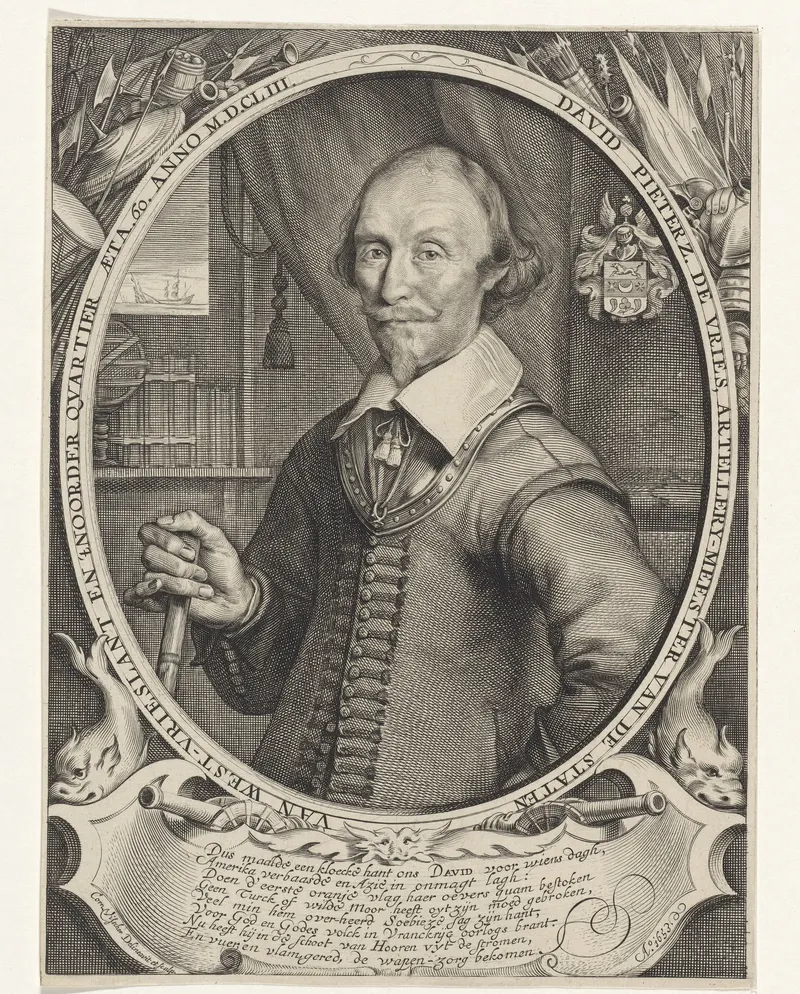
The ship Walvis (Whale), under Captain Pieter Heyes, sailed on December 12, 1630, with 28 men. Delaware’s pages say it left “Holland” and, in one case, “the city of Hoorn”; De Vries himself writes that the ship and a yacht sailed “upt Tezel”, from the Texel roadstead, and we have found no source that says the Walvis left the harbor of Hoorn. Heyes came from Edam and was used to Greenland whaling trips of three or four months, not to a voyage to America. On December 20 De Vries heard that the yacht had been taken by Dunkirk privateers. The plan was whaling, with grain and tobacco as a second source of income. The Walvis reached the river in 1631, and the settlers built Swanendael on a creek the Dutch first named Blommaert’s Kill, after one of the backers. In September 1631 the Walvis was back in Holland, and Heyes said he had come too late in the year: “een schadelijcke Reys”, a harmful voyage.
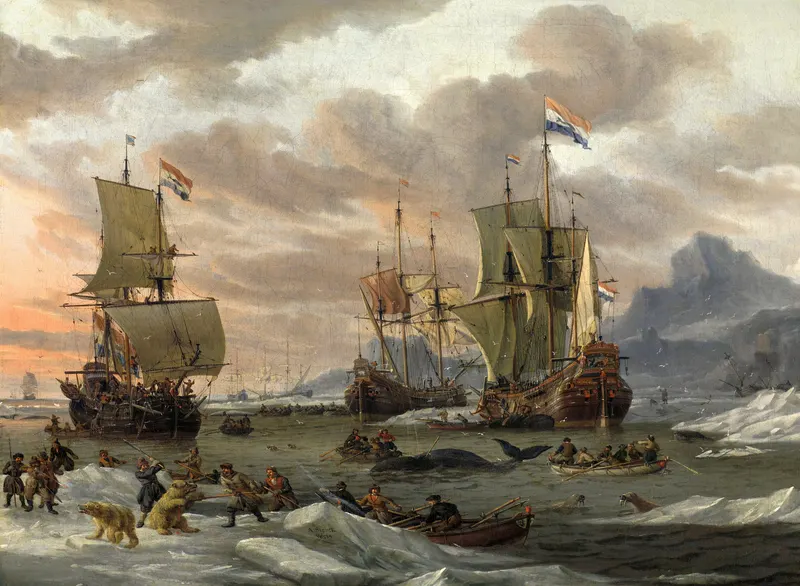
Within a year the colonists were dead and the buildings burned. The accounts we have were written by the Dutch. Before he sailed again from the Texel on May 24, 1632, De Vries heard that the little fort had been lost and that thirty-two men, who were outside it on the land at their work, had been killed. (Delaware’s pages say the Walvis carried twenty-eight men.) Years later he blamed trifling acts by the commander left in charge, Gillis Hossitt.
The Dutch gave up the site in April 1633, after more tension with the local people and a poor whaling season. The people who lived there were the Siconese, an Algonquian-speaking group; we know of no account in their own words. Dutch settlement returned to the area in 1655, and the English took over the Dutch holdings in 1664.
The ruins, day by day
De Vries himself sailed into Delaware Bay on December 5, 1632; the state museum’s page says he “came upon the burned settlement” that day. His journal has the next day: on December 6 he rowed into the kill in a well-armed boat and came to “ons Huys dat gedistrueert was”, our house that was destroyed. He found it still ringed with palisades, mostly burned, with bones of his people lying here and there, and the heads of a horse and of cows; there were no Native people to be seen.
On December 8 he sailed the yacht into the kill, and a Native man stayed aboard overnight and told him what had happened. According to De Vries, the colonists had put up a pillar with a piece of tin on it, painted with the “Hollantsche Thuyn”, the emblem of Holland. One of the chiefs took it down to make tobacco pipes, not knowing he did wrong. The Native people themselves killed the chiefs who had done it, and friends of the dead chief took revenge: all the men were working outside, and only a sick man and a chained English mastiff were in the house; three of the boldest men came with beaver skins to trade, and as the commander came down the stairs one of them split his skull with an ax; the sick man was killed too, and twenty-five arrows were shot at the dog. On December 9 De Vries made peace: the Native men sat down in a ring with their chiefs and were given presents. He could not take revenge, he writes, because they lived in no fixed place.
Adriaen van der Donck tells it differently in 1650: the arms of the States stood at this place in copper; some ill-intentioned men threw them down; the commissary demanded the head of the offender; the Native people brought a head, the matter was thought settled, and later they came in the guise of friendship and murdered the people working in their fields. Delaware’s museum calls the cause “a cultural misunderstanding” and says De Vries’s report “raises more questions than it answers.” Both accounts are Dutch; we know of none from the Native side.
Many books call the fort at Swanendael “Fort Oplandt”. That is a nineteenth-century misreading: De Vries writes that thirty-two men, “die buytens het Fort waren op Landt om haer werck te doen”, were killed, men outside the fort, on the land, at their work. In his own text the building is a “Fortje” and a “Huys” with palisades. The real Uppland or Oplant of later Dutch records lay much farther up the Delaware.
The name: Hoorn Kill or Hoere-kil?
Many Delaware histories say the creek was named the Hoorn Kill for the city of Hoorn, the birthplace of the navigator Willem Schouten and home of David de Vries's family. The early sources do not support that. De Vries himself wrote the name as Hoere-kil in his journal (published in 1655). A Dutch letter of 1640 has Hoeren-kil, Swedish records of the 1650s have Horn-kil, and later English records turned it into Whorekill. A Dutch report on the region from 1650 says: “This place we call the Hoere-kil. From whence this name is derived we do not know.”
In an essay on this name puzzle, the place-name scholar C. A. Weslager concluded that the Hoorn explanation has no support in the documents. He took hoere to be the Dutch word for a prostitute, so that the name would mean “harlot's creek,” an incident name of the kind traders and explorers often gave. Dutch and Swedish writers of the 1650s and 1660s explained it with stories about traders and local women. We cannot check those stories, and they come only from the colonists' side. Other explanations, such as a Dutch word for a nook or a creek shaped like a horn, also lack early evidence.
So we do not say that the Hoorn Kill was named for Hoorn. The links with Hoorn that are certain lie elsewhere, and the next section sets them out.
Hoorn and the colony
De Vries wrote about Hoorn himself. Coming home from a voyage, he arrived on June 21, 1644 “hier binnen mijn Vaderlijcke Stadt van Hoorn, alwaer ick een twee-hondert Jaer uytgesproten ben van mijn Vaders kant, ende Amsterdam van mijn Moeders zijde”, that is, inside his fatherly city of Hoorn, where he had sprung from for two hundred years on his father’s side, and Amsterdam on his mother’s; he reached home about three o’clock (journal, p. 190). He was born in France to Dutch parents, his father from Hoorn, around 1594 according to Amerman (other editors give 1593 and 1598). His book was printed at Alkmaar in 1655; the title page says “t’Hoorn, Voor David Pietersz. de Vries, Artillerij-Meester van ’t Noorder-quartier”, and he calls himself artillery master to the Committed Councils of the States of West Friesland and the Northern Quarter.
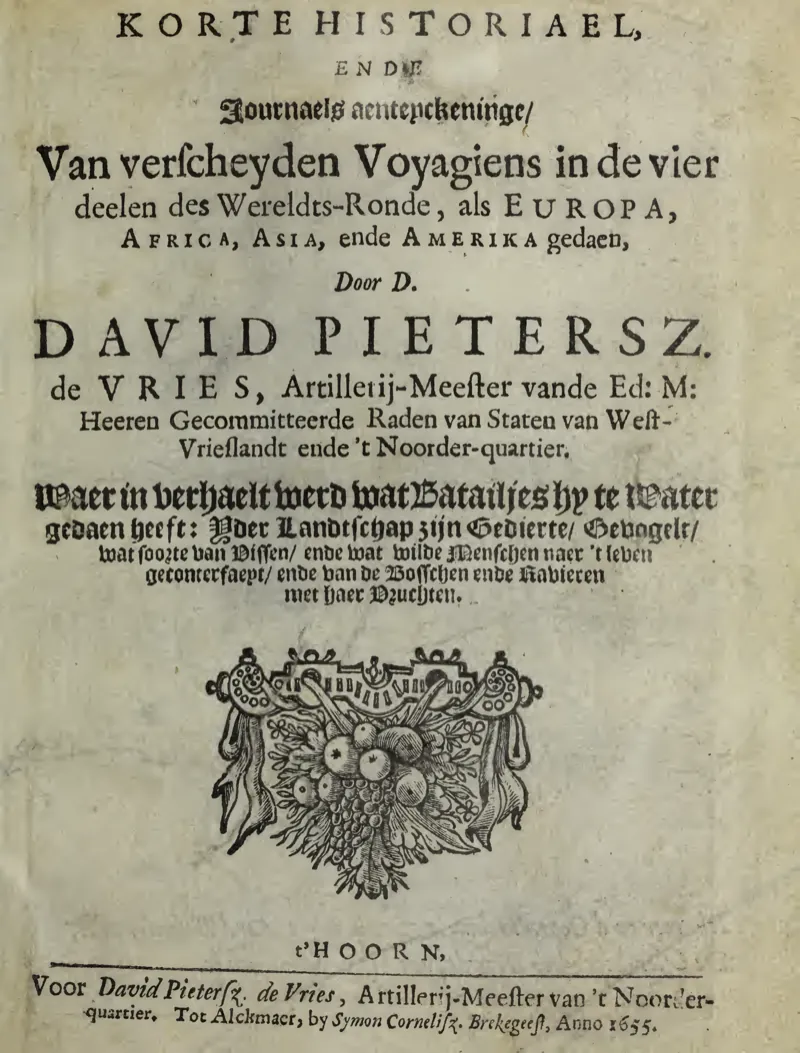
Hoorn belonged to the Northern Quarter, which held a one-ninth interest in the West India Company and two of its nineteen directors (De Halve Maen, 1969). Whether any of the Swanendael settlers came from Hoorn, we do not know.
The Zwaanendael Museum in Lewes, built in 1931 and dedicated on May 7, 1932, is modeled after the town hall in Hoorn, the museum itself says. De Halve Maen (1969) calls it “a careful adaptation of Hoorn Townhall”, with the richly ornamented gable topped with a statue of De Vries, the carved doorway and the same coursing and jointing of the brickwork; an architect was sent to Holland to study the old Stadhuis. According to the same article, that town hall was made of two convent houses, one of the Hieronymites from 1385 and that of St. Cecilia from 1402, joined in 1429, with a chapel built about 1429; after the Reformation they served as quarters and a dining room for the delegates of the Council of the Seven Towns. The building has been Hoorn’s town hall since 1795, and on its Nieuwstraat front are arms dating from 1613.
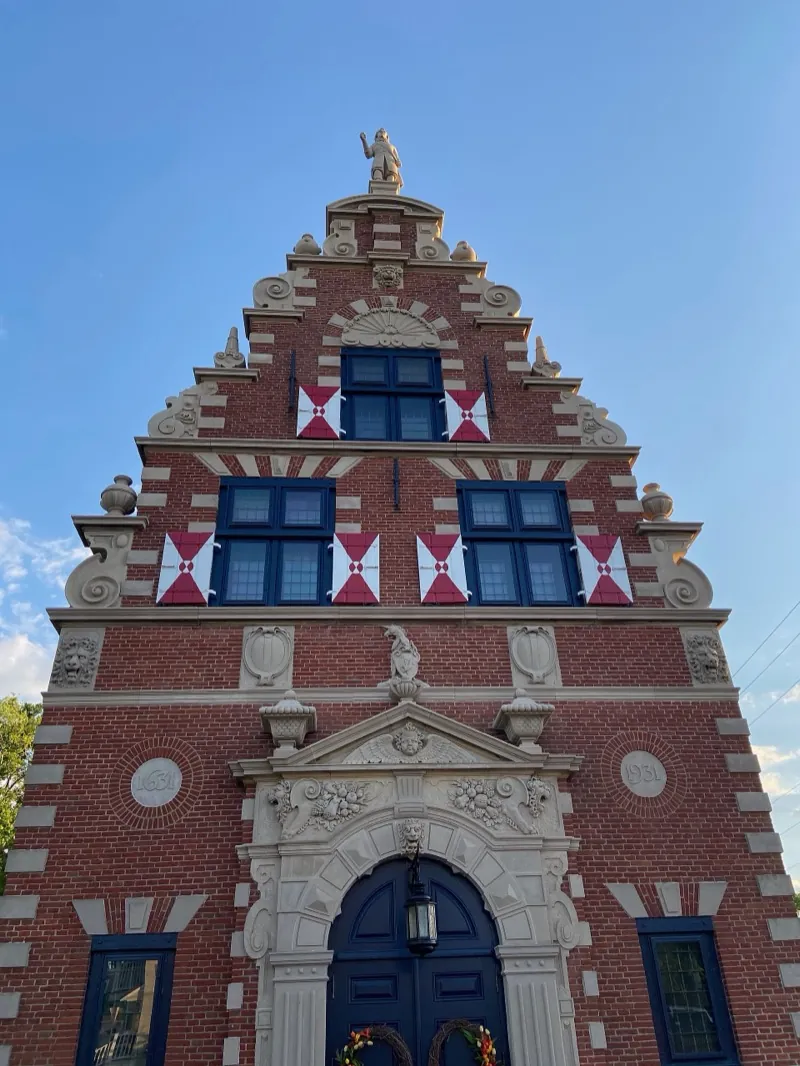
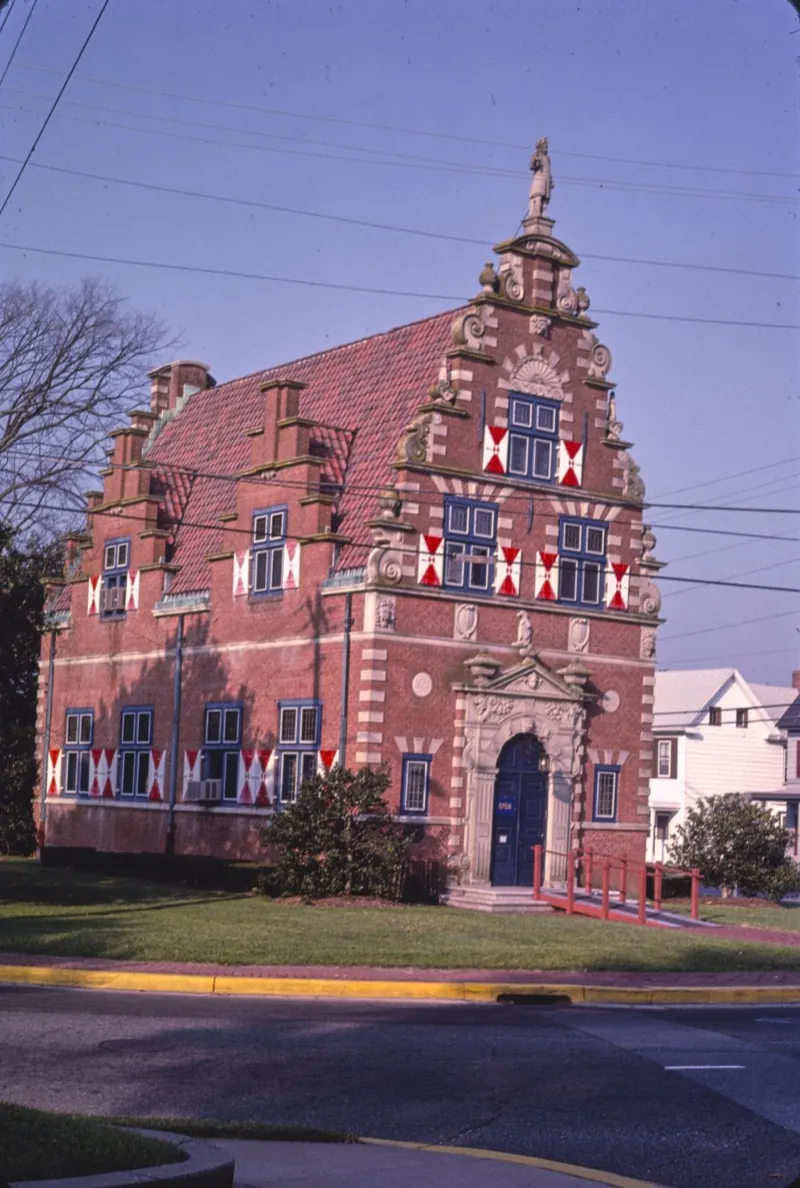
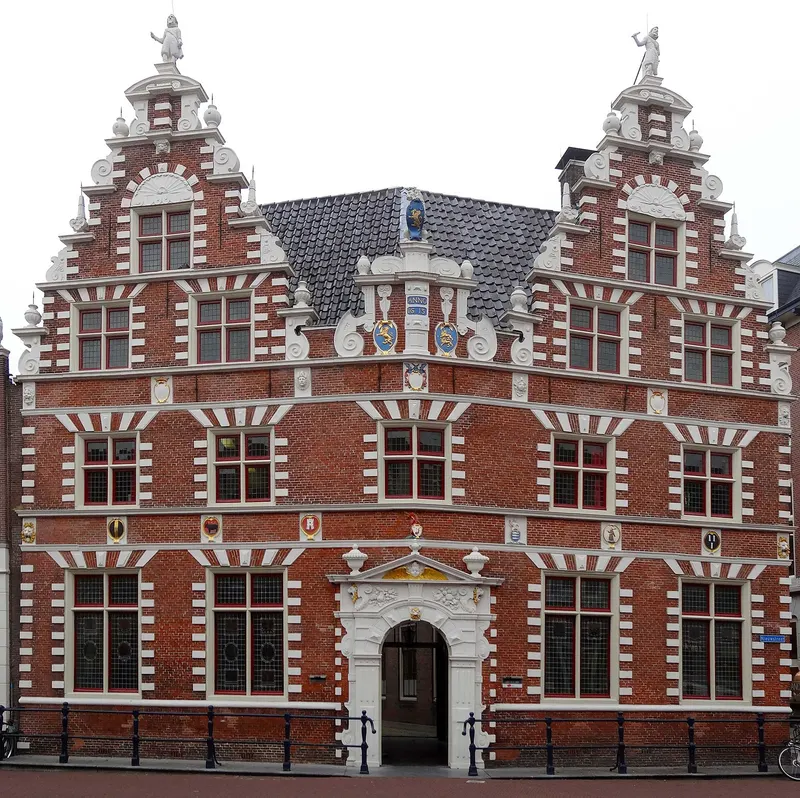

Delaware’s state museum says the building in Lewes copies the town hall of Hoorn. De Halve Maen (1969) describes that town hall: arms of 1613 on the Nieuwstraat front, once quarters for the delegates of the Seven Towns. Wikipedia names the Statenlogement, and the facade of 1613–18 in our photo fits; but we have not read a source that names the Statenlogement in the 1969 article, so treat the match as very likely, not proven.
How they found the coast: Polaris over Lewes
A pilot of the 1630s could measure latitude but not longitude. By day, he took the height of the Sun at noon; by night, the height of the Pole Star, Polaris. Lewes lies at 38.8° north, so on a clear night Polaris stands about that many degrees above the northern horizon.
But Polaris is not exactly at the celestial pole. In 1632, it was 2.7° from it; today it is 0.6°. Over one night it therefore swung between 36.1° and 41.5° above the horizon at Lewes, and a single reading had to be corrected for the time of night. The figure shows this to scale. The principle has not changed: the standard handbook, Bowditch's American Practical Navigator, describes the same correction, which depends on where Polaris is on its small circle.
Polaris over Lewes in 1632, drawn to scale. The line to the pole rises 38.8° above the horizon; the small circle is Polaris's daily path around the pole, 2.7° in radius.
Hoorn after Swanendael
In 1637, a few years after the colony ended, Andreas Cellarius became rector of the Latin School in Hoorn. His Harmonia Macrocosmica (1660) is an atlas of ways of picturing the universe, not a pilot's guide; seafarers did not use it to navigate.
What we know and what we don't
- Known: the Walvis sailed from the Texel roadstead on December 12, 1630, with 28 men, and Swanendael was built in 1631.
- Known: De Vries sailed into the bay on December 5, 1632 and rowed into the kill on December 6, where he found the burned settlement.
- Known: early Dutch sources write the creek's name as Hoere-kil or Hoeren-kil, not as Hoorn.
- Known: Captain Pieter Heyes came from Edam and was used to whaling trips to Greenland.
- Unknown: exactly when and why the colonists were killed. The accounts are Dutch, and they differ on the numbers.
- Unknown: where the name Hoere-kil comes from. Weslager's reading is the best documented, but it is an interpretation.
- Unknown: what the Siconese themselves remembered; no account from their side is known.
- Unknown: whether the Walvis left the harbor of Hoorn itself, and whether any of the settlers came from Hoorn.
Sources
- Delaware Division of Historical and Cultural Affairs, “Zwaanendael Museum History.” history.delaware.gov
- Delaware Division of Historical and Cultural Affairs, “Take a seaside vacation—and see where Delaware's modern history began” (2015). history.delaware.gov
- C. A. Weslager, “An Early American Name Puzzle,” pp. 255–262 (American Name Society archive; published after 1950). Quotes David Pietersz. de Vries, Korte Historiael, and the Dutch report of 1650. ans-names.pitt.edu
- Wikipedia, “Zwaanendael Colony” (secondary; the source here for the tin-plate story, which it takes from De Vries). en.wikipedia.org
- British Museum, biography of David Pietersz. de Vries (born in La Rochelle; the family returned to Hoorn in 1597). britishmuseum.org
- Polaris: our own calculation, with the precession model of Vondrák, Capitaine and Wallace (2011, Astronomy & Astrophysics 534, A22) and Hipparcos star data. doi.org
- Nathaniel Bowditch, The American Practical Navigator, Pub. No. 9, vol. II (Defense Mapping Agency Hydrographic Center, 1975), article 734, “Latitude by Polaris” (a U.S. government publication, public domain). It supports the principle, not the practice of the 1630s. archive.org
- David Pietersz. de Vries, Korte Historiael ende Journaels aenteyckeninge (Hoorn, printed at Alkmaar, 1655): the title page and pages 94, 95, 100 to 104 and 190, read in the scan of the Getty copy. archive.org
- Adriaen van der Donck, Representation of New Netherland (1650), in J. Franklin Jameson, ed., Narratives of New Netherland (1909), pp. 313–314. archive.org
- Atlas of Mutual Heritage, “Swanendael, fort” (after J. Jacobs, 2015): on the name “Fort Oplandt”. atlasofmutualheritage.nl
- Richard H. Amerman, “Highlights of History of Hoorn, North Holland”, De Halve Maen, July 1969, pp. 9 to 16 (scan by the Delaware Public Archives). We cite it and do not reproduce it. archivesfiles.delaware.gov
This page was written from the sources above. Where they disagree, we say so; claims we could not confirm are left out.