Quadrans Muralis: the obsolete constellation behind the Quadrantids
In what is now the north of Boötes, near the end of the handle of the Big Dipper, there once hung a mural quadrant: a measuring instrument. The constellation vanished, but the meteor shower that seems to come from this area every January still carries its name: the Quadrantids.
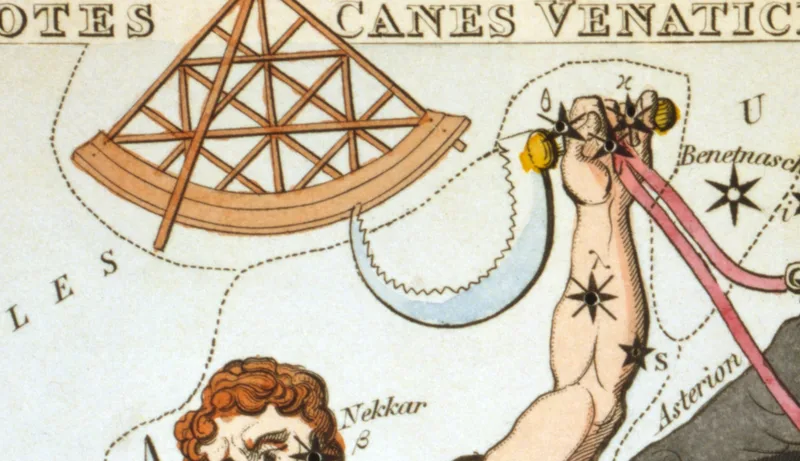
The Mural Quadrant at upper left, above the raised arm of Boötes, on card 10 of Urania's Mirror (Sidney Hall, London, 1825). The name Quadrans Muralis is at the bottom of the card.
Plate: Sidney Hall, Urania's Mirror (1825), card 10, Library of Congress (cph.3g10076), public domain; cropped by us. File on Wikimedia Commons. Digitally restored by: Adam Cuerden.

An instrument in the sky
Joseph Jérôme de Lalande (1732–1807), director of the observatory of the École Militaire in Paris, devised the constellation in 1795. It commemorated the wall-mounted quadrant that he and his nephew Michel Lefrançois de Lalande used to measure star positions ('muralis' is Latin for 'of the wall').
Forty years earlier Lacaille had filled the southern sky with constellations representing scientific instruments. Lalande followed his example by putting a quadrant in the northern sky.
From Le Mural to Quadrans Muralis
The constellation appeared in 1795 under the French name Le Mural on plate 2 of the revised Atlas Céleste of Jean-Baptiste Fortin, edited by Lalande and Pierre Méchain. In 1796 Lalande listed ten stars of 5th to 7th magnitude as its members in the Connaissance des Temps.
In 1801 Johann Bode gave it the Latin name Quadrans Muralis in his Uranographia. He made it slightly smaller than Lalande's original, to avoid overlap with its older neighbors.
Where was the Mural Quadrant?
In what is now the northern part of Boötes, just above the outstretched arm of the herdsman, with the body of Draco (the Dragon) further north. The plate shows it too: the quadrant hangs at upper left, beside the name Draco.
The Quadrantids
The Quadrantids are a meteor shower that peaks every year around the turn of the year. According to our sky calendar, the point the meteors seem to come from (the radiant) lies at right ascension 230° and declination +49.5°, in the area of this obsolete constellation. A typical maximum brings about 120 meteors per hour (ZHR).
When the shower was recognized and named in the 1830s, Quadrans Muralis was still well enough known for the shower to be named after it. The constellation itself had disappeared by the end of the nineteenth century: the IAU did not include it in its list of 88 in 1922.
What remains
In 2025 the IAU named the star 44 Boötis Quadrans. It was the brightest star of Lalande's constellation (varying between magnitude 4.7 and 4.9). In Bode's smaller version the brightest star was CL Draconis in the northern part, of magnitude 5.0.
Related
Sources
- Ian Ridpath, Star Tales, chapter 4 ('Obsolete constellations'), with a page per constellation; it also refers to the original atlases. ianridpath.com/startales/quadrans.html
- IAU Working Group on Star Names, via the overview list at exopla.net (as of September 22, 2026), for the star names. exopla.net