Felis, the Cat: an obsolete constellation
Between the snake Hydra and the Air Pump (Antlia) lie a few faint stars where a cat once sat. Felis was invented in 1799 by the French astronomer Joseph Jérôme de Lalande (1732–1807) and later disappeared. One star still bears its name.
The cat on an old chart
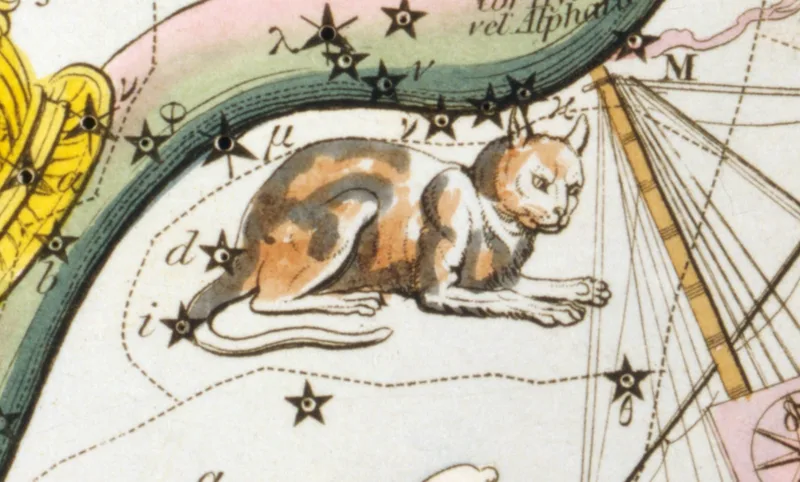
Felis under the snake Hydra, on card 32 of Urania's Mirror (Sidney Hall, London, 1825). The cat is colored here; the stars are hand-colored and pricked through.
Plate: Sidney Hall, Urania's Mirror (1825), card 32, Library of Congress (cph.3g10053), public domain; cropped by us. File on Wikimedia Commons: Wikimedia Commons. Digitally restored by: Adam Cuerden.

We do not show Bode's original drawing (Uranographia, 1801, chart XIX) here: we have not yet established under which license its scans may be used freely.
Why a cat?
Lalande had supplied Johann Bode with many star positions for his atlas and catalogue, including this part of the sky, and felt that this gave him the right to propose a few new constellations. In his Histoire abrégée de l'astronomie (1803) he wrote that there were already thirty-three animals in the sky and that he was adding a thirty-fourth: the cat. He said a recent poem about cats by Claude-Antoine Guyot-Desherbiers had inspired him.
Many books give a quotation that seems to say the opposite; it goes back to a faulty rendering of a letter by Lalande. The letter appeared in the Allgemeine Geographische Ephemeriden, vol. 3 (1799), p. 623. According to Ridpath, who checked the German text, Lalande writes that he is very fond of these animals, that he will have the cat engraved on the charts, and that the starry sky has worried him enough in his life that he may now have his joke with it.
Where was the Cat?
Felis lay between Hydra to the north and Antlia to the south, under the body of the snake, with Pyxis at lower right. Its brightest stars were of the fifth magnitude and now belong to Hydra. Lalande never drew the cat on a globe or chart himself: he suggested it to Bode, who first showed it in 1801 on chart XIX of his Uranographia.
Why did it vanish?
Other astronomers did not follow the joke. The stars were too faint to carry a figure of their own, and when the IAU fixed the list of 88 in 1922, the cat was not on it.
What is left of the Cat?
A fifth-magnitude star in the body of the cat, marked with the letter c by Bode and later cataloged as HR 3923, was named Felis by the IAU in 2018. So the cat's name lives on officially, as a star name.
Related
- the Mural Quadrant: Lalande also devised the Mural Quadrant.
- the Harvest Keeper: Lalande also devised the Harvest Keeper, in honor of Messier.
- the Balloon: Lalande also proposed the balloon.
Antlia and Pyxis, which lay next to the cat, have stayed: Lacaille invented them in the eighteenth century. See also Hydra.
Sources
- Ian Ridpath, Star Tales, chapter 4 ('Obsolete constellations'), with a page per constellation; it also refers to the original atlases. ianridpath.com/startales/felis.html
- IAU Working Group on Star Names, via the overview list at exopla.net (as of September 22, 2026), for the star names. exopla.net