Argo Navis: the ship that was taken apart
Argo is not so much obsolete as dismantled. The ship of Jason and the Argonauts was one of Ptolemy's 48 constellations, but so large and unwieldy that in the eighteenth century Lacaille divided it into three constellations: Carina, Puppis and Vela.
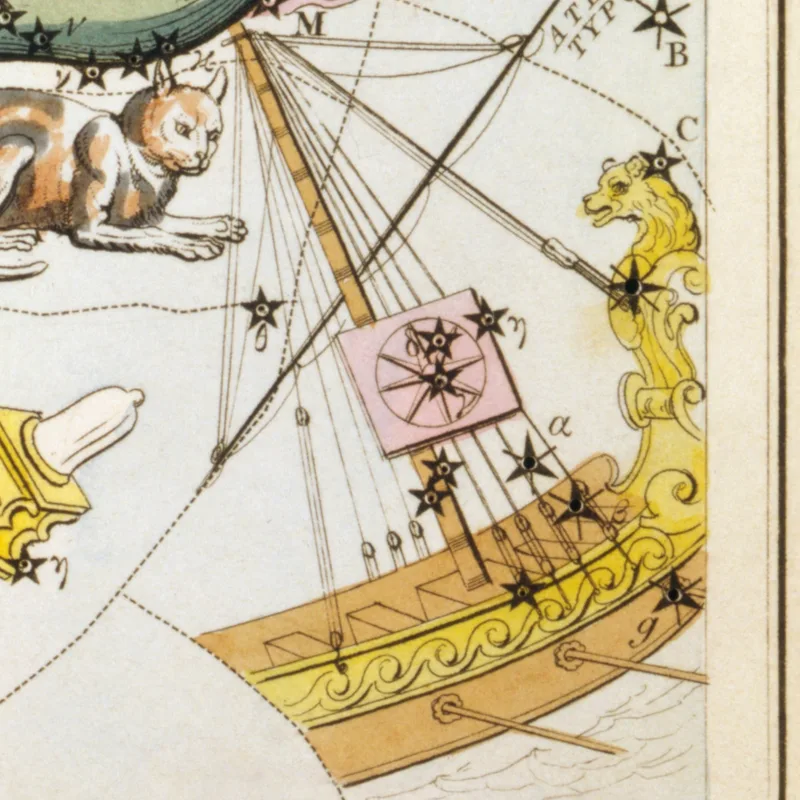
The ship Argo Navis, on card 32 of Urania's Mirror (Sidney Hall, London, 1825). The cat Felis is at upper left.
Plate: Sidney Hall, Urania's Mirror (1825), card 32, Library of Congress (cph.3g10053), public domain; cropped by us. File on Wikimedia Commons. Digitally restored by: Adam Cuerden.

Jason's ship
Argo is the 50-oared ship in which Jason and his Argonauts sailed to Colchis, on the eastern shore of the Black Sea, to fetch the golden fleece. That fleece came from the ram that is now Aries. Jason's uncle Pelias had seized the throne of Iolcus and promised to return it if Jason brought back the fleece, hoping Jason would perish on the way.
Argus built the ship under the supervision of the goddess Athene. Into the prow was fitted a speaking oak beam from the oracle at Dodona. On board were fifty great heroes, including the twins Castor and Polydeuces, the musician Orpheus and Heracles. After the return Jason dedicated the ship to Poseidon.
Three parts
In his catalogue of the southern stars (1756) Lacaille wrote that he had divided Argo into three parts: la Pouppe (Puppis, the stern), le Corps (Carina, the keel or body) and la Voilure (Vela, the sails). On his chart he still drew the ship as one figure. Put back together, the three parts would be almost 28% larger than Hydra, today's largest constellation.
There is still an echo of the unity: Lacaille used a single sequence of Greek letters for the stars, from alpha to omega, as though Argo were still whole. So there are no stars labeled alpha or beta in Puppis or Vela, the brightest star in Puppis is zeta and in Vela gamma, and there is no zeta or gamma Carinae.
Charles's Oak (Robur Carolinum)
Ptolemy describes Argo as 'cut off' ahead of the mast: only the aft part is in the sky. Map-makers solved that with a bank of mist or the Clashing Rocks. In 1678 Edmond Halley laid a new constellation over the missing prow: Robur Carolinum, Charles's Oak, in honor of King Charles II of England, who had hidden in an oak after the Battle of Worcester (1651).
Halley devised it after his stay on St. Helena (1676) and published it in 1679 in his Catalogus Stellarum Australium. His list contains Eta Carinae, the first time that eruptive variable star was recorded. Hevelius adopted the Oak in 1690 and Bode in 1801 (as Robur Caroli II), but Lacaille dropped it: he disapproved of Halley having used part of Argo.
Malus, the mast
Pyxis, the compass, is Lacaille's invention and not part of Argo. In 1844 the English astronomer John Herschel proposed replacing Pyxis with a fourth part of Argo, Malus (the mast). The proposal was not adopted; the name Pyxis Nautica was shortened to Pyxis.
What remains
The ship lives on in three constellations. Canopus, which lies on a steering oar of Argo, now belongs to Carina, and Carina also holds Eta Carinae.
Related
Sources
- Ian Ridpath, Star Tales, chapter 4 ('Obsolete constellations'), with a page per constellation; it also refers to the original atlases. ianridpath.com/startales/argo.html, ianridpath.com/startales/robur.html
- IAU Working Group on Star Names, via the overview list at exopla.net (as of September 22, 2026), for the star names. exopla.net