Mars Retrograde 2026 and 2027
About once every 26 months, Mars seems to move backward against the stars for two to three months. That is exactly when it is closest to Earth and at its brightest. Here are the dates, calculated from the planet’s position, with the time in US Eastern Time and in UTC. Below, you can read what happens in the sky and what astrologers see in it.
Now
Mars is now in the shadow before the retrograde. It is retrograde from January 10, 2027 to April 1, 2027, in Virgo. During the retrograde, it moves back from Virgo into Leo. Halfway through the period, on February 19, 2027, Mars is at opposition, with a brightness of magnitude −1.2. It is closest on February 19, 2027: about 101.4 million km.
Mars retrograde in 2026
No retrograde period of Mars begins in 2026.
Mars retrograde in 2027
| Shadow from | Retrograde | Direct again | Shadow until | Status |
|---|---|---|---|---|
| November 5, 2026 | January 10, 2027 8:01 AM EST · 1:01 PM UTC Virgo 10° 26′ | April 1, 2027 10:11 AM EDT · 2:11 PM UTC Leo 20° 56′ | June 7, 2027 | now: pre-shadow |
Another year
Times in US Eastern Time (EST or EDT) and in UTC, to the minute. Around a station, Mars almost stands still, so tables differ from one another by a few minutes. Our stations for 2025 through 2030 are within 6 minutes of JPL Horizons, and the position agrees to a hundredth of a degree. A period belongs to the year of the retrograde station, in UTC.
What happens in the sky
Mars does not really move backward. It circles the Sun in 687 days, Earth in a year. About once every 780 days, Earth overtakes Mars on its inner orbit, passing between the Sun and Mars. Seen from Earth, Mars then drifts the other way against the distant stars for two to three months: an apparent motion, like a slow car that seems to roll backward as you pass it.
By our calculation, a retrograde period of Mars between 1900 and 2100 lasts 60 to 81 days, and it moves back 10 to 20 degrees. Halfway, Mars is at opposition: on the other side of Earth from the Sun. It then rises as the Sun sets and is in the sky all night. Around opposition, Mars is also closest to Earth and at its brightest.
Why so rarely? How often a planet turns around depends on how long it takes for one planet to catch up with the other again. Mercury circles so fast (88 days) that it overtakes Earth every 116 days: three or four times a year. Venus takes 584 days, about 19 months. With Mars, it is the other way around: Mars is slower than Earth (687 days), and Earth only catches up with it again after 780 days, about 26 months.
Mars at opposition
How close Mars comes differs each time, because its orbit is an ellipse. If opposition falls near the point where Mars is closest to the Sun, it comes to about 56 million km; on the other side of its orbit, it stays at about 100 million km. Between 1900 and 2100, the brightness at opposition ranges from magnitude −1.2 to −2.9: the lower the number, the brighter.
| Retrograde | Opposition | Closest to Earth | Brightness (magnitude) |
|---|---|---|---|
| January 10, 2027 to April 1, 2027 | February 19, 2027 | February 19, 2027, 101.4 million km | −1.2 |
| February 14, 2029 to May 5, 2029 | March 25, 2029 | March 29, 2029, 96.8 million km | −1.3 |
| March 28, 2031 to June 13, 2031 | May 4, 2031 | May 11, 2031, 82.8 million km | −1.8 |
| May 26, 2033 to August 1, 2033 | June 27, 2033 | July 5, 2033, 63.3 million km | −2.5 |
| August 15, 2035 to October 15, 2035 | September 15, 2035 | September 11, 2035, 56.9 million km | −2.8 |
| October 12, 2037 to December 23, 2037 | November 19, 2037 | November 11, 2037, 73.8 million km | −2.2 |
Dates in this page’s time zone. Opposition is the moment the Sun, Earth and Mars line up as seen from above. The closest distance can fall more than a week away from it, because the orbits are not circles. Our own calculation; the distances for 2025, 2027 and 2029 are within 2,000 km of JPL Horizons.
What astrologers see in it
In astrology, Mars stands for strife, courage and energy. In 1647 the English astrologer William Lilly called him “the lesser Infortune, author of Quarrels, Strifes, Contentions.” Popular media now present a retrograde Mars as a time when energy and motivation drop and it is better to slow down. Bustle is one example. That is a belief; no measurable effect has been shown.
From omen to psychology
In older astrology, a planet moving backward was an omen. Ptolemy wrote that a planet loses strength when it is “slow in motion or retrograde” (Tetrabiblos, book I, chapter 27; p. 39 in Ashmand’s translation). In 1647, Lilly counted “Retrograde” among a planet’s debilities, worth 5 penalty points (p. 115). For Mars, this led to concrete judgments. If a woman had run away from her husband and Mars was “Occidental and Retrograde,” then “she will return of her own will” (p. 330). And in a birth chart, a retrograde Mars took away “all Military signification”: no career as a soldier (p. 629).
In the twentieth century, astrologers read the same motion psychologically: as something turning inward. In 1992 the astrologer Erin Sullivan wrote a book on retrograde planets subtitled “Traversing the Inner Landscape.” On a retrograde Mars in the birth chart, it says: “Rampant, undifferentiated Mars is obviously dangerous, but an imprisoned Mars is equally so in a different way” (p. 164). What goes with it, Sullivan calls “the thwarted natural impetus to be number one” (pp. 165–166). What Lilly counted as a weakness in his scoring of the planets becomes an inner side of a person.
The shadow is a concept from astrology. The pre-shadow begins when Mars first reaches the degree where it will later turn direct again; the post-shadow ends when it passes the degree of the beginning again. For Mars, each lasts six to ten weeks (42 to 68 days).
History
In 1609, in the first chapter of his Astronomia nova, Johannes Kepler drew how Mars would move from 1580 to 1596 if Earth stood still at the center: a single line with a loop for every retrograde period. His book on Mars rested on the observations of Tycho Brahe, as its title says. In it, Kepler showed that Mars moves around the Sun in an ellipse.
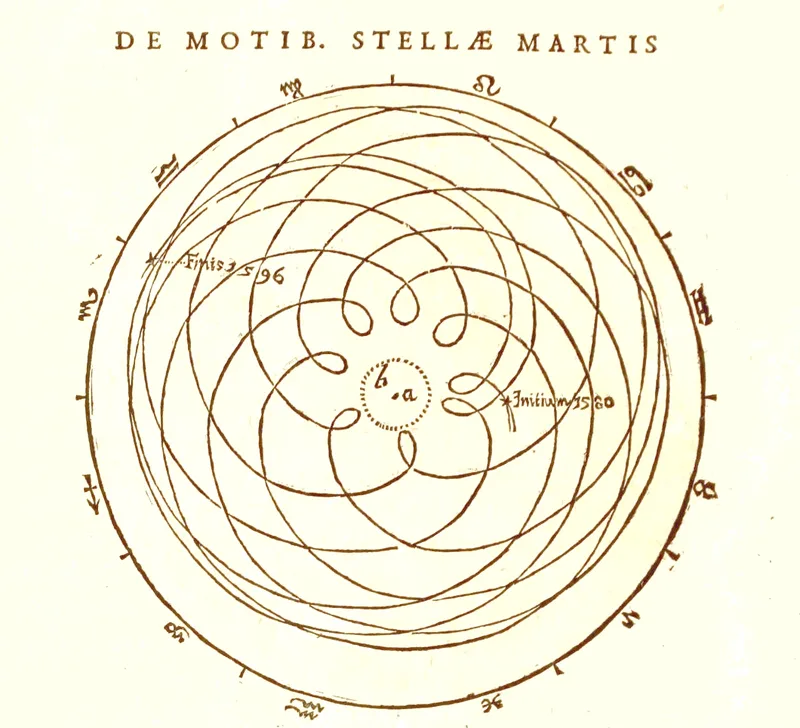

Ptolemy also explained the backward motion of Mars with epicycles, and in 1543 Copernicus made it a consequence of Earth’s own motion; he also noted that Mercury turns around more often than Venus and Mars. In 1647, William Lilly wrote that Mars is retrograde for 80 days; our calculation gives 60 to 81 days. About the explanations, and about what early astrologers thought of retrograde planets, you can read in the history of Mercury retrograde.
Questions
- What does Mars retrograde mean?
- It means that Mars, seen from Earth, seems to move the other way against the stars for two to three months. Popular media present that time as a period of lower energy and delays; that is a belief, not a measured effect.
- How often is Mars retrograde?
- About once every 26 months (780 days), and then for 60 to 81 days each time. That is why Mars is not retrograde at all in many years.
- Why is Mars closest and brightest then?
- Because Earth is overtaking Mars. The two planets are on the same side of the Sun, closest to each other, and you see Mars fully lit. Halfway through the retrograde period, Mars is at opposition.
- Why is Mars retrograde less often than Mercury?
- Earth overtakes Mars only once every 780 days, while Mercury overtakes Earth every 116 days.
- When is Mars retrograde next?
- The current or next period, and the one after it: from January 10, 2027 to April 1, 2027 (in Virgo); from February 14, 2029 to May 5, 2029 (in Libra). The times and the shadow are in the table at the top.
What we don’t know
- We do not know since when astrologers have linked a retrograde Mars with delays and lower energy; we found no historical research on it.
- We found no research into whether people argue more or undertake less during a retrograde Mars.
Sources
- JPL Horizons (NASA Jet Propulsion Laboratory): the position of Mars every five minutes around each station in 2025–2030, and the distance to Earth around the oppositions of 2025, 2027 and 2029, compared with our calculation on November 21, 2026. ssd.jpl.nasa.gov
- NASA, Planetary Fact Sheet: the orbital periods of Mercury (88 days), Venus (225 days), Earth and Mars (687 days). nssdc.gsfc.nasa.gov
- Nicolaus Copernicus, De revolutionibus (1543), book I, chapters 9 and 10, in the English translation by E. Rosen (1978).
- Johannes Kepler, Astronomia nova … de motibus stellae Martis, ex observationibus G. V. Tychonis Brahe (1609), University of Toronto copy on the Internet Archive: the drawing of the path of Mars in chapter 1. archive.org
- Ptolemy, Tetrabiblos, in the English translation by J. M. Ashmand (London: W. Foulsham, new edition), scan on the Internet Archive: book I, chapter 27, p. 39. archive.org
- William Lilly, Christian Astrology (London, 1647), Wellcome Library copy, scan on the Internet Archive: Mars on pp. 65–66 (“retrograde 80 dayes,” “the lesser Infortune, author of Quarrels, Strifes, Contentions”); the table of debilities on p. 115; the runaway wife on p. 330; profession on p. 629. archive.org
- Erin Sullivan, Retrograde Planets: Traversing the Inner Landscape (London: Arkana/Penguin, 1992): chapter 7, “Natal Mars Retrograde,” pp. 164–166.
- An example of how popular media present a retrograde Mars: Bustle, Nina Kahn, “Mars Retrograde Is About To Shake Things Up For 2 Months” (December 12, 2024). bustle.com