Obsolete constellations
Officially the sky has 88 constellations. For centuries there were more: astronomers and mapmakers kept inventing new ones, often to honour a king, a friend or an invention. Here are twenty-five of them, from old to new.
These are not constellations that were abolished. In 1922, at its first General Assembly, the International Astronomical Union (IAU) simply chose the 88 we know today; the boundaries were approved in 1928 and published in 1930. The rest stayed behind in old atlases. A number of them live on in the name of a star.
Ancient constellations, divided differently
Antinous
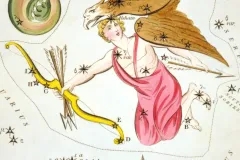

Antinous
- Invented by
- Caspar Vopel
- Year
- 1536
- Now part of
- Aquila
Ptolemy counted Antinous, the favourite of Emperor Hadrian, as part of the Eagle. Caspar Vopel first drew him as a constellation of his own in 1536, and Tycho Brahe kept him in 1602. Later he was absorbed into Aquila again.
In 2024 the IAU named the star θ Aql Antinous.
Argo Navis
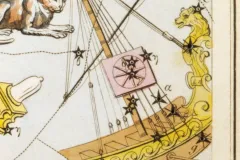

the ship Argo
- Invented by
- Lacaille
- Year
- 1756
- Now part of
- Carina, Puppis, Vela
The ship of Jason and the Argonauts was one of the ancient constellations, but it was far too large. In 1756 Lacaille divided it into Carina (the keel), Puppis (the stern) and Vela (the sails). So the ship lives on in three constellations.
Plancius and Bartsch (1612–1624)
Jordanus
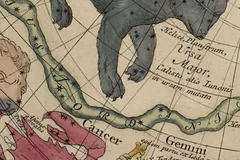
the River Jordan
- Invented by
- Plancius
- Year
- 1612
Plancius put the River Jordan on his celestial globe in 1612. Bartsch was the first to print it, in 1624.
In 2026 the IAU named the star 25 CVn Jordanus.
Tigris
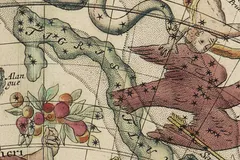
the River Tigris
- Invented by
- Plancius
- Year
- 1612
Plancius put the Tigris on his celestial globe too, in 1612. Bartsch was the first to print it, in 1624.
Gallus
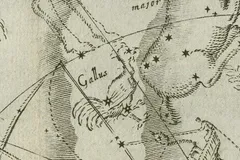

the Rooster
- Invented by
- Plancius
- Year
- 1612
Plancius added the Rooster to his celestial globe in 1612.
Musca Borealis
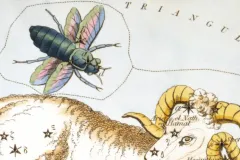

the Northern Fly
- Invented by
- Plancius, Pardies, Royer, Hevelius, Jamieson
- Year
- 1612
- Now part of
- Aries
In 1612 Plancius put a Bee (Apes) here, in Aries; in 1624 Bartsch turned it into a Wasp (Vespa). The same stars were the Lily (Lilium, so named by Royer in 1679, after Pardies in 1674) and Hevelius' Fly (1687). The name Musca Borealis is Jamieson's (1822).
In 2017 the IAU named the star 39 Ari Lilii Borea.
Hevelius, Halley and their time (1678–1690)
Robur Carolinum
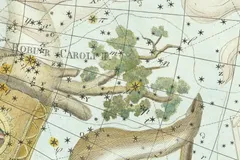

Charles's Oak
- Invented by
- Halley
- Year
- 1678
Halley made the Oak in 1678 from stars of Argo, in honour of King Charles II. It holds the first mention of Eta Carinae.
Sceptrum
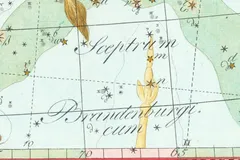

the Sceptre
- Invented by
- Royer, Kirch
- Year
- 1679
In 1679 Royer put a French sceptre in the sky. Do not confuse it with the Brandenburg Sceptre (Sceptrum Brandenburgicum), invented by Kirch in 1688 in Eridanus. The name 'Sceptrum et Manus Iustitiae' dates only from 1988.
In 2017 the IAU named the star 53 Eri Sceptrum.
Cerberus
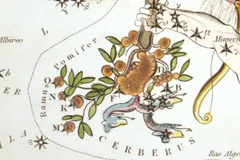

Cerberus, the hound of Hades
- Invented by
- Hevelius
- Year
- 1690
- Now part of
- Hercules
Hevelius drew Cerberus beside Hercules in his atlas of 1690, in place of Bayer's apple branch. Around 1721 Senex combined the two as 'Ramus Cerberus'. The name Ramus Pomifer (Apple Branch) comes only from Jamieson (1822).
Mons Maenalus
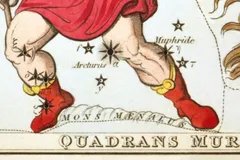

Mount Maenalus
- Invented by
- Hevelius
- Year
- 1690
- Now part of
- Boötes
Hevelius put this Arcadian mountain beneath Boötes in 1690. It was never a constellation of its own.
In 2026 the IAU named the star 109 Vir Maenalus.
Triangulum Minus
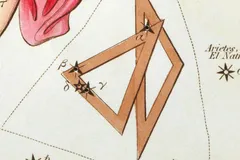

the Little Triangle
- Invented by
- Hevelius
- Year
- 1690
Hevelius put a small triangle next to the ancient Triangle. The stars now belong to Triangulum.
In 2025 the IAU named the star 6 Tri Triminus.
Le Monnier and Poczobut (1743–1777)
Rangifer
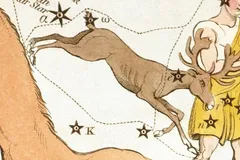

the Reindeer
- Invented by
- Le Monnier
- Year
- 1743
- Now part of
- Cepheus
Le Monnier invented the Reindeer in 1743; it is also called Tarandus.
In 2025 the IAU named the star 49 Cas Rangifer.
Noctua
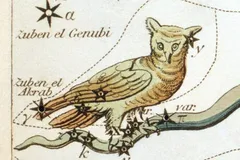
the Owl
- Invented by
- Le Monnier, Jamieson
- Year
- 1776
- Now part of
- Hydra
In 1776 Le Monnier drew the Solitary Thrush (Turdus Solitarius) near Hydra; in 1822 Jamieson renamed it the Owl (Noctua). So it is one constellation with two names.
In 2024 the IAU named the star E Hya Solitaire.
Taurus Poniatovii
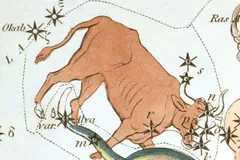

Poniatowski's Bull
- Invented by
- Poczobut
- Year
- 1777
Poczobut invented the Bull in 1777 in honour of King Stanisław August Poniatowski of Poland.
Kings and fatherlands (1787–1789)
Honores Friderici
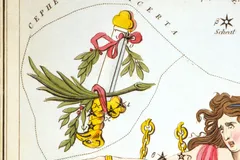
Frederick's Honour
- Invented by
- Bode
- Year
- 1787
In 1787 Bode devised 'Friedrichs Ehre' in honour of Frederick the Great; the Latin name Honores Friderici dates from 1801.
In 2025 the IAU named the star 7 And Honores.
Psalterium Georgianum
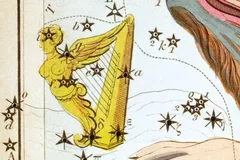

George's Harp
- Invented by
- Hell, Bode
- Year
- 1789
Hell devised the Psalterium Georgianum in 1789 for King George III; Bode called it Harpa Georgii in 1801. It is one constellation with two names.
Telescopium Herschelii
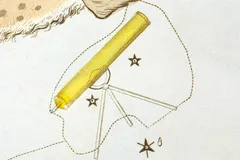

Herschel's Telescope
- Invented by
- Hell, Bode
- Year
- 1789
Hell devised two telescopes in 1789 in honour of William Herschel; Bode merged them into one in 1801.
Lalande, Bode and the instruments (1775–1801)
Custos Messium
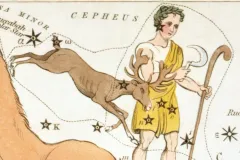
the Harvest Keeper
- Invented by
- Lalande
- Year
- 1775
- Now part of
- Cassiopeia
Lalande devised the Harvest Keeper in 1775 in honour of Charles Messier; the comet of 1774 only gave the place. In 1807 Thomas Young called it the Vineyard Keeper.
In 2025 the IAU named the star BE Cam Custos.
Quadrans Muralis
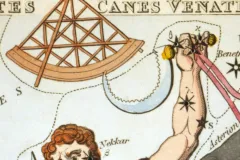
the Mural Quadrant
- Invented by
- Lalande
- Year
- 1795
- Now part of
- Boötes
Lalande devised the Mural Quadrant in 1795, first as 'Le Mural' in Fortin's Atlas Céleste; the Latin name is Bode's (1801). This constellation gives the Quadrantids their name.
In 2025 the IAU named the star 44 Boo A Quadrans.
Globus Aerostaticus
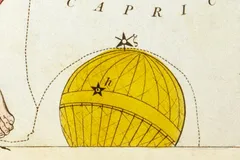

the Balloon
- Invented by
- Lalande, Bode
- Year
- 1798
Lalande proposed the Balloon in August 1798 at Gotha; Bode drew it in 1801 (chart XVI).
In 2026 the IAU named the star ε Mic Aerostaticus.
Felis
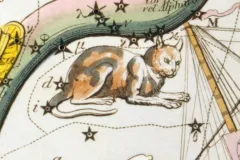
the Cat
- Invented by
- Lalande, Bode
- Year
- 1799
- Now part of
- Hydra
Lalande proposed the Cat in 1799; Bode drew it in 1801. Lalande loved cats.
In 2018 the IAU named the star HR 3923 Felis.
Lochium Funis
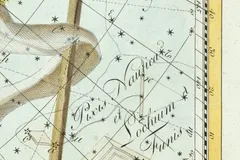
the Log-line
- Invented by
- Bode
- Year
- 1801
In 1801 Bode drew the log-line, the rope with which ships measure their speed.
Machina Electrica
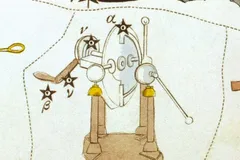
the Electrical Machine
- Invented by
- Bode
- Year
- 1801
In 1801 Bode drew an electrical machine, one of his instruments in the sky.
Officina Typographica
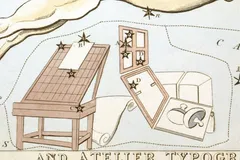

the Printing Office
- Invented by
- Bode
- Year
- 1801
In 1801 Bode drew a printing office. Urania's Mirror shows it as 'Atelier Typographique'.
The nineteenth century
Malus
We found no free historical image of this constellation.
the Mast
- Invented by
- J. Herschel
- Year
- 1844
In 1844 John Herschel proposed replacing Pyxis (the Compass) with the Mast of Argo; the proposal was not adopted.
Other skies that disappeared
- Dark constellations: figures in the dark clouds of the Milky Way, such as the Emu and the llama Yacana.
- The Christian sky: in 1627 Julius Schiller replaced the constellations with people and things from the Bible; Cellarius shows his sky on two plates.
Sources
- Ian Ridpath, Star Tales, chapter 4 ('Obsolete constellations'), with a page per constellation; it also refers to the original atlases. ianridpath.com/startales
- IAU Working Group on Star Names, via the overview list at exopla.net (as of 22 September 2026), for the star names. exopla.net
- The 88 constellations: IAU, 1922; boundaries by Delporte, 1930.