Antinous: an obsolete constellation for Hadrian's beloved
For centuries a young man hung below the Eagle (Aquila) in star atlases. Antinous is not a myth but a real person: the young beloved of the emperor Hadrian. His constellation was absorbed into Aquila again in the nineteenth century.
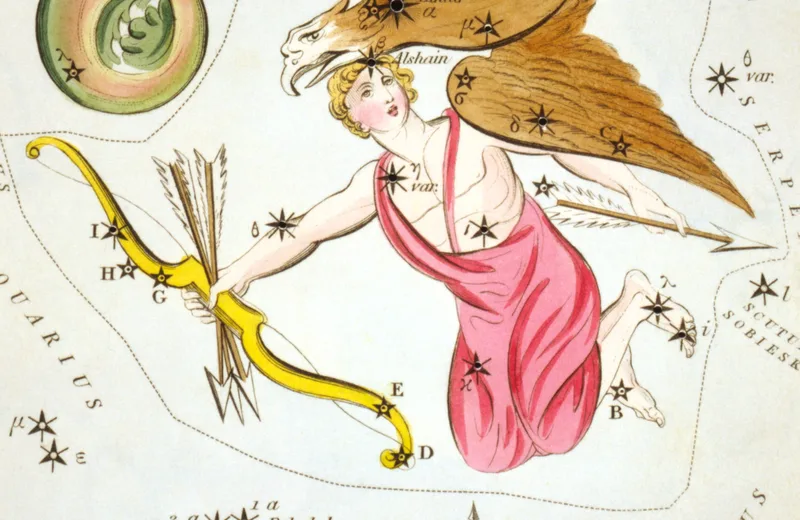
Antinous with bow and arrows below the Eagle, on card 13 of Urania's Mirror (Sidney Hall, London, 1825). The Dolphin is at upper left.
Plate: Sidney Hall, Urania's Mirror (1825), card 13, Library of Congress (cph.3g10062), public domain; cropped by us. File on Wikimedia Commons. Digitally restored by: Adam Cuerden.

A real boy
Antinous was born around AD 110 in Bithynium (also Claudiopolis), near present-day Bolu in north-western Turkey, then a Roman province. Hadrian probably met him during an official visit and took him along as his constant companion.
In AD 130 Antinous drowned on a trip up the Nile, near present-day Mallawi in Egypt. Whether it was an accident, suicide or sacrifice we do not know; according to a tradition an oracle had predicted that the emperor would be saved by the sacrifice of what he loved most. Hadrian was heartbroken. He founded the city of Antinoöpolis near the place of the drowning, declared Antinous a god and commemorated him in the sky, using stars below the Eagle that had not belonged to any constellation.
In the sky
Ptolemy mentions Antinous in the Almagest as part of Aquila, although he is not among the 48 classical Greek figures. He describes six stars of 3rd to 5th magnitude: what we now know as Eta, Theta (the brightest, magnitude 3.2), Delta, Iota, Kappa and Lambda Aquilae.
The first known depiction of Antinous as a figure is on a celestial globe by Caspar Vopel from 1536; Mercator showed him again in 1551. Tycho Brahe listed him as a separate constellation in his catalogue of 1602 (with only three stars), which brought him onto many later charts.
On the chart
Bayer imagined Antinous grasped in the claws of the Eagle, and so did Bode; on other charts he flies free, as befits a young god. Hevelius gave him a bow and arrow, perhaps recalling Hadrian's hunt for a lion in Libya. On the plate beside this text, from Urania's Mirror (1825), he holds a bow and arrows below the Eagle.
Because he hovers beneath the Eagle he is sometimes confused with Ganymede, carried off by an eagle for Zeus. Ganymede, however, is represented by Aquarius.
Why did he vanish?
Antinous remained widely accepted into the nineteenth century. After that, his stars were merged with Aquila again. When the IAU fixed the list of 88 constellations in 1922, he was no longer on it.
What remains
The brightest star of Antinous, Theta Aquilae, was officially named Antinous by the IAU in 2024. On Bode's chart the star in the shoulder of Antinous is marked as variable: that is Eta Aquilae, one of the brightest known Cepheid variables.
Related
Sources
- Ian Ridpath, Star Tales, chapter 4 ('Obsolete constellations'), with a page per constellation; it also refers to the original atlases. ianridpath.com/startales/antinous.html
- IAU Working Group on Star Names, via the overview list at exopla.net (as of 22 September 2026), for the star names. exopla.net