Musca Borealis: the Northern Fly that was once a Bee, a Wasp and a Lily
Above the back of the Ram (Aries) are four faint stars that over about two centuries were successively a bee, a wasp, a lily and a fly. Only the fly, Musca Borealis, became a lasting name. That one too has vanished, although it lives on in a star name.
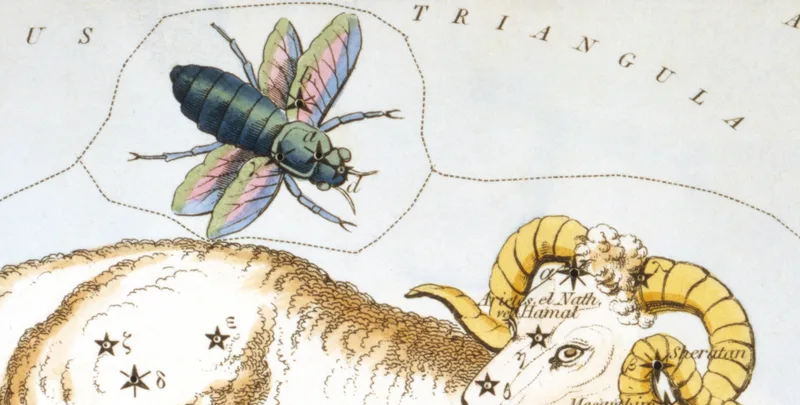
The Northern Fly above the Ram, on card 16 of Urania's Mirror (Sidney Hall, London, 1825). The constellation Aries is the ram below it.
Plate: Sidney Hall, Urania's Mirror (1825), card 16, Library of Congress (cph.3g10064), public domain; cropped by us. File on Wikimedia Commons. Digitally restored by: Adam Cuerden.

Four stars, four names
Petrus Plancius created the constellation on a celestial globe in 1612, under the name Apes, the Bee. He formed it from four 'unformed' stars of 4th and 5th magnitude that Ptolemy describes in the Almagest as lying 'over the rump' of the ram. In 1624 Jacob Bartsch changed the name on his map to Vespa, the Wasp, but kept Apes in his text.
The same four stars formed the fleur-de-lis of France for the Frenchman Ignace-Gaston Pardies, in an atlas of 1674 (the year after his death). The name Lilium first appears five years later in Augustin Royer's Cartes du Ciel (1679), in which Royer enlarged the lily to seven stars.
In 1687 Hevelius made a fly of it, Musca, in his Firmamentum Sobiescianum. In his catalogue it stayed four stars under Aries. The name Musca Borealis, the Northern Fly, first appears in Alexander Jamieson's Celestial Atlas of 1822.
Where was the Fly?
In the northern part of Aries. The four stars are now known as 33, 35, 39 and 41 Arietis. In 1801 Bode drew the fly within the borders of Aries; on the plate from Urania's Mirror (1825) it sits in a compartment of its own above the ram.
Why did it vanish?
There already was a Musca in the southern sky, made almost a century earlier from the observations of Keyser and de Houtman. So the name had to be extended with 'Borealis', which was confusing. In the end astronomers dropped the northern fly; the southern Musca remained.
What remains
The star 39 Arietis is called Lilii Borea: the name comes from Lacaille (in his catalogue of 1757) and was made official by the IAU in 2017. 41 Arietis, Lacaille's Lilii Austrina, is named Bharani, after the second lunar mansion (nakshatra) in Hindu astronomy, which consists of the stars 35, 39 and 41 Arietis.
Related
Sources
- Ian Ridpath, Star Tales, chapter 4 ('Obsolete constellations'), with a page per constellation; it also refers to the original atlases. ianridpath.com/startales/muscaborealis.html
- IAU Working Group on Star Names, via the overview list at exopla.net (as of 22 September 2026), for the star names. exopla.net