Gods of the planets
Long before telescopes, people watched seven lights move against the stars: the Sun, the Moon, Mercury, Venus, Mars, Jupiter and Saturn. Many cultures linked each of them to a god or gave it a name with a meaning. This page compares six of those traditions, with the names in their own scripts and with a clear line between what the sources say and what scholars infer.
One planet, many gods
The table shows the god or the name that each culture linked to each planet. Click a culture to read why the link existed and how sure it is.
| Planet | Mesopotamia | Greece | Rome | India | China | The Arabic world |
|---|---|---|---|---|---|---|
| Sun | Utu / Šamaš | ἭλιοςHelios | Sol | Sūrya | Tàiyáng | al-Shams |
| Moon | Nanna / Sîn | ΣελήνηSelene | Luna | Candra | Tàiyīn | al-Qamar |
| Mercury | Nabû | ἙρμῆςHermes · Stilbon | Mercurius | Budha | Chénxīng | ʿUṭārid |
| Venus | Inana / Ištar | ἈφροδίτηAphrodite · Phosphoros, Hesperos | Venus | Śukra | Tàibái | al-Zuhara |
| Mars | Nergal† | ἌρηςAres · Pyroeis | Mars | Maṅgala | Yínghuò | al-Mirrīkh |
| Jupiter | Marduk | ΖεύςZeus · Phaethon | Iuppiter | Bṛhaspati | Suìxīng | al-Mushtarī |
| Saturn | Ninurta† | ΚρόνοςKronos · Phainon | Saturnus | Śani | Zhènxīng | Zuḥal |
In China the planets were not gods at first but stars with names: the five planets belonged to the five phases (wood, fire, earth, metal, water). The Sun and the Moon were not part of the classical set of five.
† Given in the scholarly literature (the astronomical compendium MUL.APIN, as edited by Hunger and Pingree), but not in a source we could read ourselves.
Mesopotamia
In Mesopotamia the gods were present in the sky. In the first millennium BCE Babylonian scholars linked the Sun to Utu (Akkadian Šamaš), the Moon to Nanna (Suen or Sîn), Venus to Inana (Ištar), Mercury to Nabû, the god of writing and son of Marduk, and Jupiter to Marduk, the patron god of Babylon.
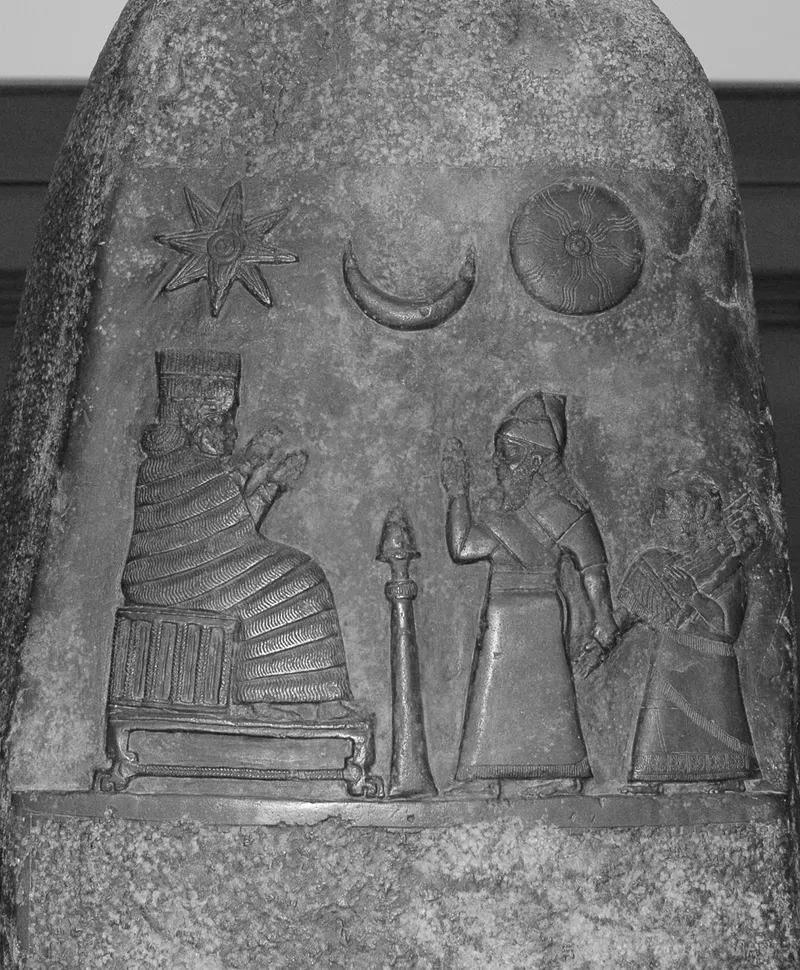
Each god had a symbol that appears on boundary stones and seals: the eight-pointed star of Ištar, the crescent of Sîn, the sun disk of Šamaš, the spade of Marduk and the stylus of Nabû. On the boundary stone of King Meli-Šipak in the Louvre the star of Ištar, the sun of Šamaš and the crescent of Sîn stand side by side above the king and his daughter.
For Mars and Saturn the handbooks give Nergal, god of war, plague and the underworld, and Ninurta, a warrior and farming god. Their source for these planet names is the Babylonian astronomical compendium MUL.APIN.
- Sun Utu / Šamaš
- Moon Nanna / Sîn
- Mercury Nabû
- Venus Inana / Ištar
- Mars Nergal†
- Jupiter Marduk
- Saturn Ninurta†
Uncertain: We could not read MUL.APIN ourselves, so the links of Nergal with Mars and Ninurta with Saturn are given here on the authority of the handbooks.
Greece
The oldest Greek names for a planet are not names of gods. Homer calls the morning star Heosphoros, the bringer of dawn, and the evening star Hesperos (Iliad 22.318 and 23.226). That they are the same planet, Venus, was recognised later.
The divine names appear in the Epinomis, a dialogue from around 350 BCE attributed to Plato or his circle. It speaks of the star of Hermes, of Aphrodite, of Ares, of Zeus and of Kronos: Ares is the reddest of all, Kronos the slowest. The author adds that the name Aphrodite suits a "Syrian lawgiver", a hint that these names came from the East.
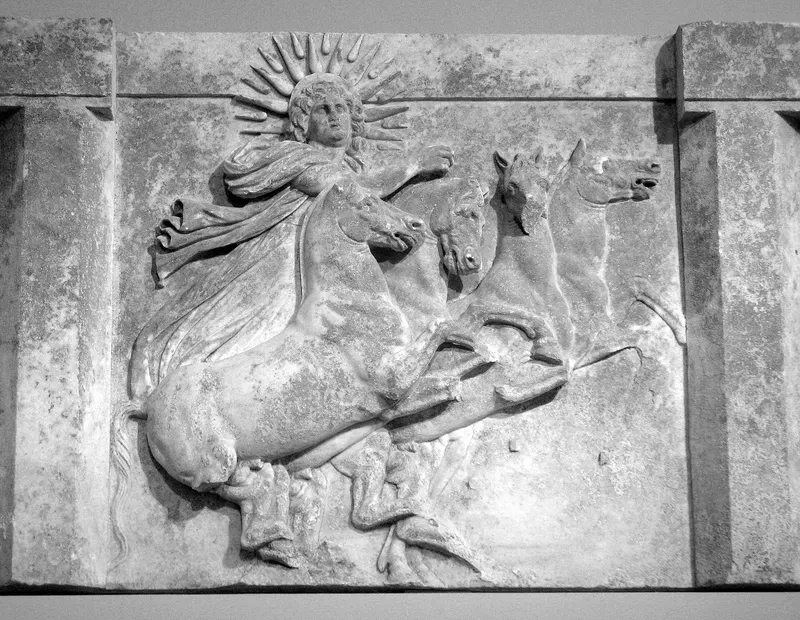
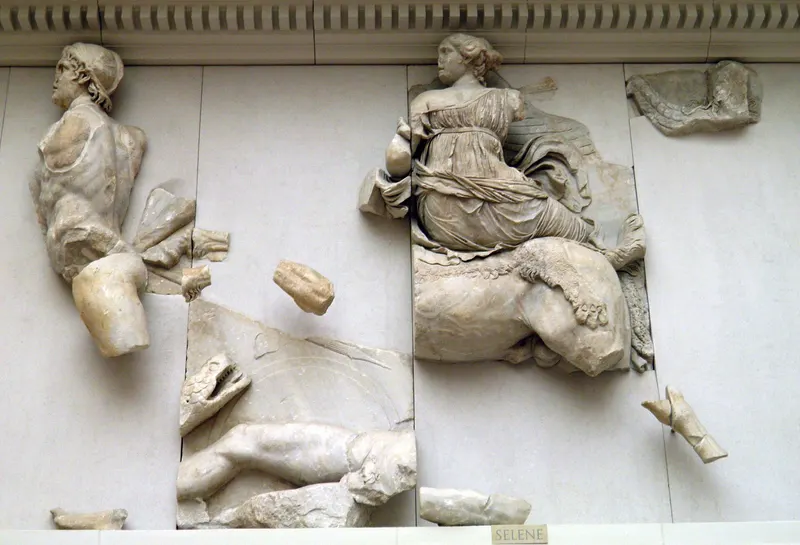
Later, in the treatise On the Cosmos attributed to Aristotle, each planet also has a descriptive name: Stilbon (the gleaming one) for Mercury, Pyroeis (the fiery one) for Mars, Phaethon (the shining one) for Jupiter and Phainon (the bright one) for Saturn. Helios and Selene, the Sun and the Moon, were gods in their own right: in the Homeric Hymn to Helios he is the son of Hyperion and the brother of Eos and Selene.
- Sun ἭλιοςHelios
- Moon ΣελήνηSelene
- Mercury ἙρμῆςHermes · Stilbon
- Venus ἈφροδίτηAphrodite · Phosphoros, Hesperos
- Mars ἌρηςAres · Pyroeis
- Jupiter ΖεύςZeus · Phaethon
- Saturn ΚρόνοςKronos · Phainon
Uncertain: That the Greeks took the planet gods directly from Babylon (Nabû as Hermes, Ištar as Aphrodite, Nergal as Ares, Marduk as Zeus, Ninurta as Kronos) is a scholarly reconstruction. No Greek source states those equations in so many words.
Rome
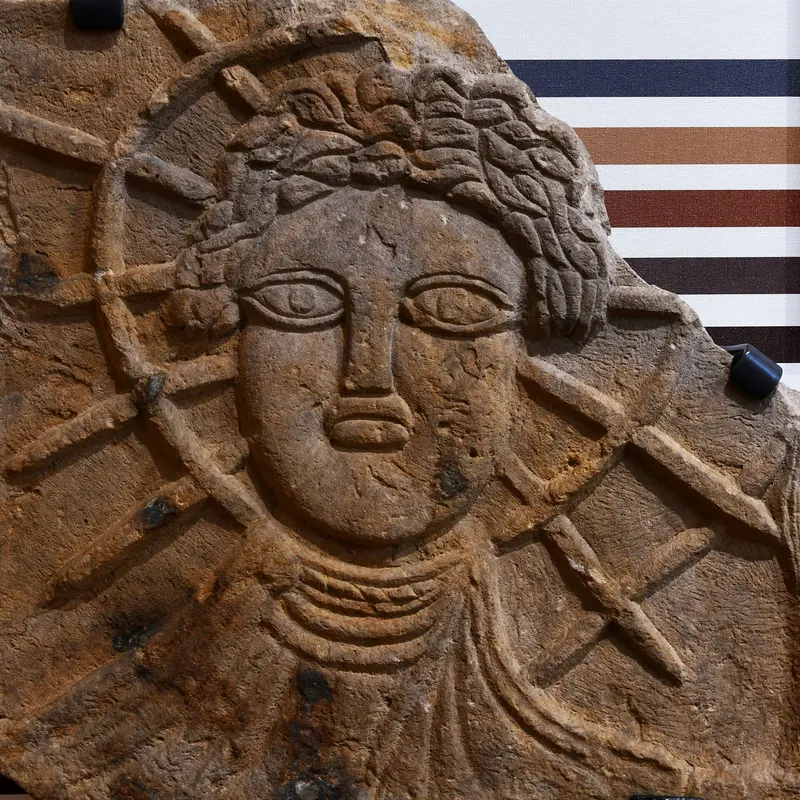
The Romans adopted the Greek pairs and gave the planets the names of their own gods: Mercurius, Venus, Mars, Iuppiter and Saturnus, with Sol and Luna for the Sun and the Moon. These are the names the planets still carry in English and most European languages.
In the poet Manilius (early first century CE) the planets keep their divine character in an astrological picture of the world: they and the signs of the zodiac shape human character and fate.
- Sun Sol
- Moon Luna
- Mercury Mercurius
- Venus Venus
- Mars Mars
- Jupiter Iuppiter
- Saturn Saturnus
Uncertain: When exactly the Latin planet names became fixed is not known to the year; by the early empire they were in common use.
India
In Indian astronomy and astrology the planets are grahas, "seizers". Their Sanskrit names are also the names of deities: Sūrya (the Sun), Candra or Soma (the Moon), Budha (Mercury), Śukra (Venus), Maṅgala (Mars), Bṛhaspati or Guru (Jupiter) and Śani (Saturn).
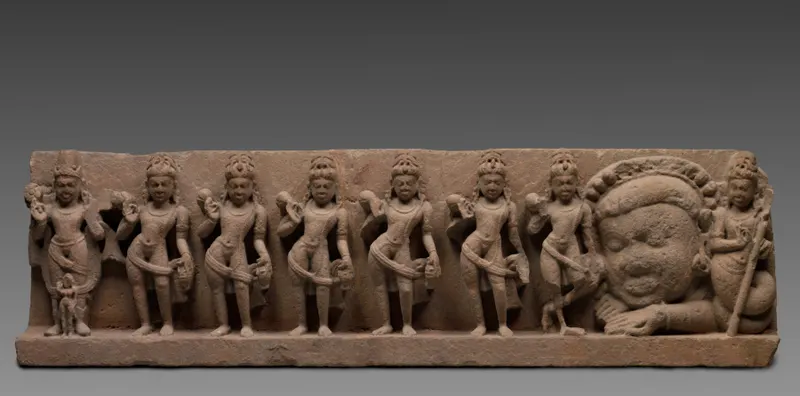
Two more bodies make the nine grahas, the navagraha: Rāhu and Ketu, which cannot be seen. On an eighth-century lintel from central India in the Cleveland Museum of Art the nine stand in a row; the museum describes Rāhu as a bodiless head, "the eclipse, who swallows the moon".
This page describes the planet deities as part of the history of astronomy. For many people in India and elsewhere they are part of a living religion.
- Sun Sūrya
- Moon Candra
- Mercury Budha
- Venus Śukra
- Mars Maṅgala
- Jupiter Bṛhaspati
- Saturn Śani
Uncertain: Ketu first meant a comet or a similar bright sign; only later did it become the descending node of the Moon's orbit. The Cleveland Museum describes the figure with the serpent tail on its lintel as a comet. How much of the Indian planet deities came from Greek astrology, and how much is older, is debated.
China
In early China the five planets were not gods but stars with their own names, each tied to one of the five phases, a direction and a kind of omen. The Records of the Grand Historian (Shiji, chapter 27, around 100 BCE) puts the Year Star (Jupiter) in the east with wood, the Sparkling Deluder (Mars) in the south with fire, the Quelling Star (Saturn) in the centre with earth, the Great White (Venus) in the west with metal and the Chronographic Star (Mercury) in the north with water.
Even older is the Wu xing zhan (Prognostics of the Five Planets), a silk manuscript from the tomb at Mawangdui, closed in 168 BCE. It describes the motions and omens of all five planets.
Later, in Daoist religion, each planet received a star lord as a deity (for example , the Star Lord of the Virtue of Wood, for Jupiter), and the Sun and the Moon were venerated as Taiyang and Taiyin. Buddhist astrology added two invisible bodies from India in the Tang period (see below).
- Sun Tàiyáng
- Moon Tàiyīn
- Mercury Chénxīng
- Venus Tàibái
- Mars Yínghuò
- Jupiter Suìxīng
- Saturn Zhènxīng
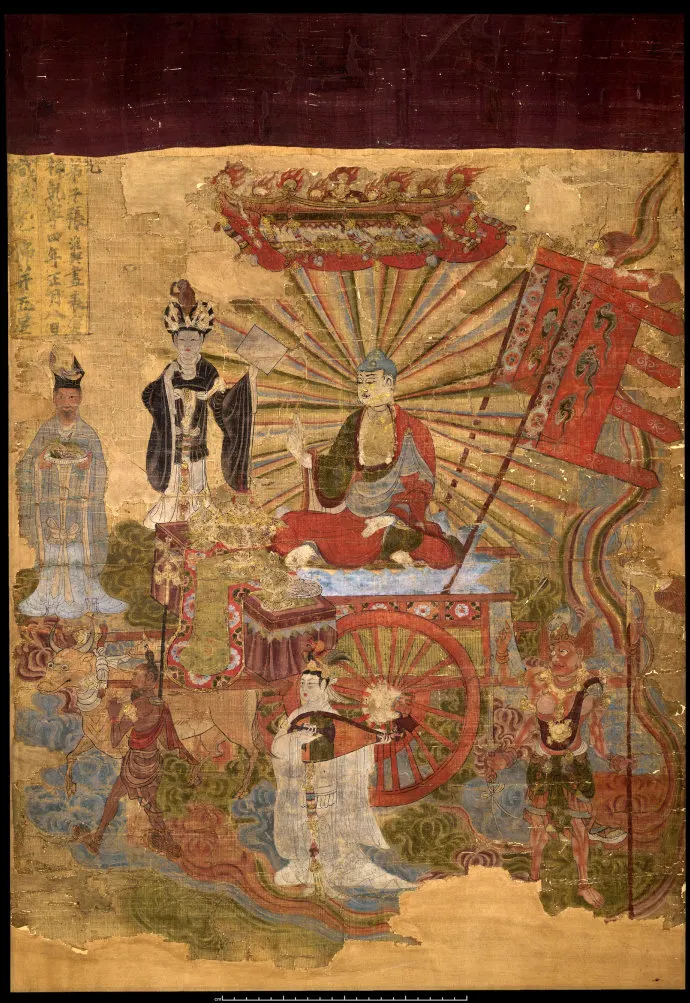
Uncertain: When the star lords were first depicted as persons is not clear from our sources for the early period; the painting from Dunhuang below, from 897, already shows the five planets as figures.
The Arabic world
Islamic astronomy and astrology inherited the seven planets from the Greek tradition, but the Arabic names are older than Islam and are not names of gods. Many have a meaning. According to the Iranist Wilhelm Eilers, ʿUṭārid (Mercury) means something like "the swift little runner", and al-Zuhara (Venus) comes from the root z-h-r, "to shine". Zuḥal (Saturn) is the one that "recedes from its place": the planet that falls behind all the others. Sun and Moon together are al-azharān, "the two radiant ones".
Other names are harder. Of al-Mirrīkh (Mars) Julius Ruska wrote that the origin of the name is unknown. Al-Mushtarī (Jupiter) is often translated as "the buyer", but Eilers argues that the name must be kept apart from that ordinary word.
Was any planet worshipped as a god in pre-Islamic Arabia? The ethnologist Josef Henninger concluded that a star cult can be defended only for Venus, and then "with a high degree of probability", not as a certainty. He also notes that no Arabic source explicitly identifies the goddess al-ʿUzzā with the planet Venus.
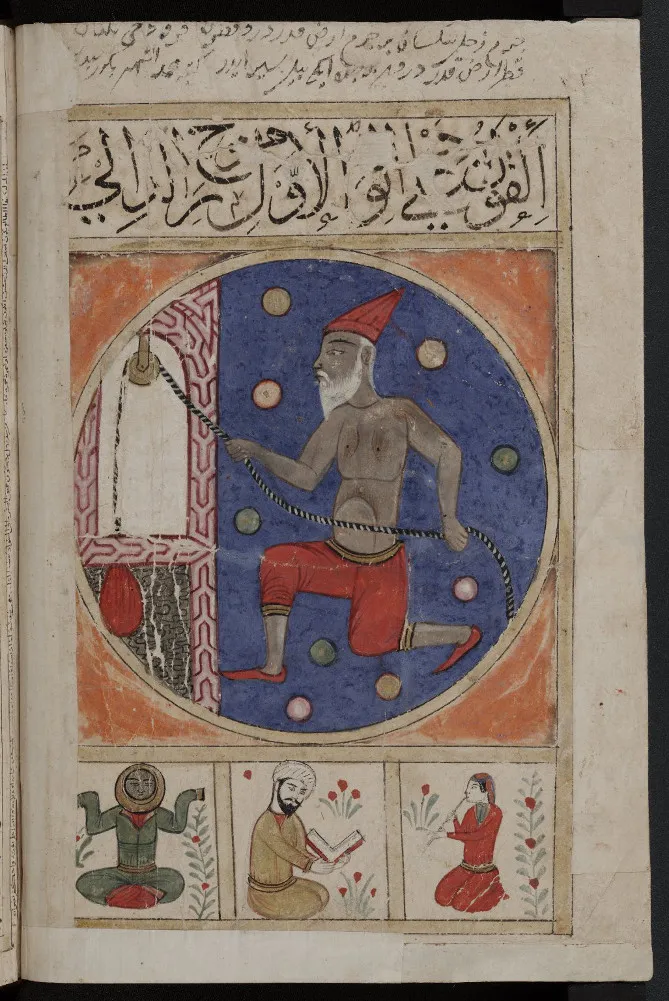
In astrology the planets kept their Greek characters. Al-Bīrūnī's Book of Instruction (1029) calls Saturn extremely cold and dry, Mars extremely hot and dry, Jupiter moderately warm and moist and Venus moderately cold and moist, and names Saturn and Mars the malefics, Jupiter and Venus the benefics. In the illustrated Book of Wonders (Kitāb al-Bulhān) Saturn appears as the lord of Aquarius, a dark-skinned man drawing water from a well.
- Sun al-Shams
- Moon al-Qamar
- Mercury ʿUṭārid
- Venus al-Zuhara
- Mars al-Mirrīkh
- Jupiter al-Mushtarī
- Saturn Zuḥal
Uncertain: Many popular accounts link other Arabian deities with the planets and describe fixed images of each planet in Islamic art; we found those claims only in secondary summaries without a source we could check, so they are not on this page.


How the names travelled
The planet gods were not invented separately in each place. In the Hellenistic period (after about 300 BCE) Babylonian planet names and omen astrology reached the Greek world; the Greek divine names may be translations of Babylonian ones, but that is an inference, not a statement in the sources.
From the Greeks the names went to Rome. Through Greek horoscopic astrology they also reached India: the Yavanajātaka, the "horoscopy of the Greeks", is one of the texts of that transmission. The Indian planet deities themselves have older Indian roots.
India in turn passed on its system of nine grahas, including Rāhu and Ketu, to China. In the Tang period Buddhist texts such as the Sūtra of the Lunar Mansions and Planets () brought the seven luminaries as names for the days of the week and the nine luminaries .
The same seven planets still give their names to the days of the week in many languages. That story is on a separate page: The planets in the days of the week.
What we do not know
- For Mars and Saturn, the Babylonian gods given here come from the handbooks; we could not read the compendium MUL.APIN itself.
- Whether the Greek planet gods are translations of the Babylonian ones is likely but not stated in any Greek source.
- How much of the Indian planet deities is older than Greek astrology, and how much came with it, is a matter of scholarly debate.
- When the Chinese star lords were first shown as persons is uncertain for the period before the ninth century.
Sources
- Hermann Hunger and David Pingree, MUL.APIN: An Astronomical Compendium in Cuneiform (Horn: Berger, 1989), Archiv für Orientforschung, Beiheft 24. We have not consulted this source directly.
- Hermann Hunger and David Pingree, Astral Sciences in Mesopotamia (Leiden: Brill, 1999). brill.com
- Francesca Rochberg, The Heavenly Writing: Divination, Horoscopy, and Astronomy in Mesopotamian Culture (Cambridge University Press, 2004). archive.org
- Ulla Koch-Westenholz, Mesopotamian Astrology (Copenhagen: Museum Tusculanum Press, 1995).
- Jeremy Black and Anthony Green, Gods, Demons and Symbols of Ancient Mesopotamia (London: British Museum Press, 1992).
- Ancient Mesopotamian Gods and Goddesses (Oracc and the UK Higher Education Academy): entries on Marduk, Nabû, Inana/Ištar, Utu/Šamaš and Nanna/Suen. oracc.museum.upenn.edu
- Musée du Louvre, kudurru of King Melishipak, Sb 23. collections.louvre.fr
- Homer, Iliad 22.318 and 23.226 (Greek text, Perseus). perseus.tufts.edu
- [Plato], Epinomis 986e–987c. scaife.perseus.org
- [Aristotle], On the Cosmos 392a (Loeb Classical Library). loebclassics.com
- Franz Cumont, "Le nom des planètes et l'astrolatrie chez les Grecs", L'Antiquité classique 4 (1935), 5–43. persee.fr
- Homeric Hymn 31, to Helios. scaife.perseus.org
- The Oxford Classical Dictionary, 4th ed. (Oxford, 2012), entries on Sol, Luna and the planet gods. archive.org
- Manilius, Astronomica, ed. and trans. G. P. Goold (Loeb Classical Library, 1977). loebclassics.com
- R. S. McGregor, The Oxford Hindi-English Dictionary (Digital Dictionaries of South Asia): entries on the planet names. dsal.uchicago.edu
- David Pingree, The Yavanajātaka of Sphujidhvaja (Cambridge, MA: Harvard University Press, 1978). We have not consulted this source directly.
- Stephen Markel, Origins of the Indian Planetary Deities (Lewiston: Edwin Mellen Press, 1995). We have not consulted this source directly.
- Cleveland Museum of Art, Nine Celestial Bodies (Navagraha), 1971.61. clevelandart.org
- David W. Pankenier, Astrology and Cosmology in Early China (Cambridge University Press, 2013).
- Sima Qian, Shiji, chapter 27, Tianguan shu (Chinese Text Project). ctext.org
- Christopher Cullen, "Understanding the Planets in Ancient China: Prediction and Divination in the Wu xing zhan", Early Science and Medicine 16 (2011), 218–251. doi.org
- Xiuyao jing (Sūtra of the Lunar Mansions and Planets), Taishō no. 1299.
- Wilhelm Eilers, Sinn und Herkunft der Planetennamen, Sitzungsberichte der Bayerischen Akademie der Wissenschaften, phil.-hist. Klasse, 1975, no. 5 (Munich, 1976), pp. 15, 51, 62, 76, 84, 91, 97. publikationen.badw.de
- al-Bīrūnī, The Book of Instruction in the Elements of the Art of Astrology, trans. R. Ramsay Wright (London: Luzac, 1934), §§ 381–382, 390.
- Josef Henninger, "Über Sternkunde und Sternkult in Nord- und Zentralarabien", Zeitschrift für Ethnologie 79 (1954), 82–117; reprinted in Arabica Sacra (1981).
- Stefano Carboni, "The 'Book of Surprises' (Kitab al-bulhan) of the Bodleian Library", La Trobe Journal 91 (2013), 22–34. slv.vic.gov.au