Custos Messium and Rangifer: the Harvest Keeper and the Reindeer
In the far north, between Cepheus and Camelopardalis, a harvest keeper with a staff and a reindeer once stood side by side. Both vanished from the official list, but since 2025 stars carry their names.
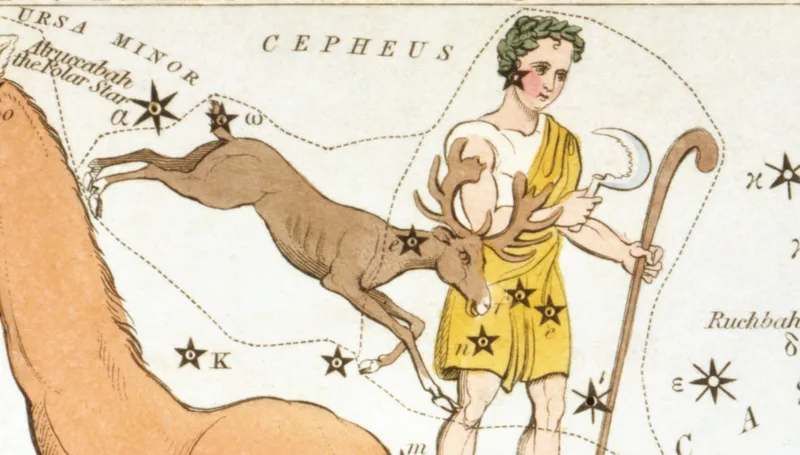
The Harvest Keeper with staff and sickle and the reindeer with antlers, on card 2 of Urania's Mirror (Sidney Hall, London, 1825). On this card the reindeer is called Tarandus.
Plate: Sidney Hall, Urania's Mirror (1825), card 2, Library of Congress (cph.3g10051), public domain; cropped by us. File on Wikimedia Commons. Digitally restored by: Adam Cuerden.

Custos Messium: a nod to Messier
Joseph Jérôme de Lalande put the Harvest Keeper on his celestial globe in 1775 and described him in the pamphlet Explication des nouveaux globes céleste et terrestre. The name is a pun on Charles Messier, the famous comet hunter; in France the constellation was often simply called 'Messier'.
Lalande chose this spot because the comet of 1774 (now C/1774 P1) was first seen here. Messier observed that comet extensively but did not discover it: that was Jacques Leibax Montaigne. On Lalande's globe the figure carries a spear; on Bode's chart (1801) he is a shepherd with a crook.
Rangifer, the Reindeer
Pierre-Charles Le Monnier put the Reindeer on a chart in his book La Théorie des Comètes in 1743, on the track of the comet of 1742 near the north pole. He chose a reindeer as a reminder of his trip to Lapland (1736–37) with the Maupertuis expedition, which went to measure the length of a degree of latitude.
At first it was called 'le Reene', a misspelling of 'le Renne'. In 1801 Bode gave it the Latin name Rangifer; some maps have Tarandus, from the reindeer's scientific name. Bode assigned it 46 stars, most of which now lie in northern Cepheus.
Where were they?
Custos Messium lay between Cepheus and Camelopardalis, in what is now northern Cassiopeia, next to Rangifer. Its brightest star was 50 Cassiopeiae, of 4th magnitude. Rangifer lay close to the north pole, also between Cepheus and Camelopardalis, and its tail pointed toward the celestial pole.
Why did they vanish?
In 1807 Thomas Young renamed the Harvest Keeper the Vineyard Keeper, but that did not widen its appeal and it faded into obscurity. Neither the Reindeer nor the Harvest Keeper is on the list of 88 that the IAU fixed in 1922.
What remains
In 2025 the IAU named BE Camelopardalis (HR 1155, magnitude around 4.4) Custos; 49 Cassiopeiae (magnitude 5.2) Rangifer; and 2 Ursae Minoris (magnitude 4.2) Tarandus.
In the same round δ Persei was named Sarvvis, after a constellation of the Sami of northern Scandinavia: a giant reindeer made up of Auriga, Perseus, Cassiopeia and Cepheus, pursued by hunters. That is a different, much larger reindeer than Le Monnier's.
Related
Sources
- Ian Ridpath, Star Tales, chapter 4 ('Obsolete constellations'), with a page per constellation; it also refers to the original atlases. ianridpath.com/startales/custosmessium.html, ianridpath.com/startales/rangifer.html
- IAU Working Group on Star Names, via the overview list at exopla.net (as of 22 September 2026), for the star names. exopla.net