The Gaulish calendar of Coligny and the druids
Little survives of the astronomy of the Celts: no star names and no zodiac. What does survive is a Gaulish calendar in bronze, a few sentences by Roman writers about the druids, and, from Ireland, fixed festival days and a way of calculating Easter of its own.
Looking for the Celtic tree horoscope? It dates from 1948: this is how it came about →
What does exist: the Coligny calendar
At the end of the nineteenth century a bronze tablet, broken into many pieces, was found near Coligny (Ain, France). It is a calendar in the Gaulish language, written in Latin letters, from the second century AD. It is kept at Lugdunum, the Gallo-Roman museum of Lyon (inventory number BR.001), which calls it one of the longest texts in a Celtic language. [1, 2]
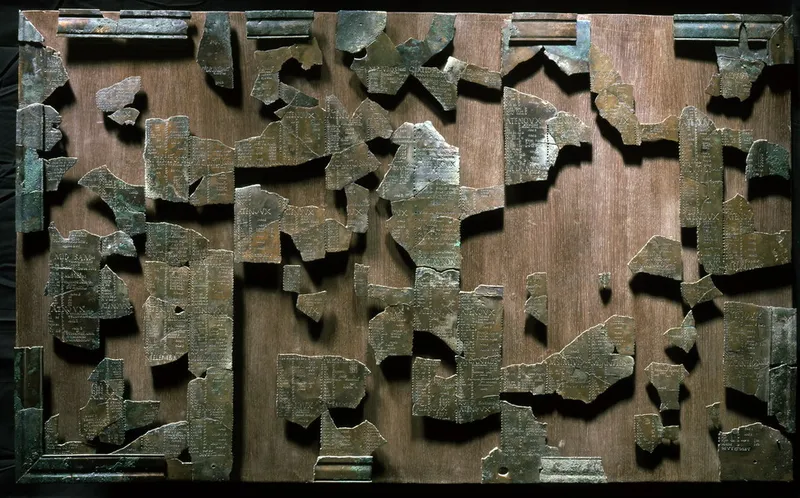
The tablet covers five years: 62 months, twelve a year plus two leap months, so that the lunar year keeps pace with the seasons. The months have 29 or 30 days and are each split into two halves. The months are marked MAT and ANM(AT); nobody knows for sure what these mean. In the month Samonios stands TRINOX SAMONI, ‘three nights of Samonios’. [2, 3]
At Villards-d’Héria (Jura), by the lake of Antre, fragments of a second calendar of the same kind were found; they were reported to the Académie des Inscriptions in 1898. [4]
What the Romans wrote about the druids
Everything we read about the astronomy of the druids comes from outsiders: Roman writers of the first centuries BC and AD. They write little, and in general terms. Below are their own words, with our translation.
Multa praeterea de sideribus atque eorum motu, de mundi ac terrarum magnitudine, de rerum natura, de deorum immortalium vi ac potestate disputant et iuventuti tradunt.
Ob eam causam spatia omnis temporis non numero dierum sed noctium finiunt; dies natales et mensum et annorum initia sic observant ut noctem dies subsequatur.
… et ante omnia sexta luna, quae principia mensum annorumque his facit et saeculi post tricesimum annum …
hi terrae mundique magnitudinem et formam, motus caeli ac siderum, et quid dii velint scire profitentur. docent multa nobilissimos gentis clam et diu, vicenis annis, aut in specu aut in abditis saltibus.
None of them mentions a constellation, a zodiac or a prediction from the stars. They only say that the druids taught ‘about the stars’.
The Irish year: four festivals
In Ireland the year is divided by four festivals: Samhain (1 November), Imbolc (1 February), Beltaine (1 May) and Lughnasa (1 August). The old tale Tochmarc Emire (which spells the names Samuin and Oimolc) says that the year had two halves: ‘summer from Beltaine (the first of May), and winter from Samuin to Beltaine’; Oimolc is ‘the beginning of spring’ and Lammas (1 August) ‘the beginning of autumn’. [8]
They are fixed days in the calendar, not positions of the sun: no early Irish text ties them to a solstice or an equinox.
Does Samhain then go back to Samonios and TRINOX SAMONI on the Coligny tablet? That is often said, and some scholars place Samonios around the end of October. It is a hypothesis: the tablet itself does not say so. [3]
Ireland and the reckoning of Easter
The early Irish church calculated Easter with a cycle of its own of 84 years; Iona only gave it up in 716. [9] Around 600 the Irish monk Columbanus wrote to Pope Gregory the Great that an Easter ‘on the twenty-first or twenty-second moon’ is ‘proved to be no Easter, considering its darkness, by many laborious scholars’. [10]
No Celtic star names
Not a single Celtic name for a star or a constellation has come down to us: not on the Coligny tablet, not in the Gaulish inscriptions and not in the early Irish or Welsh texts. What the Celts saw in the sky and what they called it, we do not know.
What we do not know
- What the Coligny tablet was for: a board on public display, with pegs in the holes to mark the day, or something for the priests.
- How long the calendar's cycle was: the tablet shows five years; whether a longer cycle lay behind it is disputed among scholars.
- What MAT and ANM(AT) mean. ‘Good’ and ‘not good’ is an interpretation, not a certain translation.
- Whether the Irish festivals really go back to the Gaulish calendar.
Sources
All Latin sentences were read in the edition named; the translations are ours. Read on 28 November 2026.
- Lugdunum, musée et théâtres romains, ‘The Gallic calendar’ (the museum page), and the museum's photograph on Wikimedia Commons (BR.001). commons.wikimedia.org
- P.-M. Duval and G. Pinault, Recueil des Inscriptions Gauloises III: Les calendriers (Coligny, Villards d’Héria) (Paris, CNRS, 1986), 442 pp. The edition of the calendar; not seen by us.
- P.-H. Billy, review of RIG III, Nouvelle revue d’onomastique 9–10 (1987), pp. 183–184 (Persée): the five-year calendar, the months of 29 and 30 days and the place of Samonios. persee.fr
- A. Héron de Villefosse, ‘Le calendrier du lac d’Antre’, Comptes rendus de l’Académie des Inscriptions et Belles-Lettres 42 (1898), pp. 264–272. Not seen by us.
- Caesar, De bello Gallico VI.14 and VI.18, Latin text ed. T. Rice Holmes (Oxford 1914), via Perseus. perseus.tufts.edu
- Pliny the Elder, Naturalis historia XVI.249–251, Latin text ed. K. Mayhoff (Teubner), via LacusCurtius; English translation by J. Bostock and H.T. Riley (London 1855) for ‘fifth day’. penelope.uchicago.edu
- Pomponius Mela, De chorographia III.18–19, ed. C. Frick (Leipzig, Teubner, 1880), via the Internet Archive. archive.org
- Tochmarc Emire, trans. K. Meyer, Archaeological Review 1 (1888), p. 233, via CELT (University College Cork). celt.ucc.ie
- D. McCarthy and D. Ó Cróinín, ‘The ‘Lost’ Irish 84-Year Easter Table Rediscovered’, Peritia 6–7 (1987–1988), pp. 227–242. We know only the bibliographic details and the abstract; we did not see the article itself.
- Columbanus, letter 1 to Pope Gregory (c. 600), ed. and trans. G.S.M. Walker, Sancti Columbani Opera (Dublin 1957), via CELT (University College Cork). celt.ucc.ie
