Huygens’s Saturn anagram
Through the telescopes of the seventeenth century, Saturn looked strange, with something on either side that came and went. In 1655 and 1656 Christiaan Huygens found a moon and an explanation. He kept the explanation secret at first, in a puzzle of 62 letters.
What the sources say
- In March 1656 Christiaan Huygens had a small booklet printed in The Hague about a moon he had found near Saturn. At the end were 62 loose letters, in alphabetical order. [1]
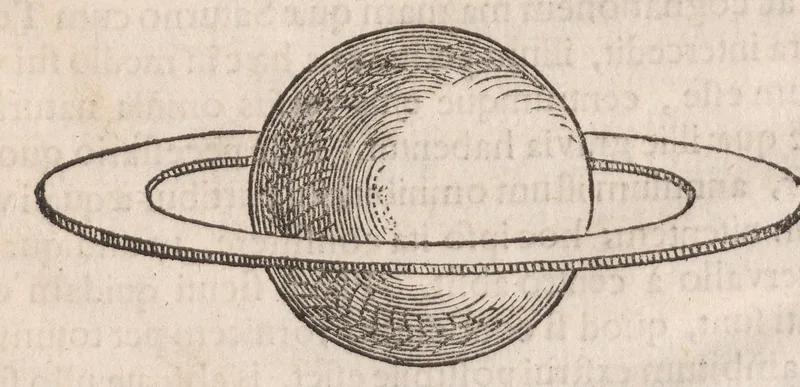
- Only in his Systema Saturnium of 1659 did he put the letters in place: Saturn is surrounded by a ring, thin and flat, which touches the planet nowhere and is inclined to the ecliptic. [2], [3]
A moon near Saturn (25 March 1655)
- On 25 March 1655, at about eight in the evening, Huygens saw a small star to the west of Saturn, about three minutes of arc from the planet. It turned out to be a moon, the moon now called Titan. [1], [3]
- He first recorded that discovery in an anagram as well. On 13 June 1655, he sent the English mathematician John Wallis a Latin line followed by seventeen loose letters. On 15 March 1656, he gave the solution: the moon goes around Saturn in sixteen days and four hours. [1]
- The editors of his Oeuvres complètes give the true mean period, measured from sun to sun as seen from Saturn: 15 days, 23 hours and 15 minutes. [1]
Anno millesimo sexcentesimo quinquagesimo quinto, Mensis Martii die quinto & vicesimo … stellulam quandam ab occasu adstantem, tribus circiter scrupulis remotam
Admovere ocvlis distantia sidera nostris, vvvvvvvcccrrhnbqx … Saturno lvna sva circunducitur diebus sexdecim horis quatuor.
John Wallis’s hoax
- On 1 July 1655, Wallis replied with a string of letters of his own, which he said contained discoveries made in England. After hearing of Huygens’s discovery, he arranged his letters so that they seemed to describe exactly that discovery. [1]
- Huygens found the sentences long-winded and the phrase ‘lunando vehitur’ odd, but he did not doubt that the English had beaten him to it. Wallis left him in that belief until January 1659; only then did he admit the hoax. [1]
Saturni Comes quasi lunando vehitur. Diebus sexdecim circuitu rotatur. Novas super Saturni formas Telescopo vidimus primitus. Plura speramus.
The booklet of March 1656
- The booklet was called De Saturni luna observatio nova, ‘new observation of Saturn’s moon,’ and was published in The Hague by Adriaan Vlacq, in quarto. Huygens signed it ‘Hagae-Com. 5. Mart. 1656’: The Hague, 5 March 1656. [1]
- Why the letters? Huygens says so himself: anyone who believed they had found the same thing would have time to come forward, and no one could say that one had taken it from the other. [1]
- He worked with telescopes 12 and 23 feet long; he made the observations up to 19 February 1656, with the 12-foot telescope and the later ones with the 23-foot telescope. [3]
- For comparison, the editors name the telescopes of others in those years: Fontana had ones of 15 and 30 feet, Wallis mentions ones of 24 and 52 feet in England, Eustachio de Divinis had ones of 18 and 27 feet, and Hevelius had telescopes of 17 or 18 feet but used none longer than 12 feet for his observations. [1]
Cujus interea summam sequenti grypho consignare visum est, ut si quis fortasse idem se invenisse existimet, spatium habeat ad expromendum, neque à nobis ille aut nos ab illo mutuati dicamur.
Galileo did it first (1610)
- Huygens was not the first to hide a discovery in letters. In 1610 Galileo wrote from Florence to Prague, first about Saturn and then about Venus. Johannes Kepler printed those letters in the preface of his Dioptrice (Augsburg 1611). [7]
- For Saturn, Galileo sent the letters ‘Smaismrmilmepoetaleumidunenugttauiras.’ Kepler tried to put them in order himself and came up with ‘Salve umbistineum geminatum Martia proles,’ which contains ‘Martia proles,’ offspring of Mars. In a letter of 13 November 1610, Galileo gave the solution: ‘Altissimum planetam tergeminum observavi,’ I have observed the highest planet threefold. To him Saturn was not a single star but three together. [7]
- For Venus, the letters ‘Hæc immatura à me jam frustra leguntur o y’ followed on 11 December 1610, and on 1 January 1611, the solution: ‘Cynthiæ figuras æmulatur mater amorum,’ the mother of loves imitates the shapes of Cynthia. Venus has phases like the Moon. [7]
- The Venus anagram is an exact rearrangement: 35 letters, if you count u and v, i and j, and æ and ae as the same, as in the printing of the time. For Saturn, Kepler’s printing has a d in one place where the solution needs a b; with a b they are exactly the same 37 letters. We counted this ourselves and checked it on the scan. [7]
Altissimum planetam tergeminum observavi.
The solution (1659)
- Three years later Huygens gave the solution in his Systema Saturnium, on page 47, followed directly by his drawing of Saturn with the ring. He had already told it on 28 March 1658, in a letter to Jean Chapelain. [1], [2], [3]
- The letters of 1656 and the solution of 1659 are exactly the same 62 letters: a seven times, c five times, one d, e five times, one g, one h, i seven times, l four times, m twice, n nine times, o four times, p twice, one q, r twice, one s, t five times and u five times. We counted them ourselves, with u and v as one letter, as in the printing of the time. [1], [2]
- Note: the booklet is dated 5 March 1656, but in the Systema Huygens writes that he published the letters on 25 March 1656. [1], [2]
Et haec ea ipsa hypothesis est quam anno 1656 die 25 Martij permixtis literis una cum observatione Saturniae Lunae edidimus. Erant enim Literae … quae suis locis repositae hoc significant, Annulo cingitur, tenui, plano, nusquam cohaerente, ad eclipticam inclinato.
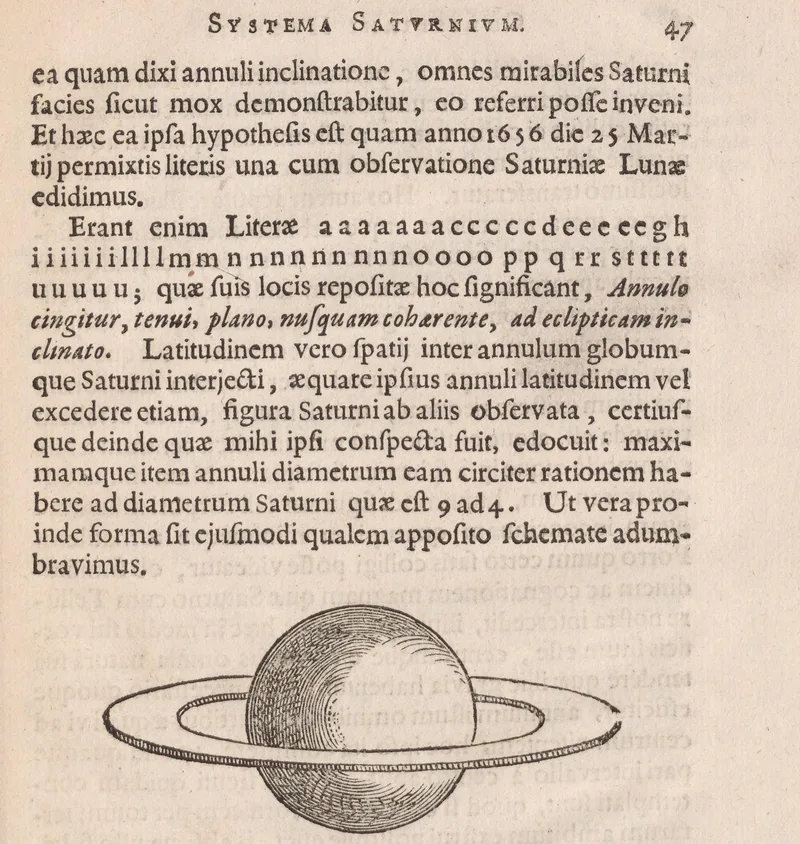
The 62 letters of 1656, in alphabetical order
aaaaaaacccccdeeeeeghiiiiiiillllmmnnnnnnnnnooooppqrrstttttuuuuu
Put in their places (1659)
Annulo cingitur, tenui, plano, nusquam cohaerente, ad eclipticam inclinato
Translation: ‘It is surrounded by a ring, thin, flat, nowhere attached, inclined to the ecliptic.’
Where his lenses are now
- Christiaan and his brother Constantijn ground their own lenses. With those lenses Christiaan discovered the moon Titan and the ring of Saturn, and the brothers scratched their names into the lenses, writes Rijksmuseum Boerhaave in Leiden. [4]
- In February 2025 Leiden University transferred about three thousand historical instruments, partly on loan to the museum since 1928, to Rijksmuseum Boerhaave; the university names Huygens’s lenses as its first example. [5]
And Cellarius?
- A year after the Systema Saturnium, Cellarius’s atlas appeared, the Harmonia Macrocosmica (1660). Huygens saw it and wrote comments on it, which we describe on the page about how the atlas was received. According to Robert van Gent, Huygens’s own discoveries are not on the plates. [6]
What we do not know
- We don’t know why the Systema gives 25 March 1656, while the booklet is dated 5 March. It is exactly one year after the first sighting of Titan, but Huygens himself does not make that connection.
- We don’t know which letters Wallis sent on 1 July 1655. The editors of Huygens’s Oeuvres do not print them; they refer to volume I, which we have not read.
- We don’t know to whom Huygens sent the booklet from March 1656 onward. The list is in volume I of the Oeuvres, which we have not read.
- We don’t know how many of Huygens’s lenses survive. We only found a number without a source we could read ourselves.
Sources
- Christiaan Huygens, De Saturni luna observatio nova (The Hague: Adriaan Vlacq, 1656), in: Oeuvres complètes, volume XV (The Hague 1925), pp. 165 to 177, with the editors’ introduction and notes (DBNL) Read: the text with the letters (pp. 173 and 177), note 7 on p. 177, notes 1 and 2 on p. 168 (the first anagram and Wallis) and note 5 on the telescopes.
- Christiaan Huygens, Systema Saturnium (The Hague 1659), in: Oeuvres complètes, volume XV (The Hague 1925), pp. 298 and 299 (DBNL) Read: the solution on p. 299 with the French translation on p. 298.
- Christiaan Huygens, Systema Saturnium (The Hague: Adriaan Vlacq, 1659), copy of the Smithsonian Libraries (Internet Archive) Viewed ourselves: p. 9 (Titan on 25 March 1655, the 12- and 23-foot telescopes) and p. 47 (the letters, the solution and the figure).
- Rijksmuseum Boerhaave, ‘Lenses That Unveil the Cosmos’ Read: the lenses of Christiaan and Constantijn Huygens and their scratched names.
- Leiden University, news item of 11 February 2025, on the transfer of the historical instruments to Rijksmuseum Boerhaave Read: about three thousand instruments went to the museum. Some of them had been on loan there since 1928. The university gives Huygens’s lenses as its first example.
- R.H. van Gent, ‘De hemelatlas van Andreas Cellarius: Het meesterwerk van een vergeten Hollandse kosmograaf,’ Caert-Thresoor 19 (2000) no. 1, pp. 9 to 25 As summarised on our page about the reception of the atlas.
- Johannes Kepler, Dioptrice (Augsburg 1611), preface with Galileo’s letters, pp. 15 to 22 (Internet Archive) Read on the scan: the letters and the solution for Saturn (pp. 15 and 16, letter of 13 November 1610) and for Venus (pp. 18 to 22, letters of 11 December 1610, and 1 January 1611).
Each number refers to the source below. What appears only on Wikipedia or in popular articles, we have left out.