Who was Cellarius?
Andreas Cellarius (around 1596 – 1665) was a schoolmaster and cosmographer. For almost thirty years he was rector of the Latin School in Hoorn, and it was there that his most famous work appeared: the Harmonia Macrocosmica, a celestial atlas with twenty-nine engraved plates. This site borrows its style from him. On this page you can read what we know about him and, just as honestly, what we do not: no portrait of him survives, his grave is unknown, and his early years are largely in the dark.
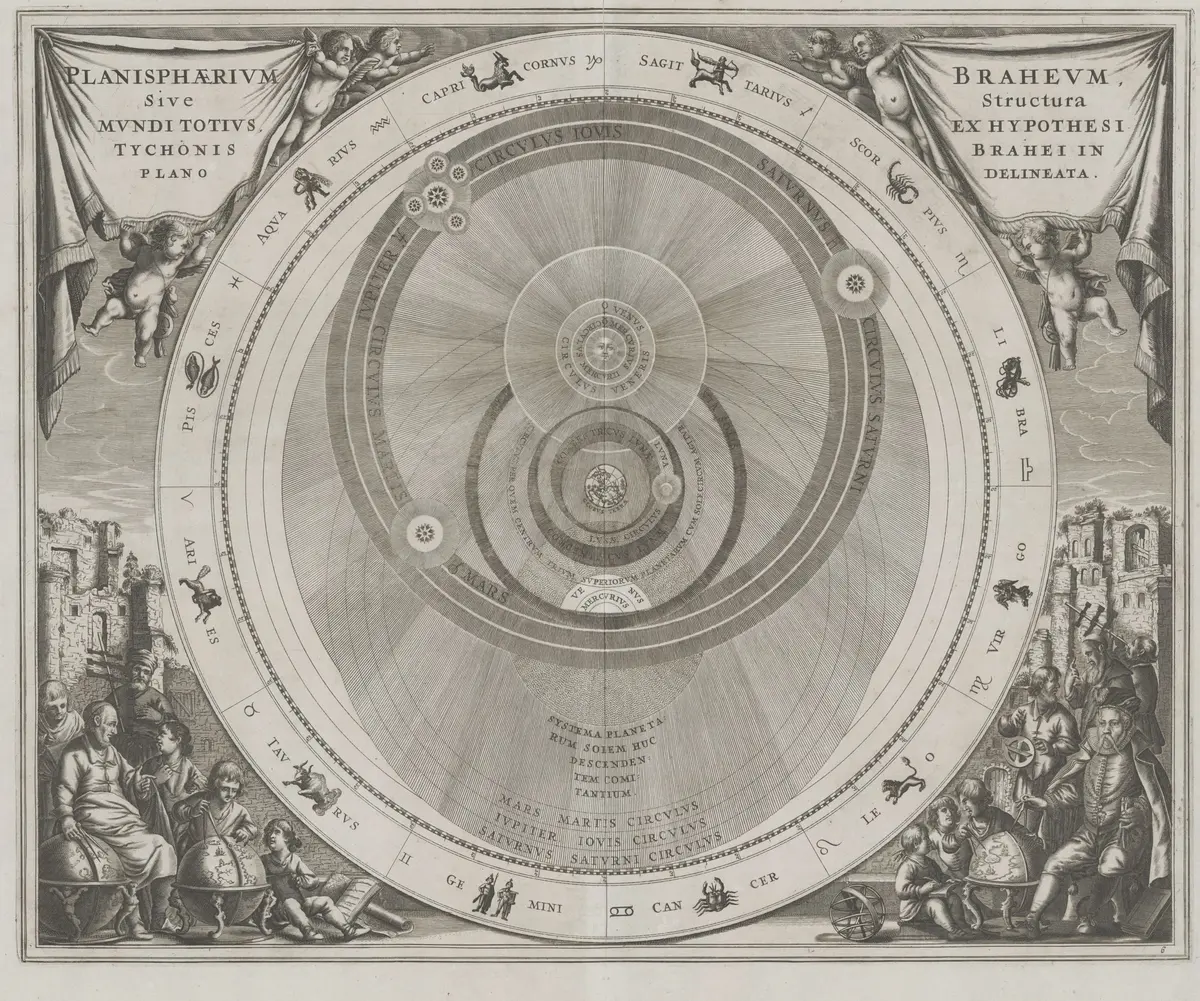
Plate 6 of the Harmonia Macrocosmica: the world system of Tycho Brahe.
Planisphaerium Braheum (plate 6) · Andreas Cellarius, Harmonia Macrocosmica (Amsterdam, Janssonius, 1660; according to Stanford possibly a 1708 impression) · Stanford University Libraries, Glen McLaughlin Map Collection of California as an Island · Public domain (Public Domain Mark) · Source
From Neuhausen to Amsterdam
Cellarius was born around 1596 in Neuhausen, near Worms, the son of the pastor Andreas Cellarius, who served there from 1596 to 1599. In 1614 he was enrolled at the University of Heidelberg. After that, the trail grows faint. From his later books on Poland and fortification it has been inferred that he spent time in Poland, perhaps as a military engineer, but there is no archival evidence for it.
Firm ground begins in 1625. That year he married Catharina Eltmans in Amsterdam; the marriage register lists him as a schoolmaster, thirty years old. The couple had at least four children: Andreas (1626), Catharina (baptised in Amsterdam in 1628) and the sons Johannes and Joris. In Amsterdam he probably taught at the Latin School in the Koestraat, although archival records are lacking. Around 1630 he moved to The Hague, where he taught at the Latin School in the former Agnietenklooster on the Zuilingstraat. Johannes and Joris were baptised there in 1631 and 1635.
Rector in Hoorn
In 1637 Cellarius became rector of the Latin School in Hoorn, and he remained so until his death. The school stood in the former Cecilia convent. Hoorn was then the capital of West Friesland and a seafaring trading town with its own chamber of the Dutch East India Company (VOC). Later the complex served as town hall, district court and police station; only the Cecilia Chapel on the Nieuwsteeg survives. In 1632 the Statencollege was completed in the city, now the Westfries Museum; the Committed Councils of West Friesland and the Northern Quarter (Gecommitteerde Raden) met there.
As rector, Cellarius prepared boys for university. His deputy was Henrick Bruno (around 1620 – 1664), earlier a tutor to Constantijn and Christiaan Huygens. Cellarius wrote laudatory poems in Bruno's Hooghe-Liedt, which shows that the two knew each other. Bruno became deputy rector in Hoorn in 1649; he is buried in the Grote Kerk.
His books
Everything Cellarius published appeared during his years in Hoorn. He wrote on fortification, in Architectura Militaris (1645, reprinted in 1656), and on Poland, in Regni Poloniae (1659; a Dutch translation followed in 1660). His celestial atlas, the Harmonia Macrocosmica, appeared in 1660/61 from Johannes Janssonius in Amsterdam. It was meant as a historical introduction to a two-part work on cosmography. The second part never appeared.
Remembrance
Cellarius died in 1665. The exact date is uncertain: Oud Hoorn (the Hoorn historical society) gives a burial on 21 November 1665, while Robert van Gent writes that he died in February or March of that year and that his eldest son Andreas was buried in November, in a rented grave near the choir of the Grote Kerk. Where Cellarius himself lies, we do not know.
In 2008, minor planet 12618 was given the name Cellarius. It was discovered on 24 September 1960 at Mount Palomar by Cornelis Johannes van Houten, Ingrid van Houten-Groeneveld and Tom Gehrels.
Remembering Cellarius in Hoorn
In Hoorn the memory of him long stayed modest. Oud Hoorn paid attention to him in 2003: in its quarterly, Ton van Weel wrote about the research of Piet Duursma. In February 2004 the Noordhollands Dagblad wrote about that research and reported that the Westfries Museum would hold an exhibition on Cellarius in the autumn; according to Oud Hoorn, that exhibition took place. At the end of an article about the atlas in the Dutch newspaper NRC (28 October 2006), Robert van Gent suggested that Hoorn could honour Cellarius, if only with a small park or an alley. Oud Hoorn took this up and called Hoorn's 650th anniversary (2007) a fine occasion. In 2007 Christ Stoffelen wrote an article about Cellarius in the quarterly.
At a glance
- 1596Cellarius is born around this year in Neuhausen, near Worms.
- 1614He is enrolled at the University of Heidelberg.
- 1625Marriage to Catharina Eltmans in Amsterdam.
- 1630Around this year in The Hague, at the Latin School.
- 1637Rector of the Latin School in Hoorn.
- 1645Architectura Militaris appears.
- 1649HoornHenrick Bruno becomes deputy rector of the school.
- 1659Regni Poloniae appears.
- 1660The Harmonia Macrocosmica appears (1660/61).
- 1664HoornHenrick Bruno dies.
- 1665Cellarius dies.
- 2008Minor planet 12618 is named Cellarius.
What we do not know
- His youth and the years between 1614 and 1625. That he was in Poland is an inference from his later books.
- His original name. Wikipedia gives Keller; Robert van Gent does not mention it, so we leave it open.
- His date of death and his grave (see above).
- What he looked like: no portrait of him survives.
- Who designed the plates of the Harmonia Macrocosmica. Ten are signed by the engraver Johannes van Loon; the sources are silent about the others.
See the plates of the Harmonia Macrocosmica
Sources
Everything on this page is written in our own words from these sources:
- Robert H. van Gent (Universiteit Utrecht), Andreas Cellarius – Biography
- Robert H. van Gent, The Plates of the Harmonia Macrocosmica of Andreas Cellarius
- Linda Hall Library, Scientist of the Day: Andreas Cellarius
- Vereniging Oud Hoorn, Cellarius, de ‘onbekende’ Horinees
- Christ Stoffelen, Andreas Cellarius: auteur van de “Harmonia Macrocosmica”, Oud Hoorn kwartaalblad 2007, nr. 3
- H.A. van Vessem, De Latijnse school in Hoorn, Westfriese Oudheden Notities 1976
- Wikipedia, Ceciliaklooster (Hoorn)
- Wikipedia, Statencollege (Hoorn)
- NASA JPL Small-Body Database: 12618 Cellarius