Yacana, the sky llama
In the Andes there is a llama in the sky. She is made not of stars but of shadow: her body is a dark lane in the Milky Way between the Southern Cross and Scorpius, and her eyes are the two bright stars Alpha and Beta Centauri. Beneath her walks her calf.
The Milky Way is called Mayu there, the river, and the animals walk along that celestial river. This page follows the fieldwork of the anthropologist Gary Urton in Quechua villages near Cusco (publications from 1981 and 1982), as summarised in later literature.
How Yacana lies in the Milky Way
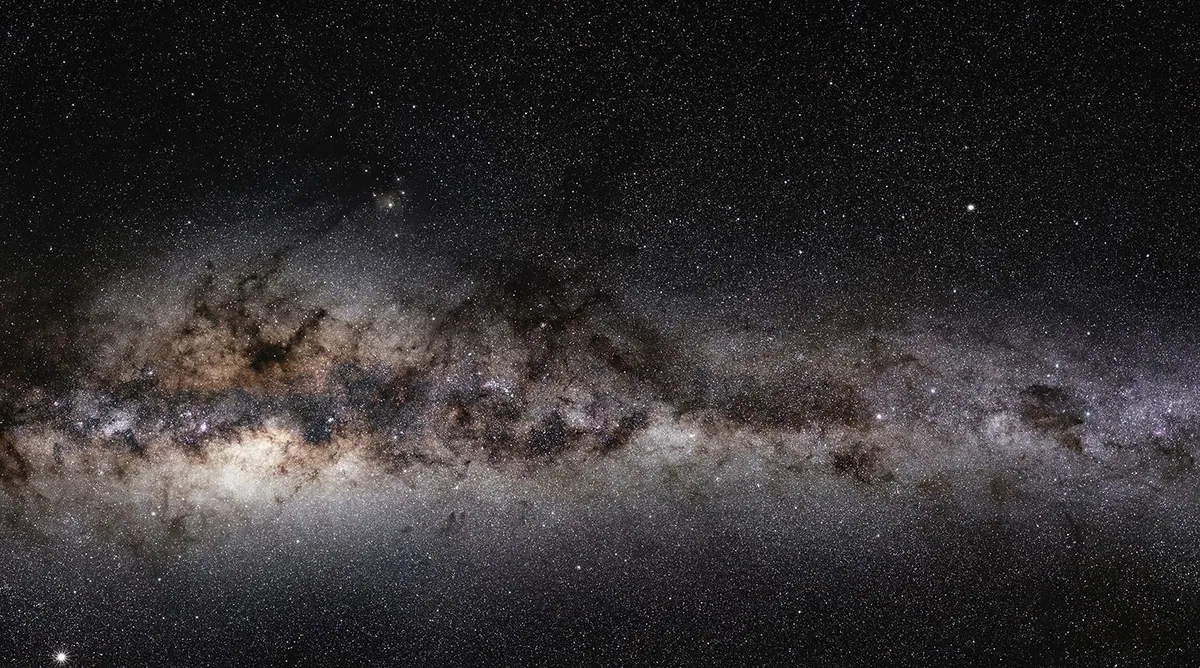
Swipe across the photo to move along the Milky Way.
Yacana and her calf, Yutu in the Coalsack, and Atoq the fox, outlined by dotted lines around the dark clouds; the llama's eyes are marked as well. This is our sketch: the traditions have no fixed drawing. Hanp'atu and Mach'acuay are not drawn here.
The dark animals
According to Urton, his Quechua informants saw six animals in the dark clouds of the southern Milky Way, between Scutum and Canis Major, as well as a second tinamou. The spelling of the names differs between sources.
- Yacana, the llama: between the Southern Cross and Epsilon Scorpii. Her eyes are Alpha and Beta Centauri.
- Uñallamacha, the llama calf: below the mother, at her breast.
- Yutu, the tinamou (a bird that resembles a partridge): the Coalsack, below the Southern Cross.
- Hanp'atu, the toad: near the Southern Cross.
- Mach'acuay, the serpent: between Adhara, in Canis Major, and the Southern Cross.
- Atoq, the fox: between the tail of Scorpius and Sagittarius.
- A second Yutu lies in the constellation Scutum.
Mayu, the celestial river
The Milky Way is called Mayu, the river, and is the celestial counterpart of the Vilcanota, the river near Cusco. In this view the water that flows on earth is the same water that flows in the celestial river, and it returns to earth in the rainy season (Magli 2005).
The dark clouds belong to the rainy season, from October to April. According to Urton, the darkness of the clouds was, and is, used to predict how much rain will fall and how the sowing will turn out (Magli 2005).
How we know this
Chroniclers from the time of the Spanish conquest, such as Garcilaso de la Vega, already wrote that the Inka saw animals in the sky, in the region of the Milky Way. But for a long time people searched in vain for constellations in the sense of lines between stars. Urton's fieldwork in the Quechua villages of Sonqo and Misminay, about 50 kilometres from Cusco, solved the puzzle: the animals are not patterns of stars but black regions of the Milky Way (Magli 2005).
According to Magli, who refers to Bauer & Dearborn (1995), the llama and the fox are certainly the same ones the Inka saw more than six hundred years ago.
The same shadows, a different animal
The Emu of the Aboriginal peoples of Australia and the llama of the Quechua in the Andes lie in the same dark lanes of the same Milky Way. They are two stories about the same shadows, told by peoples who lived far apart.
Being honest about what you read here
These are living traditions of Quechua communities, and the stories differ between villages and between sources. What is written here is a small selection of what has been recorded in scientific publications. The outline is our own sketch: there is no fixed drawing of Yacana.
From Cusco, at about 13.5 degrees south, these animals stand high in the sky. From Europe the Coalsack is never visible, and the body of the llama, near Scorpius, barely rises above the horizon.
Sources
- Magli, G. (2005). On the astronomical content of the sacred landscape of Cusco in Inka times. Nexus Network Journal 7, 22-32. arxiv.org/abs/physics/0408037
- Urton, G. (1982). At the Crossroads of the Earth and the Sky: An Andean Cosmology. University of Texas Press, Austin (as cited by Magli).
- Urton, G. (1981). Animals and Astronomy in the Quechua Universe. Proceedings of the American Philosophical Society 125(2), 110-127. dash.harvard.edu/handle/1/33703660
- Troche, K. (updated 2025). August's Night Sky Notes: The Great Rift. NASA Night Sky Network (Yacana's eyes and calf; refers to the Smithsonian National Museum of the American Indian, Inka Road). science.nasa.gov/solar-system/skywatching/night-sky-network/augusts-night-sky-notes-the-great-rift/
- Bauer, B. & Dearborn, D. (1995). Astronomy and Empire in the Ancient Andes. University of Texas Press, Austin (as cited by Magli).
- Photo: ESO/S. Brunier, cropped and edited, license CC BY 4.0. eso.org/public/images/eso0932a