The Emu in the Sky
In the southern sky lies an Emu. It is made not of stars but of shadow: its head is the Coalsack, a dark patch beside the Southern Cross, and its neck and body follow the dark lanes of the Milky Way past Scorpius.
Stories of an Emu in the Sky have been recorded in many parts of Australia. This page follows mainly what the Kamilaroi and Euahlayi peoples of northern New South Wales know about it, as researchers recorded it in 2014 in conversations with participants from the Kamilaroi, Euahlayi, Ngemba and Murrawarri communities (Fuller et al.).
How the Emu lies in the Milky Way
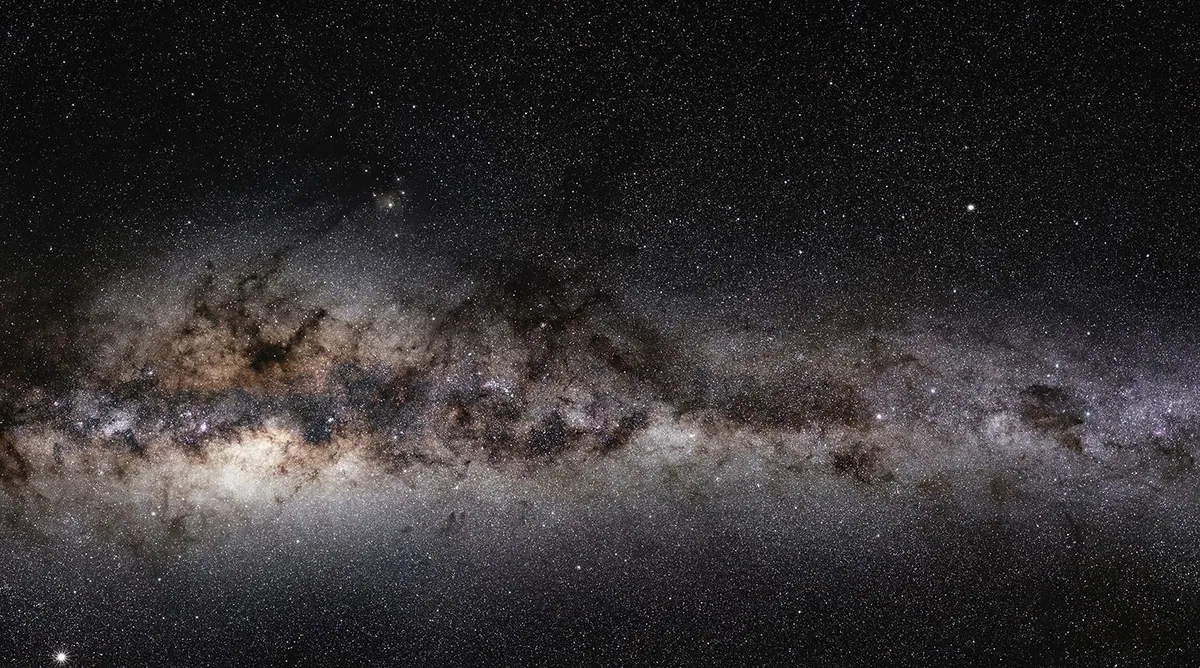
Swipe across the photo to move along the Milky Way.
Head, neck, body and tail of the Emu, outlined by dotted lines around the dark clouds. This is our sketch; its shape follows the description in the source (Fuller et al. 2014).
The Coalsack is not a hole in the sky but a cloud of dust about 600 light-years away (measurements range from roughly 500 to 650 light-years) that blocks the light of the stars behind it (Zucker et al. 2020).
The Emu's year
The Emu changes through the year, and the change follows what emus do on the ground. In this way the sky works as a calendar. The description below is for the Southern Hemisphere, where April and May are autumn, and the view is that of about nine in the evening in the area of the study, in northern New South Wales.
March
In the sky. The head and neck are already visible.
On the ground. The Emu is on its way to its full length.
April and May (autumn)
In the sky. After sunset the Emu stands at full length in the sky, from the south to the southeast. It has legs and appears to be running.
On the ground. Female emus chase the males in the mating season, and the eggs are laid. The Emu in the sky reminds people that eggs are available.
June and July (winter)
In the sky. The legs disappear. The Emu is now a male sitting on his nest.
On the ground. Among emus it is the male who incubates the eggs. The eggs are still a source of food.
August and September (late winter)
In the sky. The neck fades and only the body remains, like an egg.
On the ground. This is the sign that the chicks are hatching and that the eggs can no longer be taken. The male looks after the chicks.
Sky and ground belong together
In the stories of the Kamilaroi and Euahlayi, sky and ground belong together: what is seen in the sky is also on the ground, and the Emu in the sky is closely tied to the emu bird, an important source of food. The sky Emu helped to manage that resource: it tells people when eggs can be taken and when they cannot.
The word for the Emu in the sky is Gawarrgay or Gawarghoo; the bird on the ground is called dhinawan (after Ash et al. 2003, as cited by Fuller et al.).
Other peoples, other stories
The Emu in the sky does not belong to a single people. Fuller et al. gathered reports from across Australia, though often with few details. A few examples from their survey:
- In the 1850s the Boorong of western Victoria told of an emu living in the dark patch, the Coalsack, under the Southern Cross (Stanbridge 1857).
- In 1873 a researcher recorded a Euahlayi man pointing to an Emu in the dark space under the tree, meaning the Coalsack, with the Southern Cross as the tree (Ridley 1873).
- In a story recorded around 1904 among the Ngalea of the Great Victoria Desert, an emu goes up into the sky and becomes the dark patch in the Milky Way (Bates).
- The Wardaman of the Northern Territory connect a Cosmic Emu with songlines and rock art (Cairns & Harney 2003).
- Near Sydney, a rock engraving in the Ku-ring-gai area mirrors the Emu in shape and direction in April, when emus lay their eggs (Norris & Norris 2009).
Only the peoples themselves can say what is true in each story.
Being honest about what you read here
These are living traditions, and the stories differ between peoples and between regions. What is written here comes from publications made together with knowledge holders; the secret layers of the stories stay out, as they do in the source itself. A Euahlayi Law Man is among the authors.
From the area of the study the head of the Emu can be seen all year, because the Southern Cross never sets there. From Europe the head is never visible; only the body, near Scorpius, stands low in the south in summer.
Read on
- Dark constellations: the Milky Way with our lines and with the shadows, with a slider.
- Yacana, the sky llama: the llama, her calf and the other dark animals of the Andes.
- Why we miss the dark: what the dark patches are, and why our eye skips over them.
Sources
- Fuller, R. S., Anderson, M. G., Norris, R. P. & Trudgett, M. (2014). The Emu Sky Knowledge of the Kamilaroi and Euahlayi Peoples. Journal of Astronomical History and Heritage 17(2), 171-179. arxiv.org/abs/1403.0304
- Norris, R. P. & Norris, B. (2009). Emu Dreaming: An Introduction to Australian Aboriginal Astronomy (as cited by Fuller et al.).
- Zucker, C. et al. (2020). A compendium of distances to molecular clouds in the Star Formation Handbook. Astronomy & Astrophysics 633, A51. www.aanda.org/articles/aa/full_html/2020/01/aa36145-19/aa36145-19.html
- Photo: ESO/S. Brunier, cropped and edited, license CC BY 4.0. eso.org/public/images/eso0932a