Venus Retrograde 2026 and 2027
About once every 19 months, Venus seems to move backward against the stars for six weeks. Here are the dates, calculated from the planet’s position, with the time in the UK and in UTC. Below, you can read what happens in the sky and what astrologers see in it.
Now
Venus is now in the shadow after the retrograde, until 15 December 2026. The retrograde ran from 3 October 2026 to 14 November 2026, in Scorpio. During the retrograde, it moves back from Scorpio into Libra. Halfway through the period, on 24 October 2026, Venus passed between the Sun and Earth. It was closest on 25 October 2026: about 40.8 million km.
Venus retrograde in 2026
| Shadow from | Retrograde | Direct again | Shadow until | Status |
|---|---|---|---|---|
| 31 August 2026 | 3 October 2026 08:09 BST · 07:09 UTC Scorpio 8° 29′ | 14 November 2026 00:22 GMT · 00:22 UTC Libra 22° 52′ | 15 December 2026 | now: post-shadow |
Venus retrograde in 2027
No retrograde period of Venus begins in 2027.
Another year
Times in UK time (GMT or BST) and in UTC, to the minute. Around a station, Venus almost stands still, so tables differ from one another by a few minutes. Our stations for 2025 through 2030 are within 6 minutes of JPL Horizons, and the position agrees to a hundredth of a degree. A period belongs to the year of the retrograde station, in UTC.
What happens in the sky
Venus does not really move backward. It circles the Sun in 225 days, Earth in a year. About once every 584 days, Venus overtakes us on its inner orbit, passing between the Sun and Earth. Seen from Earth, it then drifts the other way against the distant stars for about six weeks: an apparent motion.
By our calculation, a retrograde period of Venus between 1900 and 2100 always lasts 41 to 43 days, and it moves back 15 to 17 degrees. Halfway, Venus is between the Sun and Earth (inferior conjunction) and at its closest: 40 to 43 million km. That is exactly when you can’t see it, because from Earth it is right next to the Sun. Before, it was an evening star; afterward, it becomes a morning star.
Why so rarely? How often a planet turns around depends on how long it takes for one planet to catch up with the other again. Mercury circles so fast (88 days) that it overtakes Earth every 116 days: three or four times a year. Venus is slower (225 days) and takes 584 days, about 19 months. With Mars, it is the other way around: Earth overtakes Mars, every 780 days, about 26 months.
Venus between the Sun and Earth
In the middle of every retrograde period, Venus is between the Sun and Earth. Here are the most recent and the coming ones, with the moment it is closest to Earth.
| Retrograde | Between Sun and Earth | Closest to Earth |
|---|---|---|
| 3 October 2026 to 14 November 2026 | 24 October 2026 | 25 October 2026, 40.8 million km |
| 11 May 2028 to 22 June 2028 | 1 June 2028 | 1 June 2028, 43.1 million km |
| 16 December 2029 to 26 January 2030 | 6 January 2030 | 5 January 2030, 39.7 million km |
| 20 July 2031 to 1 September 2031 | 11 August 2031 | 11 August 2031, 43.2 million km |
| 27 February 2033 to 10 April 2033 | 20 March 2033 | 20 March 2033, 41.9 million km |
| 30 September 2034 to 11 November 2034 | 21 October 2034 | 22 October 2034, 40.9 million km |
Dates in this page’s time zone. Between the Sun and Earth: the moment the Sun, Venus and Earth line up as seen from above. The closest distance falls at most a day away from it. Our own calculation; the distances for 2025 through 2030 are within 2,000 km of JPL Horizons.
What astrologers see in it
In astrology, Venus stands for love, pleasure and art. In 1647 the English astrologer William Lilly called her ‘the lesser Fortune, author of Mirth and Jolity.’ People born under Venus were, in his words, ‘oft entangled in Love-matters.’ Popular media now present a retrograde Venus as a time to take a fresh look at relationships and not to marry or make big purchases; Refinery29 is one example. That is a belief; no measurable effect has been shown.
From omen to psychology
In older astrology, a planet moving backward was an omen. Ptolemy wrote that a planet loses strength when it is ‘slow in motion or retrograde’ (Tetrabiblos, book I, chapter 27; p. 39 in Ashmand’s translation). In 1647, Lilly counted ‘Retrograde’ among a planet’s debilities, worth 5 penalty points (p. 115). For Venus, he applied this to questions of love and marriage. If a woman had run away from her husband and Venus was retrograde, she would return ‘of her owne accord’ (p. 319). And when asking when a marriage would come, a retrograde significator meant delay: ‘they prolong the time’ (p. 590).
In the twentieth century, astrologers read the same motion psychologically: as something turning inward. In 1992 the astrologer Erin Sullivan wrote a book on retrograde planets subtitled ‘Traversing the Inner Landscape.’ Sullivan treats retrograde Venus in the chapter ‘Venus, Dual Goddess,’ through the cycle the planet runs through in the sky (p. 84). What Lilly counted as a weakness in his scoring of the planets becomes an inner side of a person.
The shadow is a concept from astrology. The pre-shadow begins when Venus first reaches the degree where it will later turn direct again; the post-shadow ends when it passes the degree of the beginning again. For Venus, each lasts about a month (31 to 34 days).
History
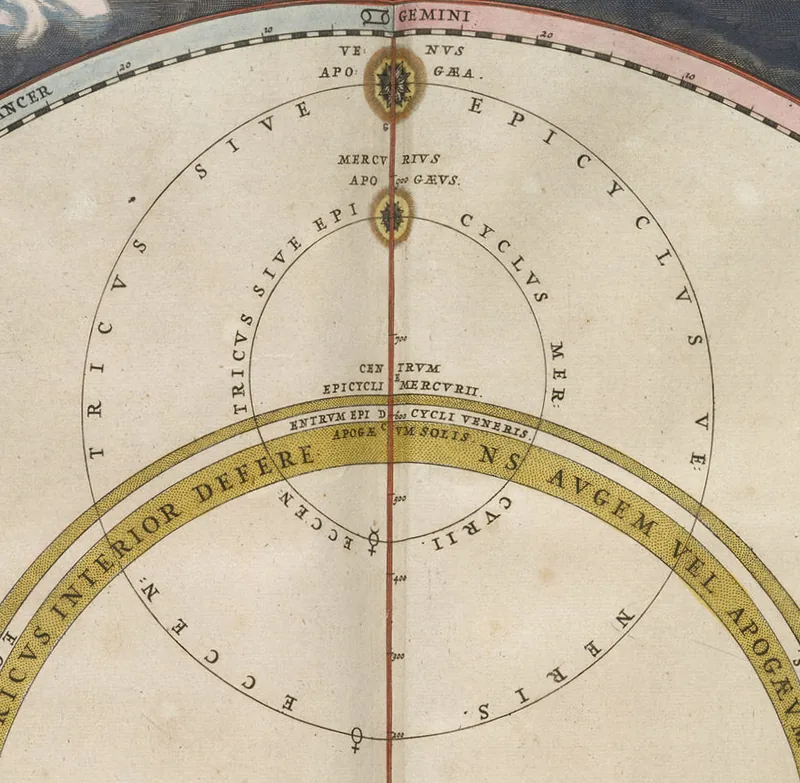
Around AD 150, Ptolemy explained the backward motion of Venus the same way as that of Mercury: the planet circles on a small circle, the epicycle, whose centre moves along a larger circle. In 1661, Cellarius drew those circles for Venus and Mercury together. In 1543, Copernicus made it a consequence of Earth’s own motion, and noted that Mercury turns around more often than Venus and Mars. In 1647, William Lilly wrote that Venus is ‘usually’ retrograde for 42 days; our calculation gives 41 to 43 days.

How the backward motion was explained later, and what early astrologers thought of retrograde planets in general, you can read in the history of Mercury retrograde.
Questions
- What does Venus retrograde mean?
- It means that Venus, seen from Earth, seems to move the other way against the stars for about six weeks. Popular media present that time as a moment to take a fresh look at love, relationships and money; that is a belief, not a measured effect.
- How often is Venus retrograde?
- About once every 19 months (584 days), for 41 to 43 days each time. With the shadow before and after, it lasts more than four months. That is why some years have no retrograde Venus.
- Why is Venus retrograde less often than Mercury?
- Venus circles the Sun more slowly. Mercury overtakes Earth every 116 days; Venus only after 584 days.
- Is Venus closer to Earth then?
- Yes. Halfway through the retrograde period, Venus is between the Sun and Earth, 40 to 43 million km away. You can’t see it then: it is right next to the Sun.
- When is Venus retrograde next?
- The current or next period, and the one after it: from 3 October 2026 to 14 November 2026 (in Scorpio); from 11 May 2028 to 22 June 2028 (in Gemini). The times and the shadow are in the table at the top.
What we don’t know
- We do not know since when astrologers have linked a retrograde Venus with love and relationships. For Mercury, this has been researched; for Venus, we found no source.
- We found no research into whether people break up more often or marry less often during a retrograde Venus.
Sources
- JPL Horizons (NASA Jet Propulsion Laboratory): the position of Venus every five minutes around each station in 2025–2030, and the distance to Earth around the middle of each period, compared with our calculation on 21 November 2026. ssd.jpl.nasa.gov
- NASA, Planetary Fact Sheet: the orbital periods of Mercury (88 days), Venus (225 days), Earth and Mars (687 days). nssdc.gsfc.nasa.gov
- Nicolaus Copernicus, De revolutionibus (1543), book I, chapters 9 and 10, in the English translation by E. Rosen (1978).
- Ptolemy, Tetrabiblos, in the English translation by J. M. Ashmand (London: W. Foulsham, new edition), scan on the Internet Archive: book I, chapter 27, p. 39. archive.org
- William Lilly, Christian Astrology (London, 1647), Wellcome Library copy, scan on the Internet Archive: Venus on pp. 73–74 (‘continue retrograde 42 dayes,’ ‘the lesser Fortune, author of Mirth and Jolity,’ ‘oft entangled in Love-matters’); the table of debilities on p. 115; the runaway wife on p. 319; marriage on p. 590. archive.org
- Erin Sullivan, Retrograde Planets: Traversing the Inner Landscape (London: Arkana/Penguin, 1992): p. 84 (‘The Cycle of Venus Retrograde,’ in the chapter ‘Venus, Dual Goddess’).
- An example of how popular media present a retrograde Venus: Refinery29, Elizabeth Gulino, ‘Venus Retrograde Means We’re Getting A Dose Of Tough Love’ (updated 11 December 2021). refinery29.com