Hoorn and Spitsbergen
Spitsbergen was found in 1596 by a voyage whose leaders had studied with a navigation teacher who later moved to Hoorn. From 1614, ships from Hoorn went whaling there for the Hoorn chamber of the Northern Company, which sat in the Hoofdtoren. This page follows what the sources themselves say.
The voyage of 1596
- On 10 May 1596, two ships sailed north from Amsterdam, with Jacob van Heemskerck, Willem Barentsz, Jan Cornelisz Rijp and Gerrit de Veer among others; De Veer described the voyage in 1598. [1]
- On 9 June they found an island at 74 degrees and 30 minutes north. After killing a polar bear there on 12 June, they named it ‘het Beyren Eylandt’: Bear Island. [1]
- On 19 June ‘sagen wy wederom landt’ (we saw land again), at 80 degrees and 11 minutes: the land later called Spitsbergen. De Veer himself does not use that name here. [1]
- On 1 July the ships parted near Bear Island. Rijp wanted to go back north; Heemskerck and Barentsz sailed to Novaya Zemlya, where they spent the winter. [1]
- Heemskerck, De Veer and Rijp had learned navigation from Robbert Robbertsz le Canu in Amsterdam; in a letter of 1627 le Canu calls them ‘myn scholieren’ (my pupils). In 1611 le Canu moved to Hoorn. [2], [3]
The Sun on Novaya Zemlya
- On 24 January 1597, De Veer, Heemskerck and a third man saw ‘de kimme vander Sonne’, the edge of the Sun, on the south side of Novaya Zemlya. Barentsz would not believe it, because by the calculation it was still about fourteen days too early. [1]
- According to Van der Werf and others, the centre of the Sun was then still 5°26′ below the horizon. It could be seen because the light was reflected several times at a layer of warmer air above cold air: the Novaya Zemlya effect. According to them, S.W. Visser showed this in 1956. [4], [5]
- From the solar declinations and the Sundays in the journal they also conclude that De Veer dated his entries in the new, Gregorian style. De Veer never says so himself. [4], [5]
- Le Canu, by then in Hoorn, did not believe a word of it. In a letter to the mapmaker Willem Jansz Blaeu, dated 14 September and signed 15 September 1627, he wrote that it must have been 6 February or 7 February when, after their long sleep, they thought it was only 24 January: ‘wel den 6 ofte 7 Februarij geweest is, als sy door haren langen slaep gemeynt hebben, dattet noch eerst den 24 Januarij was’. [3]
- He compared De Veer to a sexton whose clock struck an hour wrong and who said: ‘de son mach liegen, maer myn clock en lieght niet’ (the Sun may lie, but my clock does not). Joan Blaeu, Willem's son, printed the letter in his Grooten Atlas of 1664. [3]
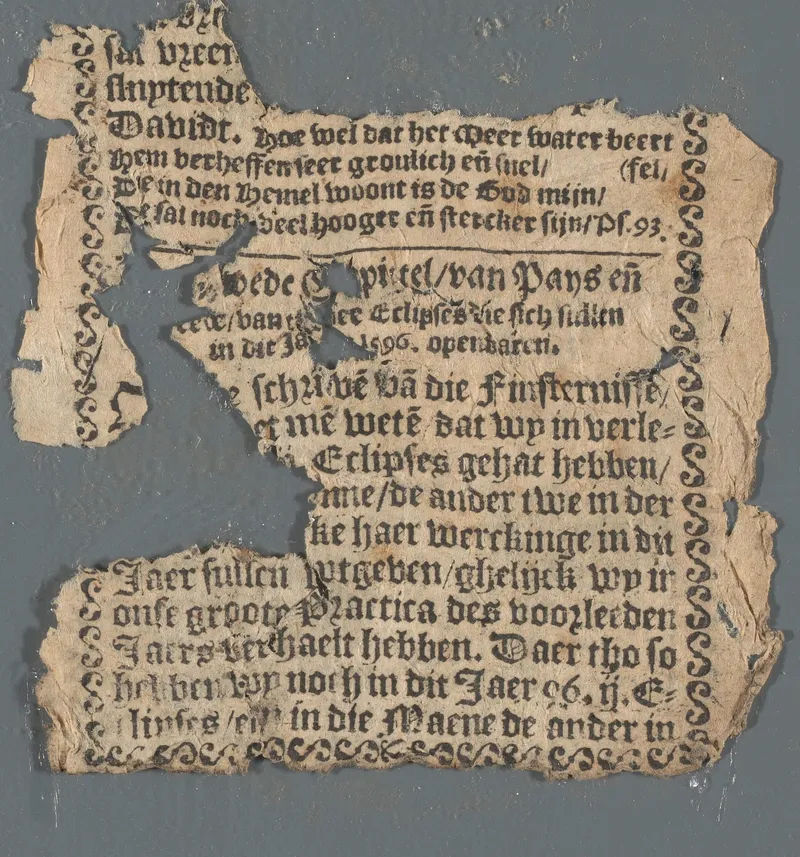
The Northern Company in the Hoofdtoren
- In 1614 the Spitsbergen Company was founded, also called the Northern Company (Noordse Compagnie), to catch whales there. According to Velius, a ship was fitted out in Hoorn that year and came home ‘wel geladen’ (well laden). [6]
- Hoorn had its own chamber (branch) in the company, as did Enkhuizen, Amsterdam, Rotterdam and Delft. [7]
- That chamber sat in the Hoofdtoren by the harbour: according to Van den Berg, ‘de pas opgerichte compagnie van Spitsbergen’ (the newly founded Spitsbergen company) moved in as early as 1614; according to Stenvert it was in the upper hall, from 1614 to 1645. A carved oak wall cupboard in the tower still recalls it; according to Van den Berg, a second cupboard and a mantelpiece frieze with whaling scenes went to the Westfries Museum. [8], [9]
- According to Hacquebord, the company existed from 1614 to 1642 and had fallen apart before 1642. The note in Velius says the company ended ‘in den jare 1645’ (in the year 1645). After that, whaling was open to everyone. [6], [7]
- In the same years, ships from Hoorn also sailed south: in 1616 Willem Schouten and Jacob Le Maire rounded Cape Horn.
The Hoorn tryworks at Smeerenburg
- On Amsterdam Island, in the northwest of Spitsbergen, Smeerenburg grew up: a settlement of tryworks, where whale blubber was boiled down into oil. [7]
- One of them belonged to the Hoorn chamber: the westernmost, very probably built in 1625 and sold in 1654 to a Rotterdam whaling firm that made no use of it. [7]
- From 1625 the Hoorn chamber fitted out one or two ships for the north almost every year, together with Enkhuizen: the Enkhuizen ship usually went to Jan Mayen, the Hoorn ship to Spitsbergen. On land, a Hoorn crew of about forty men worked. [7]
The journal of commander Raven (1639)
- On 7 May 1639, commander Dirck Albertsz Raven sailed from Texel in the ship Spitsbergen, for the ‘Groenlandts Compagnie / residerende tot Hoorn’ (the Greenland Company based in Hoorn), together with two more ships from Hoorn. [10]
- On 22 May the ship was lost in a storm and ice near Spitsbergen. The men stayed on the wreck; on 23 May there were still ‘ontrent met ons dertigen’ (about thirty of us). [10]
- On 24 May, Gale Hamkes, commander of the Oranje Boom from Harlingen, saw something drifting from the masthead, ‘menende dat het een doode Walvis was’ (thinking it was a dead whale). Through the telescope he saw it was a wreck. He took twenty men on board: ‘soo veel waren wy noch in ’t leven van 86. man’ (so many of us were still alive out of 86 men). [10], [11]
- On 24 September 1639, ‘quamen wy voor Hoorn’ (we came before Hoorn). [10], [11]
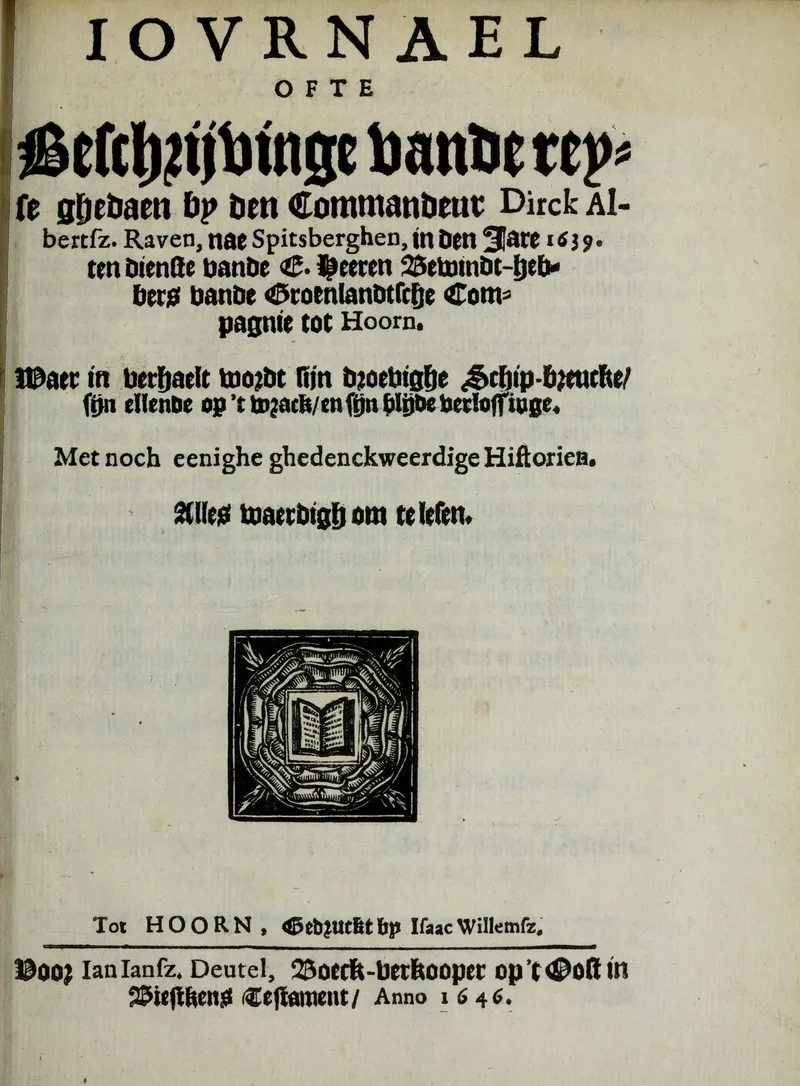
- The journal appeared in Hoorn in 1646, ‘Gedruckt by Isaac Willemsz. Voor Ian Iansz. Deutel, Boeck-verkooper op ’t Oost in Biestkens Testament’: the same address as on Bontekoe's journal of that year. [11], [12]
What we do not know
- We have not read S.W. Visser's article of 1956 (Proceedings of the KNAW); what is said about him here comes from Van der Werf and others.
- When exactly the Northern Company ended: Hacquebord says before 1642, the note in Velius 1645, and Stenvert has the company in the Hoofdtoren until 1645.
- We know le Canu's letter from De Waard's edition; we have not seen Blaeu's Grooten Atlas itself.
- Whether the land of 19 June 1596, was already called Spitsbergen: at that point De Veer calls it only ‘landt’ (land).
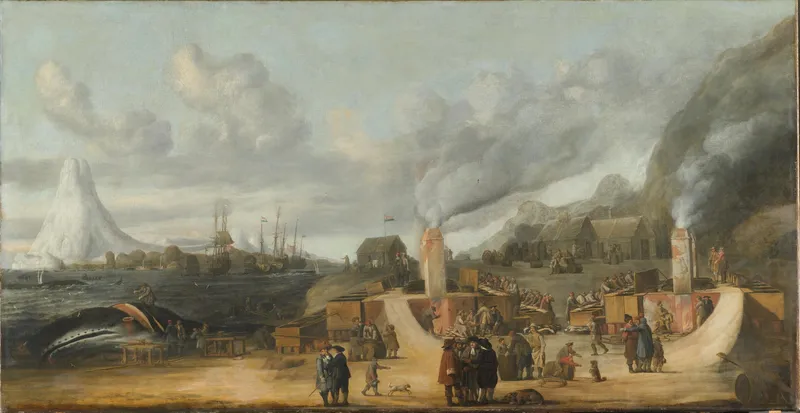
- The painting by Cornelis de Man shows a tryworks of the Northern Company, not the Hoorn one; according to the Rijksmuseum, the painter never went there.
Sources
- Gerrit de Veer, Waerachtighe beschryvinghe van drie seylagien (Amsterdam 1598), fols. 16r–19r and 34v–35r; edition by V. Roeper and D. Wildeman (DBNL) It gives the departure (10 May 1596), the island (9 June), the bear and the name Beyren Eylandt (12 June), ‘wederom landt’ (19 June) and the Sun on Novaya Zemlya (24 January 1597).
- A. van Zoonen and J. van Zoonen-Zielman, Zeshonderd jaar scholen en schoolmeesters in Hoorn 1396–1996, vol. II (Vereniging Oud Hoorn and Publicatiestichting Bas Baltus, Hoorn 2018), pp. 318–319 On le Canu and his pupils, his move to Hoorn in 1611 and the house on the Baadland. Read in the copy in the Internet Archive.
- C. de Waard (ed.), Journal tenu par Isaac Beeckman de 1604 à 1634, vol. III (The Hague, Nijhoff), Appendice I, pp. 434–438 Le Canu's letter to Willem Jansz Blaeu, dated 14 September and signed 15 September 1627, as printed in Joan Blaeu's Grooten Atlas (1664). We have not seen the atlas itself.
- S.Y. van der Werf, G.P. Können, W.H. Lehn and F. Steenhuisen, ‘Waerachtighe Beschryvinghe van het Nova-Zembla-effect’, Nederlands Tijdschrift voor Natuurkunde 66 (2000), pp. 120–126 (pdf) The Sun 5°26′ below the horizon; the new style; Visser 1956.
- S.Y. van der Werf, G.P. Können, W.H. Lehn, F. Steenhuisen and W.P.S. Davidson, ‘Gerrit de Veer’s true and perfect description of the Novaya Zemlya effect, 24–27 January 1597’, Applied Optics 42 (2003), pp. 379–389
- Th. Velius, Chronyk van Hoorn, 4th ed. (Hoorn 1740), p. 550 with note 815 (BSB) On the Spitsbergen Company in 1614 and the Hoorn ship. The note gives 1645 as the end.
- L. Hacquebord, ‘Waar archeologie en geschiedenis elkaar overlappen; historisch-archeologisch onderzoek van de Hoornse traankokerij in Smeerenburg op Spitsbergen’, Bulletin KNOB 89 (1990) no. 3, pp. 14–21 P. 15 (the chambers, 1614 to 1642) and p. 16 (the Hoorn tryworks).
- H.M. van den Berg, De Nederlandse monumenten van geschiedenis en kunst: Westfriesland, Tessel en Wieringen (1955), pp. 109 and 111
- R. Stenvert et al., Monumenten in Nederland. Noord-Holland (2006), p. 385
- B. van Tartwijk, ‘Het journaal van Commandeur Raven (I)’ and ‘(Slot)’, Oud Hoorn 21 (1999) no. 1, pp. 29–31, and no. 3, pp. 112–115 Transcription of the journal.
- Iournael ofte Beschrijvinge vande reyse ghedaen by den Commandeur Dirck Albertsz. Raven, nae Spitsbergen, inden Iare 1639 (Hoorn 1646), copy in the Koninklijke Bibliotheek (Internet Archive) Title page; leaves B i verso and B ij recto.
- Iournael ofte Gedenckwaerdige beschrijvinghe vande Oost-Indische Reyse van Willem Ysbrantsz. Bontekoe van Hoorn (Hoorn 1646), title page, copy in the Getty Research Institute (Internet Archive)
Each claim carries the number of its source. Read on 28 November 2026. Old spelling in the quotations as in the source.