Calculator · Maya calendar
The Maya calendar: the Long Count and our date
The Maya wrote a date as a count of days since a fixed starting point: the Long Count. To place such a date on our calendar, you need a single number, the correlation constant. Scholars disagree about that number by one to three days. This calculator shows the three most used side by side.
How the Long Count counts
A Long Count has five numbers: bak'tun (144,000 days), k'atun (7,200 days), tun (360), winal (20) and k'in (1). So 9.17.19.13.16 is 9 × 144,000 + 17 × 7,200 + 19 × 360 + 13 × 20 + 16 = 1,425,516 days after the start. Martin and Skidmore calculate it the same way. The start itself appears in the inscriptions as 13.0.0.0.0 4 Ajaw 8 Kumk'u.
Every date also has a Calendar Round: a day in the 260-day Tzolk'in (the numbers 1 to 13 with twenty day names) and a day in the 365-day Haab' (eighteen months of twenty days and five days of Wayeb'). The same combination only returns after about 52 years.
Why there are three correlations
The correlation constant is the Julian Day Number of the start of the count. According to Martin and Skidmore, 584283 and 584285 are the two most widely accepted. Both belong to the Goodman–Martínez–Thompson (GMT) correlation, which they say is almost universally accepted and largely confirmed by radiocarbon dating. Thompson himself arrived at 584285.
Martin and Skidmore argue for 584286. Their starting point is the only single-day astronomical event in the texts that is widely accepted by epigraphers: the solar eclipse on Stela 3 at Poco Uinic, on 9.17.19.13.16 5 Kib 14 Ch'en. According to them, an eclipse visible there fell on 16 July in the year 790 (Julian), which gives exactly 584286.
According to Martin and Skidmore, Lounsbury found 584285, ‘preferably increased by yet another day’, the best fit to the eclipse table of the Dresden Codex; we have not read Lounsbury himself. They also point to a quirk of the calendar: the Tzolk'in may have started a new day at sunset and the Haab' at sunrise. One Maya day then belongs to two of our days.
We recalculated the eclipse of 790 with the JPL planetary tables (DE441): the new moon fell on 16 July in the year 790 (Julian), with the Moon almost exactly at the node. So there was a solar eclipse that day. Whether it was visible at Poco Uinic, we have not checked.
The examples
- Poco Uinic, Stela 3: 9.17.19.13.16 5 Kib 14 Ch'en, solar eclipse of 16 July in the year 790 (584286).
- Landa: in Thompson's first calculation, 11.16.13.16.4 fell on 16 July 1553 (Julian), which gives 584284. Martin and Skidmore read Landa differently: 12 K'an 1 Pop fell on 17 July in 1553.
- The end of the thirteenth bak'tun (13.0.0.0.0): 21 December 2012 with 584283, 23 December with 584285 and 24 December with 584286.
The Dresden Codex
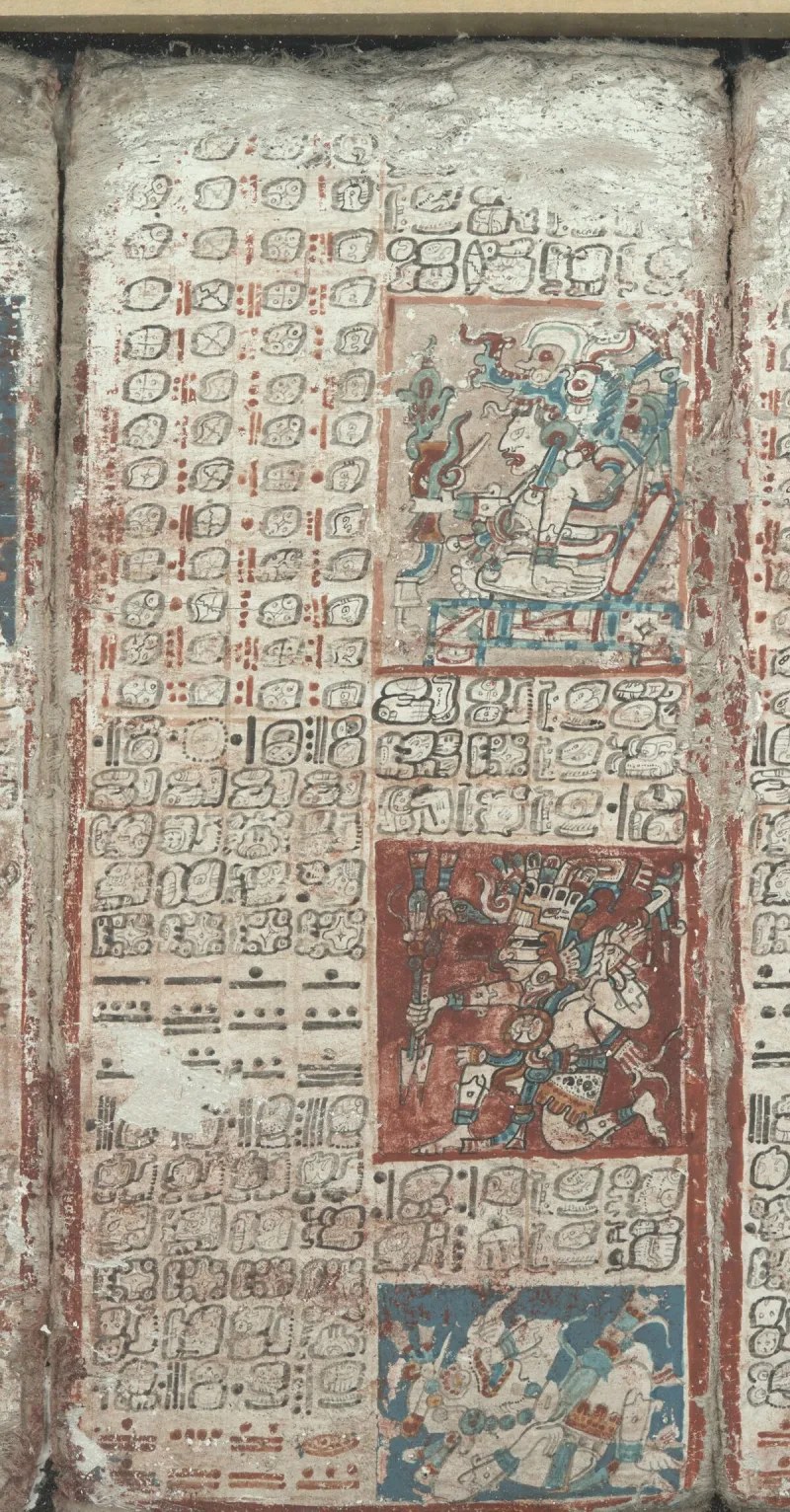
Pages 46 to 50 of the Dresden Codex hold a table for Venus. In 1906, Förstemann read the numbers 236, 90, 250 and 8 in it: together 584 days, the apparent cycle of Venus. Five times 584 is 2,920 days, exactly eight years of 365 days. Pages 51 to 58 follow with a table of 69 steps that together cover 405 lunar months.
We recalculated all 260 day signs of the Venus table. Two differ from Förstemann's text, and in both cases the scan from the library in Dresden shows the number we calculate. According to Justeson and Lowry (2025), the second table gave the new moons on which a solar eclipse was possible, probably from AD 1083 or 1116.
What we do not know
- We do not know which correlation is correct. 584283 and 584285 are the most widely accepted; 584286 is a proposal that rests on one eclipse and on the day changing at sunset.
- It is not certain whether the Long Count moved on a day at sunrise or at sunset. Martin and Skidmore think that, like the Haab', it moved on at sunrise.
- We do not know exactly how old the Dresden Codex is: the sources we read do not date the manuscript itself.
Sources
- S. Martin and J. Skidmore, ‘Exploring the 584286 Correlation between the Maya and European Calendars’, The PARI Journal 13(2), 2012, pp. 3–16 (p. 3: 584285 and 584283, GMT; p. 4: Landa; pp. 6–7: Poco Uinic; p. 9, note 12: Lounsbury; p. 12: 13.0.0.0.0). mesoweb.com
- E. Förstemann, Commentary on the Maya Manuscript in the Royal Public Library of Dresden (Papers of the Peabody Museum IV, 2), Cambridge (Mass.) 1906, the parts on pages 46–50 and 51–58. gutenberg.org
- Codex Dresdensis, SLUB Dresden, Mscr.Dresd.R.310 (scan, Public Domain Mark). digital.slub-dresden.de
- J. Justeson and J. Lowry, ‘The design and reconstructible history of the Mayan eclipse table of the Dresden Codex’, Science Advances 11(43), 2025, eadt9039 (CC BY), with the erratum of 16 October 2026 (eaem8465). doi.org
- To check our method of calculation: J. Walker, Calendar Converter (Fourmilab, public domain), and E.M. Reingold and S.M. Clamen, cal-mayan.el (GNU Emacs). fourmilab.ch
- Eclipse of 790: our own calculation with JPL DE441 (Park et al. 2021).