Pilots and calculators of North Holland
Dirck Rembrantsz. van Nierop, shoemaker and astronomer (Nieuwe Niedorp)
He worked as a shoemaker in Nieuwe Niedorp and wrote books on astronomy, mathematics and navigation that were printed in Amsterdam. This page puts together what four sources say about him, statement by statement, and where they disagree.
What the sources say
- Dirck Rembrantsz. van Nierop was born in Nieuwe Niedorp in 1610 and died there on November 4, 1682. He did not marry. [3], [1]
- He lived with his brother Jacob in their parents’ house on the Hoogsijde in Nieuwe Niedorp, probably also the shoemaker’s workshop. In 1675 the tax register calls him “a shoemaker and astronomer” (“schoenmaker ende estronomist”). [3]
- The 1868 dictionary entry says he practiced the trade of shoemaker, and that according to Jöcher he was also a mathematician in Amsterdam. It quotes a local chronicler, Dirk Borger van Schoorl, who calls him “a great mathematician, learned and renowned astronomer”. [1]
- He began in 1654 to calculate astronomical and tide tables for almanacs. He taught pupils, among them his sister’s son Pieter Cornelisz. Oomes (later Pieter Rembrantsz. van Nierop) and his nephew by marriage Albert Jansz. (later Albert Jansz. van Dam). [3]
- He defended the teaching of Copernicus. According to the 1874 entry he taught himself from Dutch and High German mathematics books, at times asking advice from C. Huygens and Descartes, with whom he was acquainted and befriended. [1], [2]
- His Nederduytsche Astronomie appeared in Harlingen in 1653; the second printing, improved and enlarged and with a printed planet guide, in Amsterdam in 1658. [2]
- Among the Amsterdam editions the dictionary of 1868 names are an astronomy with a planet guide, Astronomia of Hemelloop (1658 and 1659); two writings on the Sun standing still, Verdediging van de stilstand der Zon and Des Aerdrycks beweging in de Sonnestilstant (both 1661); and Eenige oeffeningen (1669), which the 1874 entry also names. His Mathematische Calculatie is listed in editions between 1650 and 1680. [1], [2]
- The dictionary also lists a Journaal van de reizen van Abel Tasman “by D. Rsz. van Nierop”, without a year or a publisher. [1]
- In his will of 1678 he left his mathematical instruments, books and papers (evidently also his correspondence) to his nephew Pieter Rembrantsz. van Nierop; the rest went to “all his next of kin”. [3]
- Pieter [Cornelis] Rembrantsz. [Ooms] van Nierop (Nieuwe Niedorp, c. 1640 – there, autumn 1708), surveyor (admitted July 30, 1668), was his pupil and main heir. After 1682 he continued the almanac calculations and edited and enlarged several of his uncle’s books. In September 1693, living temporarily in Hoorn, he received a patent for the calculations and for several “Van Nierop” books; it was renewed in August 1708. [3]
- The corpus table of the Huygens Institute (Huygens ING) lists 80 letters of Van Nierop, all in Dutch; the contacts are Marlise Rijks and Huib Zuidervaart. [4]
The grave slab
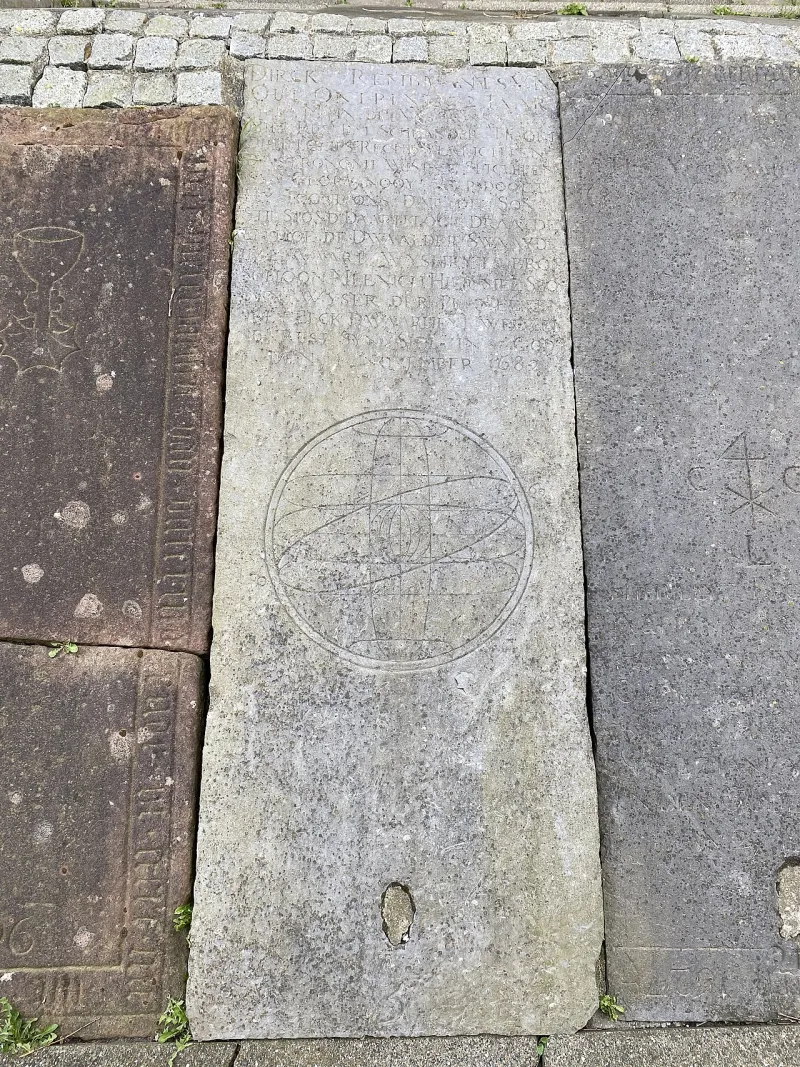
- His grave slab lay in the church of Nieuwe Niedorp; that church was demolished in 1875, and since 1963 the slab lies in the open air, where Rijks says it can still be seen. The inscription calls him “MR IN DE WISKONST” (master in mathematics) and says he was about 72 years old, which fits a birth year of 1610 and rules out 1615. [5], [7]
- Rijks notes that in 1682 it was still remarkable that a heliocentric worldview was carved inside a church: in many Reformed churches the system of Copernicus was not accepted for a long time. [5]
DIRCK REMBRANTS.
OUT ONTRENT 72 JAAR.
MR IN DE WISKONST.
HIER RUST DAT SCHRANDER HOOFT
DIE D'ECLIPS RECHT VERLICHTEN,
D'ASTRONOMI WIST TE STICHTEN.
SYN GLORIE NOOYT VERDOOFT.
HY TOOND ONS DAT DE SON
STIL STOND, D'AARTKLOOT DRAAYDE
EN HOE DE DWAALDER SWAAYDE.
UYT WAARE WYSHEYTS BRON.
SCHOON MEENICH HIERMEE SPOT.
ZYN WYSER DER PLANEETEN
DOET ELCK D'WAARHEYD WEETEN
NU RUST SYN SIEL IN GOD.
DEN 4 NOVEMBER 1682.
The visit to Descartes
- The story is in Baillet, La Vie de Monsieur Descartes (1691), in an “Addition” (pp. 553–555) that he says he had from Hartsoeker through De la Montre: it is second-hand, and Baillet cannot place it in any year. He writes that Descartes’s fame, and the shoemaker’s dissatisfaction with the Dutch mathematics books he had read, made the man from “Nierop” set out to consult him. [6]
- Descartes’s servants turned him away twice: the first time as a “Païsan téméraire” (a bold peasant), the second time, two or three months later, they announced him as a “mendiant importun” (a pestering beggar) who wanted to talk about philosophy and astrology to get alms. Descartes sent money and had him told he was spared the trouble of a conversation; Dirck refused the money, said his hour had not yet come, but hoped a third journey would serve him better. [6]
- On the third journey Descartes received him, recognized his ability, explained his method and counted him among his friends. According to Baillet Dirck lived five or six leagues (“lieues”) from Egmond and visited him often afterwards. [6]
- Rijks writes that Descartes lived in Egmond from 1643 to 1649, that Van Nierop visited him often and became an adherent of the Cartesian worldview, alongside the Copernican. Descartes is the person most discussed in his letters: in fourteen letters, against Brahe in nine, Copernicus in seven, Ptolemy in three and Kepler in two. Galileo does not appear in them. [5]
- We found no surviving letter between Descartes and Van Nierop. The visit therefore rests on Baillet’s story, not on letters; that is also what we set against “friends” in the entry of 1874. [5], [6]
How he learned
- In his Mathematische calculatie (1659) he writes that in 1632, at the age of 22, he learned spherical (“klootse”) trigonometry. He does not say who his teacher was. [5]
- Several books show that he was influenced by Tade Philips, a surveyor and mill maker from nearby Schagen. According to Van Nierop, Philips was self-taught; his problems appear in the Mathematische calculatie (1659) and the Tweede deel der wiskonstige rekening (1680), and his observations of 1622 in the Nederduytsche Astronomia (1658). [5]
- The family house in Nieuwe Niedorp burned down in 1639, after a fire at the neighboring bakery. Dirck lost all his possessions, including a large multifaceted sundial he had built himself after an example in a book by Simon Stevin. In 1643 he began again with the geometrical construction of sundials; the house was rebuilt on the same spot. [5], [3]
What his contemporaries said
- In 1701 Romeyn de Hooghe, in a pamphlet called “De Italiaansche waarzegger” (The Italian fortune-teller), had a character say of him: “Deze is Dirk Rembrantsz van Nierop, die onder het schoenen lappen zoo vast in de Hemels loop was” (that is, he was so deep in the course of the heavens that he had them in his little room). [5]
- Nicolaas Witsen, later mayor of Amsterdam and a director of the VOC, wrote to him on January 15, 1679: “Ik heb al lange Jaaren verwonderaar geweest van uwe wetenschappen” (for many years I have been an admirer of your sciences). [5]
- Rijks also names Christiaan Huygens, Frans van Schooten the Younger and Johannes Hudde as men who respected him, despite his modest background and the fact that he mastered no foreign language. He usually signed his letters “Dirck Rembrantsz”; he added “van Nierop” only later. [5]
- In his will of 1678 he calls himself “mr. in de Astronomij, matematicus ende Stuermanschap” (master in astronomy, mathematics and navigation); the shoemaker’s trade is gone there, although earlier tax papers call him a shoemaker. He died reasonably well off, with a house and orchard, books and instruments, and left 100 guilders to the poor of his congregation, according to Rijks most likely the Mennonite one. [5]
- The edition of 2012 has 79 letters by or to him (plus four by Albert Jansz van Dam); the CKCC table counts 80. [5], [4]
The sea chart of 1658
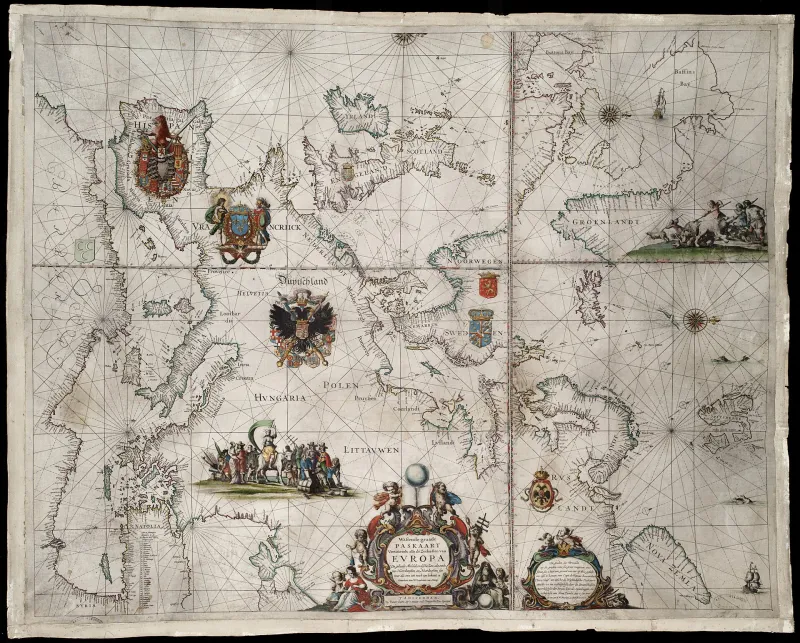
- In 1658 Van Nierop designed a sea chart with “wassende graden” (a cylindrical projection) of the coasts of Europe. According to a notarial deed of July 17, 1658, the Amsterdam publisher Gerrit van Goedesbergh passed the drawing on to his colleague Pieter Goos, who published the chart. [5]
- In 1688 Christiaan Huygens wrote to the directors of the VOC, in a report on timekeeping and finding longitude at sea, that the upper part of his own map, up to 27 degrees north latitude, was taken from a chart of Europe with increasing degrees by D. Rembrandts van Nierop. He also took over the longitude between Texel and Tenerife (22 degrees); he was comparing what his clocks measured with what navigators estimated. [5]
The school of Nieuwe Niedorp and Hoorn
- Dirck taught two younger relatives the trade, and through them the calculating for almanacs stayed in the family for almost a century and a half. Through Albert Jansz van Dam, who lived in Hoorn, the line runs to the Van Dams. Zuidervaart estimates that since the middle of the seventeenth century the dynasty supplied the tables for more than a thousand different almanacs; Meyndert van Dam alone for more than 230. [3], [5]
- The States of Holland and West Friesland granted patents on publishing those calculations: to Pieter in 1693 (renewed in 1708), to Jan Albertsz van Dam in 1709, and then in 1724, 1743, 1756 and 1780; in 1795 the system disappeared with the Republic. The last almanac with Meyndert van Dam’s name appeared in 1802. [5], [3]
- Jan Albertsz van Dam honored his teacher’s line in a poem in De Nieuwe Hoornse Schatkamer, a manual for sailors: “aanhoor het onderwijs, van ’t zaad uyt Rembrants Stam | Wiens groot geslagt zig spreyd van Nierop to van Dam” (listen to the instruction of the offspring of Rembrant’s clan, whose great family spreads from Nierop to Van Dam). [5], [3]
- Dirck Rembrantsz van Nierop (1610–1682) Nieuwe Niedorp; shoemaker and mathematician; began the calculations for almanacs in 1654
- Pieter Cornelisz Oomes, later Pieter Rembrantsz van Nierop (c. 1640–1708) son of Dirck’s sister, pupil and heir; surveyor (1668); patent 1693
- Albert Jansz van Dam (c. 1650–1715) pupil; in 1671 married Dirck’s niece Neel Pieters; surveyor (1680); boarding school at the Nieuwsteeg in Hoorn
- Jan Albertsz van Dam (c. 1672–1746) Hoorn; examiner of the VOC navigators, Chamber of Hoorn (at least 1730–1746); taught mathematics to Czar Peter the Great in 1697 and 1717
- Dirk Jansz van Dam (1705–1780) Hoorn; examiner of the VOC navigators, Chamber of Hoorn, 1747–1780
- Meyndert van Dam (1730–c. 1812) Hoorn; examiner 1781–1795; the last of the line; last almanac 1802
After Zuidervaart (2012); the family tree rests on notarial and tax records that we did not read ourselves. That Jan Albertsz taught the czar is one sentence in Zuidervaart, without particulars.
What we do not know
- His trade, birth and death: the 1874 entry says, “so they say”, that he was a skipper or barge master, was born in 1610 or 1615 and died in 1662 in his birthplace. The 1868 entry and the archive-based genealogy say shoemaker, born 1610, died on November 4, 1682. We follow those two; the 1874 statements are contradicted by them.
- Where he is buried: the 1874 entry says “probably” in his birthplace; we have found no record.
- When the Tasman journal appeared: the dictionary gives no year.
- Who his letters were to and from: the corpus table gives only the number of letters.
- Whether Baillet’s story is true and when it happened: he had it second-hand and gives no year.
- How much time he still spent on shoes after he began giving almanac calculations and navigation lessons: Rijks calls this uncertain.
- Who taught him spherical trigonometry in 1632: he names no teacher.
- Where Pieter Rembrantsz van Nierop is buried: not confirmed.
Sources
- A.J. van der Aa, Biographisch woordenboek der Nederlanden, deel 13 (1868): the entry on Dirk Rembrantsz. van Nierop (DBNL) The entry cites, among others, Lauts (1842), Blaupot ten Cate, Schoorl’s Kroniek van Medemblik and Schagen’s Naamlijst der Doopsgezinde Schrijvers. We did not read those.
- A.J. van der Aa, Biographisch woordenboek der Nederlanden, deel 16 (1874): the entry “Rembrandz of Rembrantz van Nierop (Dirk)” (DBNL) It cites Paquot, Jöcher, Poggendorff and others, which we did not read. On his trade and death it contradicts the other sources (see above).
- H.J. Zuidervaart, “The Van Nierop & Van Dam Dynasty of Mathematical Practitioners”, in M. Rijks (ed.), The Correspondence of Dirck Rembrantsz van Nierop (1610–1682), Huygens ING, The Hague 2012, pp. 387–399 (PDF) A genealogy built on notarial and tax records in the regional archive of Alkmaar. We read the genealogy, not the records it cites.
- Huygens ING, CKCC corpus table: Dirck Rembrantsz van Nierop, 80 letters We read the table; it links to Digital Web Centre pages for the editions but not to the letters themselves.
- M. Rijks (ed.), The Correspondence of Dirck Rembrantsz van Nierop (1610–1682), Huygens ING, The Hague 2012: “Introduction to this edition” (series Tools and Sources, pdf) We read the introduction (pp. 1–35) as a pdf, not the letters themselves; the address is that of the series page.
- Adrien Baillet, La Vie de Monsieur Des-Cartes, part 2 (Paris 1691), “Addition”, pp. 553–555 We read the text of the Addition in a scan with poor text recognition; the story is second-hand.
- Photo of the grave slab, Wumvanbarse, 2022, Wikimedia Commons (CC BY-SA 4.0) Licence read on the file page.
- Wassende graade paskaart (1658), University of Amsterdam, via Wikimedia Commons Public domain according to the file page.


Every statement above carries the number of its source. Read on October 25, 2026. What we could not confirm in a source is left out.