Japanese astronomy
Holland in the sky of Edo
In the Edo period, Western astronomy reached Japan mainly through Dutch books, read and translated by the interpreters of Nagasaki and the scholars of 'Dutch learning' (rangaku). This page follows that route, from a Jesuit cosmology of 1650 to the calendar reform of 1798, and ends with the question that matters most to this site: did the star atlas of Andreas Cellarius ever reach Japan?
Before the Dutch: the Earth at the center
The first systematic Western cosmology in Japan came not from the Dutch but from a former Jesuit. Sawano Chūan (沢野忠庵), a Portuguese missionary who had become a Japanese subject, compiled the Bensetsu Nanban unki sho (弁説南蛮運気書), with a preface of 1650. According to the National Astronomical Observatory of Japan, it follows the treatise on the sphere (1595) of the Spanish Jesuit Pedro Gómez. Its universe has the Earth at the center, with the Moon, Mercury, Venus, the Sun, Mars, Jupiter and Saturn around it, then the sphere of the fixed stars, a ninth sphere for precession and an outermost sphere that turns everything once a day.
Since the 1630s, the import of books touching on Christianity had been restricted. When the eighth shogun, Tokugawa Yoshimune, relaxed the ban in 1720, the Tenkei wakumon (天経或問), a Chinese astronomy book written with Jesuit knowledge, was printed with Japanese reading marks in 1730 and became a best-seller. It too kept the Earth still: the Jesuits hardly mentioned the moving Earth, which was considered heretical, and taught the system of Tycho Brahe.
Blaeu's world map for the shogun
The Dutch East India Company (VOC) brought maps as presents for the shogun and his court. In 1644, according to Miyoshi Tadayoshi of the Kobe City Museum, the governor-general in Batavia asked for new presents for Japan, among them several large globes and two large world maps, with the warning that no crucifixes or saints should appear on the maps. Which world map was sent is fairly certain: the wall map by Joan Blaeu of 1648, which the Tokugawa government kept as a treasure. Whether the globes were delivered, Miyoshi does not say. The Kobe City Museum itself owns a folding screen with a world map based on the wall map of Willem Jansz. Blaeu of 1607.
Blaeu's map of 1648 is now in the Tokyo National Museum (A-9360): a hand-colored copper engraving of 203 by 301 cm. The Dutch description of the world along its lower edge was translated by Katsuragawa Hoshū, and the map has notes in ink pasted all over it. The Italian missionary Giovanni Battista Sidotti, arrested in 1708 after landing in Japan in secret, was questioned by the scholar Arai Hakuseki, who showed him a world map engraved in Holland; Sidotti praised it as very rare. The museum considers its map to be the one described in Hakuseki's Seiyō kibun. There is no freely licensed image of the map; it can be seen on the museum's own site.
Copernicus in Japanese
Motoki Ryōei (本木良永, 1735–1794) was an interpreter of Dutch in Nagasaki, a hereditary post appointed by the shogunate. Because he could read Dutch books himself, he was the first to introduce the Sun-centered system of Copernicus in Japan, according to both the National Astronomical Observatory and the National Diet Library. His Taiyō kyūri ryōkai setsu (太陽窮理了解説), known from a manuscript copy of 1792, is a translation of the Dutch edition (1770) of an astronomy book by the Englishman George Adams (1766). In the translation, the Sun at the center and Kepler's elliptical orbits are taken for granted. His books survive only in manuscript.
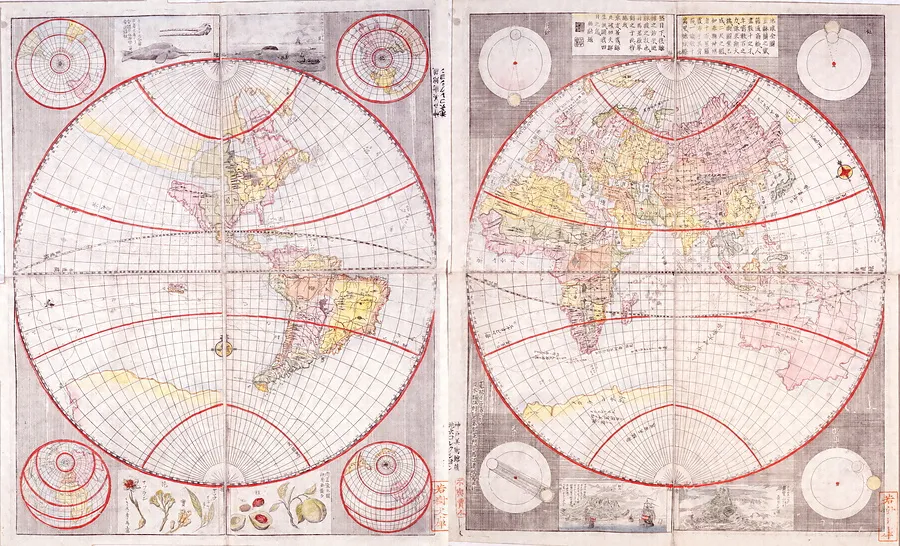
In print, the new system was spread by Shiba Kōkan (司馬江漢), who made the world map below in 1792 and published an illustrated explanation of Copernican astronomy in 1808. Shiba wrote the name of Copernicus with the same Chinese characters that Chinese astronomy books used for Kepler. Shizuki Tadao (志筑忠雄, 1760–1806), also of Nagasaki, translated the lectures of the Oxford astronomer John Keill; with his Rekishō shinsho (暦象新書), completed in 1802, he introduced Newton's physics to Japan.

The calendar makers took over Western results without the moving Earth. Asada Gōryū (麻田剛立, 1734–1799), an astronomer in Osaka, had pointed out the error of the official calendar before the solar eclipse of 1763, and the eclipse came exactly as he had calculated. His pupils claimed that he had found Kepler's third law independently; he never published it. When the shogunate called him, he sent his pupils Takahashi Yoshitoki (高橋至時, 1764–1804) and Hazama Shigetomi instead. From 1795 they worked at the Asakusa observatory in Edo on the Kansei calendar, in use from 1798. It was based on Chinese books that had taken over Kepler's ellipses but not the moving Earth: it used ellipses for the Sun and the Moon, but for the planets the system of Tycho.
Takahashi spent about the last half year of his life, from 1803 until his death in 1804, studying the Dutch translation of Lalande's astronomy and writing his notes on it; this effort is said to have shortened his life. In another book he presented the moving Earth and argued that it explains the motions of the planets more simply, yet in his own planetary theory he kept to Tycho.
And Cellarius?
This site is named after Andreas Cellarius, rector of the Latin school of Hoorn, whose star atlas Harmonia Macrocosmica appeared in Amsterdam in 1660. Did it reach Japan along the same Dutch route? We looked and found nothing: none of the sources we checked (the exhibition on Japanese-Dutch exchange of the National Diet Library, the rare books of the National Astronomical Observatory, the Tokyo National Museum and Miyoshi's essay on Dutch maps in Japan) mentions Cellarius or his atlas.
That does not prove that no copy ever came; it only means that we cannot claim it. What is certain is that Hoorn belonged to the same world of the VOC; our pages on Willem Bontekoe, the almanac makers of Hoorn and the voyage around Cape Horn tell that story.
What we do not know
- Whether the globes requested in 1644 ever reached the shogun.
- From which edition Shizuki Tadao translated Keill (Dutch or Latin), and whether the Rekishō shinsho was finished in parts (1798 and 1802) or at once.
- Whether Asada Gōryū really found Kepler's third law himself: only his pupils say so.
- How many Dutch books Motoki Ryōei translated: a popular article says eleven; we found no better source.
- Whether any copy of Cellarius's Harmonia Macrocosmica reached Edo Japan.
Sources
- National Astronomical Observatory of Japan, rare books exhibition 040, 'The universe of the Edo period': Sawano Chūan, the Tenkei wakumon, the relaxation of 1720. eco.mtk.nao.ac.jp
- Miyoshi Tadayoshi (Kobe City Museum), 'Dutch impressions of the world in Japan': the presents of the VOC, the request of 1644, Blaeu. swaen.com
- Tokyo National Museum, e-Museum, world map by Joan Blaeu, 1648 (A-9360): Katsuragawa Hoshū, Sidotti and Arai Hakuseki. emuseum.nich.go.jp
- National Astronomical Observatory of Japan, rare books exhibition 057, 'The solar system in rare books': Motoki Ryōei and George Adams. eco.mtk.nao.ac.jp
- National Diet Library, 'Japanese-Dutch exchange in the Edo period', part 2, chapter 4: Motoki Ryōei, Shiba Kōkan, the name of Copernicus. ndl.go.jp
- Weblio, 'Shizuki Tadao': the Rekishō shinsho and John Keill. weblio.jp
- Complete Dictionary of Scientific Biography, 'Asada Gōryū' (via Encyclopedia.com). encyclopedia.com
- National Astronomical Observatory of Japan, rare books exhibition 031, the Kansei reform: Takahashi Yoshitoki, Hazama Shigetomi, Lalande. eco.mtk.nao.ac.jp
- National Astronomical Observatory of Japan, Koyomi Wiki, 'Geocentrism': Kepler without the moving Earth, Takahashi and Tycho. eco.mtk.nao.ac.jp