The shafts of the Great Pyramid: do they look at the stars?
The Great Pyramid of Giza has four narrow shafts that run upward at a slant. Some people think they pointed at particular stars. Here you look through the shafts yourself and slide through the years: which star stood at the height of which shaft, and when? You see what fits, what does not, and what we don’t know.
The Great Pyramid and its four shafts
The Great Pyramid at Giza in Egypt was built for the pharaoh Khufu (Cheops), by the usual dating around 2560 BC. Inside are two chambers, one above the other: the King’s Chamber and, lower down, the Queen’s Chamber. Two narrow shafts run upward at a slant from each chamber, one toward the north and one toward the south.
The shafts are about 20 cm wide. In 1964 Virginia Trimble and Alexander Badawy proposed that they pointed at stars; Robert Bauval worked that idea out later. It has drawn a lot of criticism. On this page we only check what is geometrically possible: which star stood at the height of which shaft in which year? Whether the builders intended that, we cannot say.
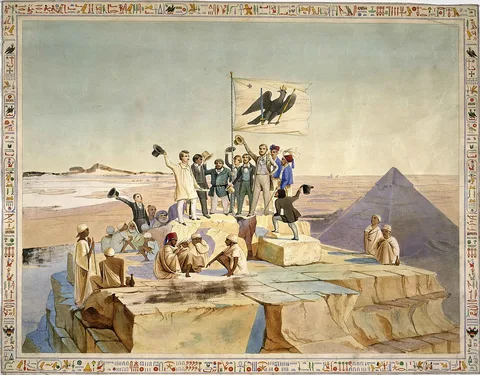
Watercolor of the Prussian expedition to Egypt under Richard Lepsius on top of the Great Pyramid, celebrating the birthday of King Frederick William IV on 15 October 1842. An image from the early days of research, not a photograph of today.
Watercolor by Johann Jakob Frey, 1842, public domain, via Wikimedia Commons.

Looking through the shaft
Choose a shaft, slide through the years and watch how the proposed stars move along the axis of the shaft. The dotted ring in the viewing hole is our margin of 0.5°: a star inside it would be ‘in the shaft’. Below the viewing hole you see, for each star, how many degrees too high or too low it stands, and in the graph how that changes over the centuries.
- Alnitak
- −0.33°
- height 44.67° against shaft angle 45.0° · within the margin
- Alnilam
- −0.04°
- height 44.96° against shaft angle 45.0° · within the margin
- Mintaka
- +0.44°
- height 45.44° against shaft angle 45.0° · within the margin
Tap a numbered circle to choose a shaft.
Schematic section, north on the left and south on the right, in the dimensions of the source (Alison, after Petrie and Gantenbrink). The passages and the bent parts of the north shafts are not drawn. Open circle: the shaft comes out on the outside. Cross: the shaft ends in a blockage. Tap a numbered circle to choose a shaft, or use the buttons above.
This is what the sky looks like when you look south along the shaft of 45.0° (east on the left, west on the right). The stars move from left to right; the dotted line is their path and the dot is the star at the chosen time. The axis of the shaft is in the middle.
How many degrees the star on the meridian stands above (+) or below (−) the shaft angle. The light band around zero is our margin of 0.5°; the yellow zone is the construction window (2660 BC – 2460 BC). Where the line runs inside the band, the star fits the shaft.
What we know, and what is disputed
- Established in broad terms: the four shafts have angles of 45° (King’s Chamber, south), about 32.5° (King’s Chamber, north; measured at 32° 36′ 08″, the shaft bends) and about 39.5° (Queen’s Chamber, south and north; the sources give 39.1° to 39.6°). All angles come from secondary sources, and we found no measurement uncertainty anywhere.
- Only the two shafts of the King’s Chamber come out on the outside of the pyramid. The two shafts of the Queen’s Chamber are closed. The south shaft ends after about 60 m at a limestone slab with two copper pins (Gantenbrink, with a robot, 1993); the Pyramid Rover (2002) saw a second door behind it. The north shaft, which has bends, ends at a door with copper pins (Pyramid Rover). A closed shaft cannot have served as a sighting tube.
- Proposed stars: for the King’s Chamber south, the belt of Orion (Alnitak); for the King’s Chamber north, Thuban; for the Queen’s Chamber south, Sirius; and for the Queen’s Chamber north, Kochab. What exactly was proposed in 1964 and what Bauval added later is not the same in all sources (the Queen’s Chamber shafts were only measured properly in 1993). All of these assignments are disputed.
- Orion correlation: Bauval also proposed that the layout of the three great pyramids of Giza imitates the three stars of Orion’s belt. That is disputed: Edwin Krupp pointed out that the line of the pyramids bends differently from that of the belt, and Bauval disputes this. It is a different question from the one about the shafts, and we do not calculate it here.
- Whether the shafts were ever meant to be looked along is disputed. They are narrow, they have bends, and those of the Queen’s Chamber are closed; ventilation and a symbolic meaning have also been proposed. J. J. Wall wrote an article in 2007 on exactly this hypothesis (Journal for the History of Astronomy 38); we have not been able to read it yet.
Our calculation
For each star: in which year did it stand at the height of the shaft, and by how many degrees was it too high (+) or too low (−) in 2560 BC (the usual building date)? The construction window is 2560 BC ± 100 years.
| Shaft and star | Reaches the angle in | Offset in 2560 BC |
|---|---|---|
| King’s Chamber south (45°): Alnitak | 2492 BC | −0.33° |
| King’s Chamber south (45°): Alnilam | 2553 BC | −0.04° |
| King’s Chamber south (45°): Mintaka | 2648 BC | +0.44° |
| King’s Chamber north (32.5°): Thuban | 3243 BC and 2351 BC | −1.18° |
| King’s Chamber north (measured 32° 36′ 08″): Thuban | 3261 BC and 2333 BC | −1.28° |
| Queen’s Chamber south (39.5°, closed): Sirius | 2398 BC | −0.50° |
| Queen’s Chamber north (39.5°, closed): Kochab | 2491 BC (and AD 381) | +0.24° |
The angle fixes a date poorly. If the angle is 0.5° larger or smaller, the year in which the star reaches it shifts by about 100 years (Alnitak), 90 years (Thuban), 140 years (Kochab) or 165 years (Sirius): as much as the width of the whole construction window. The margin of 0.5° is our own assumption.
What this says, and what it does not
- Orion fits best, but not exactly. Around 2560 BC Alnilam stands within 0.04° of the 45° of the King’s Chamber shaft, Alnitak 0.33° below it and Mintaka 0.44° above it: all three stars of the belt lie within our margin of 0.5°. So the angle does not pick out one star of the belt, and it does not show which one might have been meant.
- Kochab and Sirius fit roughly: Kochab stands 0.24° above the north shaft of the Queen’s Chamber, Sirius 0.50° below the south shaft, right at the edge of the margin. But those two shafts are closed.
- Thuban does not fit. Around 2560 BC it stands 1.2° below the north shaft of the King’s Chamber (with the measured 32° 36′ 08″ even 1.3°), well outside the margin. It reaches the angle only in 3243 or 2351 BC: the second time more than 200 years after 2560 BC, so outside the construction window.
- Only the two shafts of the King’s Chamber come out on the outside, so only those two could have served as a line of sight. Whether the builders intended that does not follow from angles: that remains disputed.
- Planets and the Moon are often at the height of a south shaft. Such a hit is ordinary and proves nothing, and they can never hit a north shaft (see the layer in the picture above).
How we calculate
For each star we use our model for ancient star positions (precession after Vondrák et al., proper motion from Hipparcos) to calculate where it crosses the meridian. At the latitude of the pyramid, 29° 58′ 45″ north, a star that crosses the meridian south of the zenith does so at a height of 90° minus the latitude plus the declination. For a star in the north it is 90° plus the latitude minus the declination.
We assume that the shafts lie exactly in the north–south plane and leave out refraction and nutation (together at most about 0.03°). The path of the star in the viewing hole is shown as a flat projection around the axis of the shaft.
The margin of 0.5° is our own assumption: the sources we read give no measurement uncertainty, and the shafts are narrow, bend and are partly walled up. That is why we also say how many years the result shifts if the angle is 0.5° larger or smaller.
The planets and the Moon are not calculated in the browser. We calculated the meridian transit for every day from 3500 to 1500 BC in advance with JPL’s DE441 ephemeris (via Skyfield), and checked that against JPL Horizons and against independent analytical theories. The time scale (the Earth’s rotation, ΔT) is uncertain in that period: two ΔT models already differ by about 27 minutes in 2560 BC. That is why the days in the planet layer are approximate, and not historical dates.
What we don’t know
- The angles come from secondary sources and we found no measurement uncertainty anywhere. The margin of 0.5° is our assumption.
- The angle of the north shaft of the King’s Chamber (32.5° or 32° 36′ 08″) and those of the Queen’s Chamber shafts (39.1° to 39.6°) differ from source to source. We use 32.5° and 39.5°.
- We have not been able to check in the original articles exactly what Trimble and Badawy proposed in 1964 and what Bauval added later.
- We have not yet read the article by Wall (2007). We leave out the deviation of the shafts from true north and the course of the bent shafts.
- What lies behind the doors in the Queen’s Chamber shafts, and whether the outer openings of the King’s Chamber shafts were originally open, we have not been able to check in primary sources.
- The section is schematic. The dimensions come from one secondary source (Alison, after Petrie and Gantenbrink); the passages and the bent parts of the north shafts are not drawn.
- The building date, around 2560 BC, is the usual dating. We did not determine it ourselves.
Sources
- J. Alison, Proposed Design Specifications for the Great Pyramid and for the Siteplan of the Giza Plateau (dimensions of the pyramid, the chambers and the shafts; refers to Petrie, Gantenbrink and Legon). Secondary. home.hiwaay.net
- V. Trimble (1964), Astronomical investigation concerning the so-called air-shafts of Cheops’ pyramid, Mitteilungen des Instituts für Orientforschung 10, 183–187, and A. Badawy (1964), The stellar destiny of Pharaoh and the so-called air shafts in Cheops pyramid, ibid., 189–206. Cited via secondary sources; not read in the original.
- R. Bauval and A. Gilbert (1994), The Orion Mystery. And R. Bauval (1993), The Upuaut Project, Discussions in Egyptology 27, 5–7. Not read. giza.fas.harvard.edu
- J. J. Wall (2007), The star alignment hypothesis for the Great Pyramid shafts, Journal for the History of Astronomy 38(2). Not read yet.
- NBC News (2011), Robot finds hidden hieroglyphs inside pyramid, on the shafts of the King’s Chamber and the Queen’s Chamber and the doors with copper pins. nbcnews.com
- Real Robotics, The Djedi Project, on the copper pins in the blockages of the Queen’s Chamber shafts (Gantenbrink 1993, Pyramid Rover 2002). realrobotics.co.uk
- Wikipedia, Star shaft and Orion correlation theory (the criticism of the shafts and of Bauval; secondary). en.wikipedia.org
- R. S. Park et al. (2021), The JPL Planetary and Lunar Ephemerides DE440 and DE441, The Astronomical Journal 161, 105 (the ephemeris for the planets and the Moon); checked against JPL Horizons. doi.org
- J. Vondrák, N. Capitaine and P. Wallace (2011), New precession expressions, valid for long time intervals, Astronomy & Astrophysics 534, A22; F. van Leeuwen (2007), Hipparcos, the new reduction, Astronomy & Astrophysics 474, 653. doi.org
We keep what the sources say separate from what we calculate ourselves. All angles and dimensions come from secondary sources; our calculation is a geometric check, not proof for or against an intention of the builders.
More monuments
Also available:
- Newgrange (Ireland)
- Maeshowe (Scotland (Orkney))
- Stonehenge (England)
- Nabta Playa (Egypt (Sahara))
Not yet available:
- Goseck (Germany)