Newgrange and the winter sun
Newgrange is a passage tomb: a large round mound with a passage and a chamber in County Meath, Ireland, more than 5,000 years old. Around the winter solstice the first sunlight enters through an opening above the entrance, called the roof box, and reaches the floor of the chamber. Here you can see how that works geometrically, what we know, and what we don’t.
Where you stand
Newgrange lies about 50 km (30 miles) north of Dublin. It is a round mound with a single passage, 19 m long, leading to a chamber. The entrance faces southeast. Above the entrance is the roof box, an opening through which the light of the rising winter sun travels along the floor of the passage into the chamber.
In the horizon view below, you stand at the entrance, looking southeast. The mound with the passage is behind you. The plan is a diagram and not to scale; only the length of the passage and its direction come from the sources.
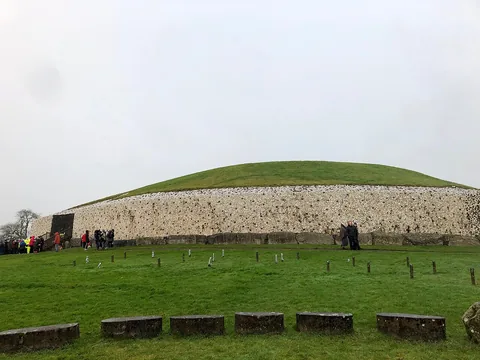
Newgrange on 21 December 2018, the winter solstice, seen from the southeast. The entrance is on the left; the roof box is above it.
Photo: Warren LeMay, CC0 (public domain), via Wikimedia Commons.
_Monument,_Donore,_%C3%89ire_-_44753827130.jpg)
The winter solstice sunrise, to scale
The view shows the southeast horizon, 32° wide and 8.7° high, with the Sun at its true size (0.53°). Choose a year and step through the days around the solstice. The orange band marks the directions from which the passage lets light reach the chamber. We do not show clock times; what matters is the direction.
3150 BC, on the day of the solstice: first light falls at the edge of the passage, about 1′ outside it, within the measurement uncertainty; the light enters the chamber almost immediately at first light.
- Declination of the Sun
- −24.036°
- at the solstice: −ε = −24.036°
- Azimuth of first light
- 133°48′
- upper limb at 55′; Ray: 133°54′ ± 4′ (−6′)
- Sun’s altitude when it reaches the passage
- 0.19°
- centre of the disc, true altitude (without refraction); at first light 0.17°
What we know and what we don’t
- Established: around the winter solstice the light enters through the roof box and along the passage into the chamber. O’Kelly saw it on 21 December 1969, for about 17 minutes (O’Kelly 1982).
- Measured: Ray (1989) found an azimuth of 133°54′ ± 4′ for the midwinter sunrise at the time of construction, with an obliquity of 24°2′ and a horizon of 55′ ± 2′. Construction is dated to 3150 ± 100 BC (radiocarbon dating).
- Widely accepted: the alignment was intentional (Patrick, Ray, Stout).
- Debated: whether the roof box is original or partly a result of O’Kelly’s reconstruction (see Hensey, 2017), and whether the alignment could be coincidental (Heggie, 1981: about 1 in 13; Ray, 1989: the chance is at least twice as small).
- Our calculation says what was geometrically possible. In 3150 BC the first light around the solstice fell right at the edge of the light band: just outside it by our calculation, just inside it by Ray’s, both within the measurement uncertainty. Shortly afterward, when the Sun stands higher, the light does reach the chamber. Today the first light falls more than a degree outside the band. On what the builders intended, and on whether the alignment is a coincidence, the calculation says nothing.
Our calculation
| Location | 53°41′41″ N (53.6947°) |
|---|---|
| Obliquity | IAU 2006 (P03); checked against Laskar (1986): 8″ difference in 3150 BC |
| Solar longitude | Kepler orbit with the eccentricity and perihelion passage of that epoch (in October in 3150 BC, in January now) |
| Horizon | 55′ ± 2′ (Ray), flat |
| First light | upper limb of the Sun at the horizon, refraction at 1010 mbar and 0 °C (as Ray) |
| Result | 133°48′ (Ray: 133°54′ ± 4′) |
| Sensitivity | horizon 53′ gives 133°43′, 57′ gives 133°52′; at 10 °C about 2′ is added |
We do not show clock times: the uncertainty in the Earth’s rotation (ΔT) is too large for 3150 BC. The azimuth is not affected.
How we calculate
At the winter solstice the Sun’s declination equals minus the tilt of the Earth’s axis (the obliquity of the ecliptic). In 3150 BC that tilt was 24.04°; today it is 23.44°. We compute it with the IAU 2006 formula and check it against Laskar’s (1986); the two differ by 8 arcseconds.
The calculation engine that computes the planets elsewhere on this site gives a declination of −23.91° for the solstice of 3150 BC instead of −24.04°, because its simplified orbit model only partly tracks how the plane of the Earth’s orbit tilts over such a long time. At Newgrange that puts the azimuth 17′ too low. So here we use our own solar model. Switch on ‘Show the calculation engine’s uncorrected result’ to see the difference.
Our result is about 6′ lower than Ray’s, just outside his margin of ± 4′. Ray used the same horizon and the same refraction (1010 mbar, 0 °C), so the difference does not come from there. How he treated the solar disc and which coordinates he used is not in the reprint we read, so we do not know where the difference comes from.
Sources
- J. Patrick, Midwinter sunrise at Newgrange, Nature 249, 517–519 (1974). nature.com
- T.P. Ray, The winter solstice phenomenon at Newgrange, Ireland: accident or design?, Nature 337, 343–345 (1989). Figures read in the reprint on newgrange.com. nature.com
- M.J. O’Kelly, Newgrange: Archaeology, Art and Legend, Thames & Hudson (1982).
- R. Hensey, Rediscovering the Winter Solstice Alignment at Newgrange, Ireland, in: The Oxford Handbook of Light in Archaeology, ed. C. Papadopoulos and H. Moyes, Oxford University Press (2017), pp. 140–163, on the roof box and its reconstruction. The positions of Patrick, Ray and Stout are summarised in Archaeology Ireland, winter 2017. doi.org
- J. Laskar, Secular terms of classical planetary theories, Astronomy & Astrophysics 157, 59–70 (1986). ui.adsabs.harvard.edu
- N. Capitaine, P.T. Wallace, J. Chapront, Expressions for IAU 2000 precession quantities (P03), Astronomy & Astrophysics 412, 567–586 (2003). doi.org
- J. Meeus, Astronomical Algorithms, 2nd edition (1998).
- D.C. Heggie, Megalithic Science, Thames & Hudson (1981), as cited by Ray (1989).
We keep what the sources say separate from what we calculate ourselves. See also the Sky calendar for this year’s solstices.
More monuments
Not yet available:
- Maeshowe (Scotland)
- Stonehenge (England)
- Goseck (Germany)