Arabic astronomy · Islamic calendar
Eid al-Fitr 2027 (1448 AH): expected date
Eid al-Fitr, the feast at the end of Ramadan, falls on the first day of Shawwal. It begins once the crescent of Shawwal has been seen.
- Expected date (Umm al-Qura)
- Tuesday, March 9, 2027
- Hijri date
- 1 Shawwal 1448 AH
- Begins at sunset on
- March 8, 2027
- Expected date (tabular calendar)
- Wednesday, March 10, 2027
- Astronomical new moon
- March 8, 2027 at 09:30 UTC
These dates are calculated. The start of a month is decided by religious authorities, nationally or locally, often after the new crescent has been seen. Where you live, a month may begin a day later than shown here, and occasionally a day earlier.
Can the crescent of Shawwal be seen on March 8, 2027?
The month of Shawwal begins after its crescent is seen on the evening after the new moon. This map shows where that is possible on the evening of March 8, 2027, by Odeh’s criterion.
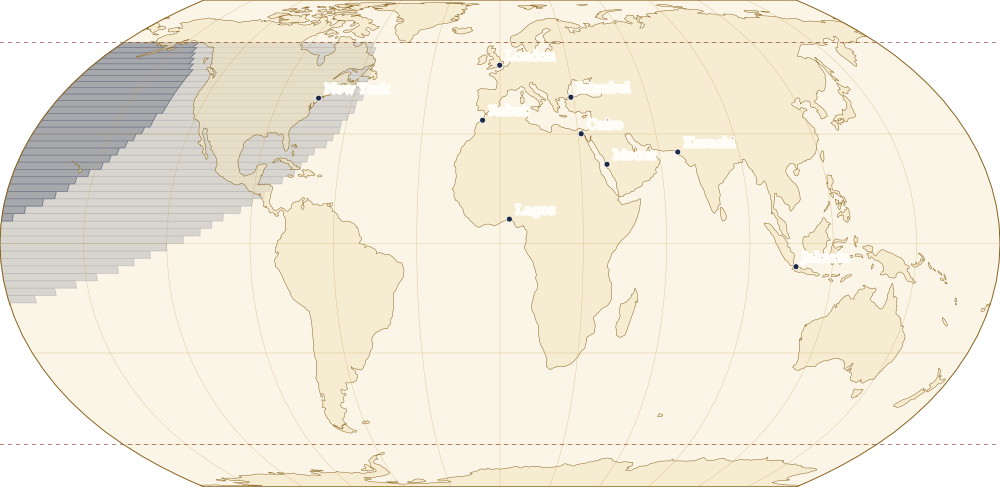
- Visible to the naked eye
- Visible with optical aid, and possibly to the naked eye
- Visible with optical aid only
- Not visible, even with optical aid
- Not calculated (beyond 60° latitude)
Sources
- Mohammad Sh. Odeh, “New Criterion for Lunar Crescent Visibility,” Experimental Astronomy 18 (2004): 39–64, doi:10.1007/s10686-005-9002-5. doi.org
- Robert H. van Gent, “The Umm al-Qura Calendar of Saudi Arabia,” Utrecht University, webspace.science.uu.nl/~gent0113/islam/ummalqura.htm (consulted November 13, 2026). webspace.science.uu.nl
- Edward M. Reingold and Nachum Dershowitz, Calendrical Calculations, 4th ed. (Cambridge University Press, 2018).
- Positions of the Sun and Moon: Astronomy Engine by Don Cross (MIT License), checked against a second calculation with Skyfield and the JPL DE440 ephemeris. github.com · rhodesmill.org
- Coastlines: Natural Earth (public domain). naturalearthdata.com